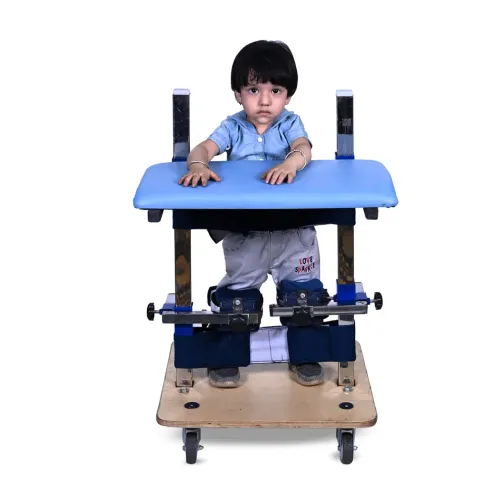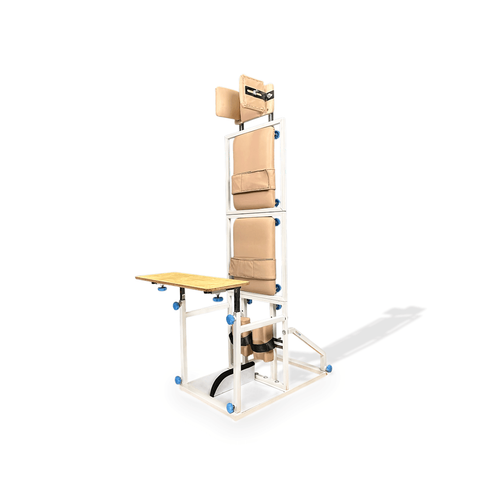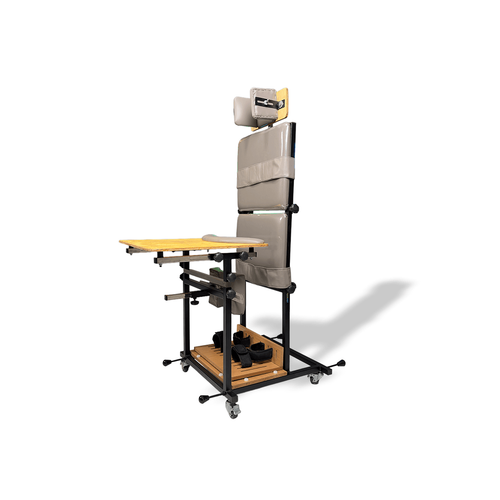
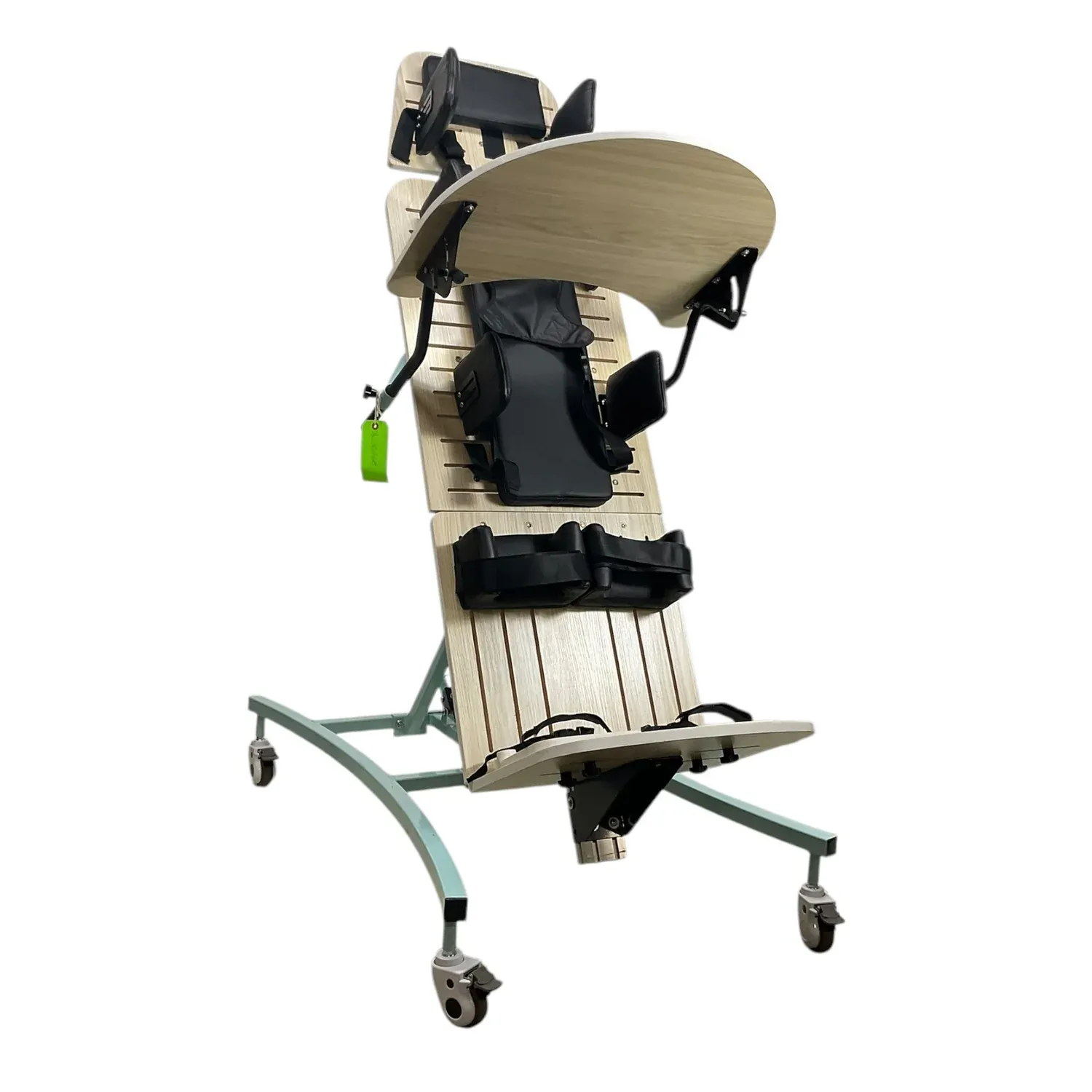
Morecare Peony – Electric Pediatric Supine Standing Frame
An electric supine standing frame for children who require extensive postural support, allowing gradual positioning from lying to upright standing with adjustable body supports and caregiver-controlled tilt.





Delivery
Support
Eligibility
Support
Product Information
Everything you need to know about this product.
A Gentler Way to Begin Supported Standing
For children with cerebral palsy or other neurological and neuromuscular conditions, upright standing may require extensive support around the head, trunk, pelvis and legs. Some children cannot be placed directly into an upright standing frame, particularly when they have limited head or trunk control or require a carefully managed transition into weight bearing.
The Morecare Peony is an electric pediatric supine standing frame designed for therapist-guided standing programmes. The child is positioned with their back supported while the electric mechanism adjusts the frame gradually from horizontal to upright.
The system provides an electrically controlled 0°–90° tilt range, helping caregivers make prescribed positional changes without manually lifting the entire standing structure.
How Peony Addresses the Standing Challenge
- Gradual Supine-to-Upright Positioning: Children can begin in a supported lying position and move through intermediate angles toward upright standing according to their individual tolerance and therapy programme.
- Electric Tilt Assistance: A 150 mm electric linear actuator operates the positioning mechanism using 220V AC mains power and a wired handset, reducing the manual effort involved in changing the frame angle.
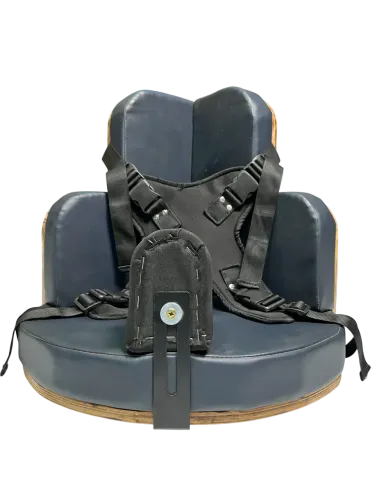
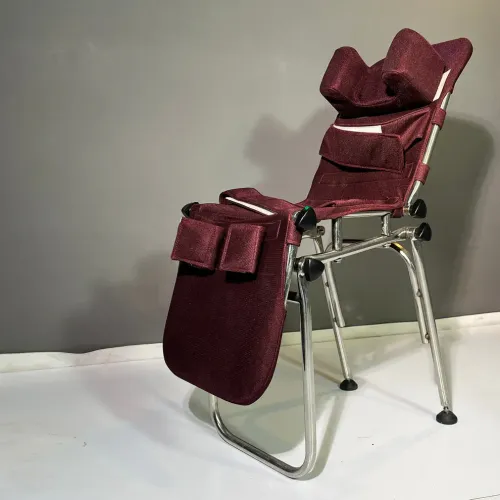
- Extensive Postural Support: Adjustable supports are provided for the head, trunk, pelvis, knees, calves and feet, helping therapists establish an individually appropriate position.
- Padded Body Support: High-density PU cushions over a laminated support board provide a supported contact surface during positioning sessions.
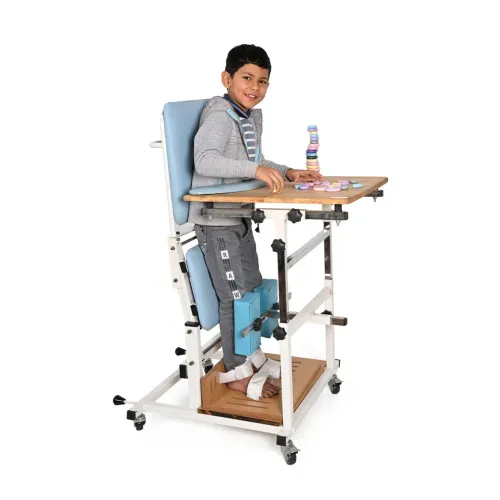
- Activity Participation: The product includes an adjustable-position therapy tray in its published configuration, allowing suitable activities when the child is correctly positioned and supervised.
- Suitable for Home and Clinical Programmes: After professional assessment, installation and caregiver training, Peony may be incorporated into prescribed standing routines at home, in rehabilitation clinics and in special schools.
Who May Benefit From Peony?
Peony may be considered for selected children with cerebral palsy, spinal muscular atrophy, muscular dystrophy, developmental delay, spinal cord injury or other conditions requiring extensive support during standing.
It is especially relevant where the rehabilitation professional recommends a supine standing system with gradual angle adjustment rather than immediate fixed-upright positioning.
The maximum user weight is 60 kg, and the previously confirmed user-height range is 60–137 cm. Body measurements, support fit, joint alignment and clinical readiness must be reviewed individually.
What Peony Does Not Do
Peony is not a gait trainer, independent standing aid, general patient-transfer hoist or wheelchair. It does not make the child stand independently, and its electric mechanism does not create active stepping movements.
The frame helps make appropriately supported upright positioning possible. Clinical outcomes such as improved walking, bone density, strength or joint mobility are not guaranteed.
Important Power and Safety Information
The standard product operates on 220V AC mains power only, without a confirmed battery-powered operating mode. The previously confirmed power-failure behaviour is that the frame remains in its current position when power is lost. Electric repositioning cannot resume until power is restored; caregivers must have the approved assistance and recovery plan available before use.
Standing angle, duration, transfer method and level of supervision should always follow the child's individual rehabilitation assessment.
| Section | General Information |
|---|---|
| Product Name | Morecare Peony – Electric Pediatric Supine Standing Frame |
| Model | Peony |
| Product Type | Electric Pediatric Supine Standing Frame |
| Recommended Age | Approximately 4–18 Years; Individual Fitting Required |
| Clinical Reference | Selected Children with CP, Including GMFCS III–V; Individual Assessment Required |
| Recommended User Height | 60–137 cm |
| Maximum User Weight | 60 kg |
| Product Weight | Approximately 35 kg |
| Primary Application | Therapist-Directed Supported Standing and Gradual Weight-Bearing Positioning |
| Operating Environment | Suitable Indoor Home, School, Hospital and Rehabilitation Settings |
| Standing Orientation | Supine / Back-Supported |
| Country of Origin | India |
| Section | Electric Tilt & Power |
| Tilt Range | 0°–90° |
| Tilt System | Electric Linear Actuator |
| Actuator Stroke | 150 mm |
| Control Interface | Wired Handset |
| Input Power | 220V AC Mains |
| Standard Battery Mode | Not Specified / Do Not Advertise Battery Operation |
| Mains Power Failure Behaviour | Frame Remains in Its Current Position |
| Electric Movement on Loss of Power | Unavailable Until Mains Supply Returns |
| Manual Emergency Lowering | Not Described; Follow Approved Model-Specific Recovery Procedure |
| Transfer Between Angles | Caregiver-Controlled, Under Therapist's Prescribed Limits |
| Section | Frame & Dimensions |
| Frame Material | Powder-Coated Steel |
| Support Board | Laminated Wooden Board |
| Cushioning | High-Density PU Cushions |
| Overall Dimensions | 130 × 62 × 100 cm |
| Frame Weight | Approximately 35 kg |
| Electric Mechanism | Linear Actuator with 150 mm Stroke |
| Product Placement | Stable, Level Indoor Surface |
| Section | Body Support & Positioning |
| Head Support | Adjustable; Side Supports Described |
| Trunk / Chest Support | Adjustable |
| Pelvic Support | Adjustable |
| Knee Supports | Adjustable |
| Calf Supports | Adjustable |
| Foot Supports | Adjustable |
| Foot Positioning Straps | Described in Published Customization Field |
| Support Surface | PU-Padded Laminated Board |
| Therapy Tray | Adjustable Height and Position; Confirm Standard Inclusion Versus Accessory |
| Positioning Assessment | Required for Body Alignment, Joint Range and Pressure Areas |
| Section | Mobility & Stability |
| Castors | Lockable Medical Casters |
| Number of Castors | Not Specified in Uploaded Product Record |
| Braking Procedure | Engage All Provided Wheel Locks Before Positioning or Tilting |
| Occupied Relocation | Not Advertised; Use Only Approved Handling Procedure |
| Caregiver Operation | Single Caregiver Operation Referenced; Handling Staffing Depends on Child's Transfer Plan |
| Section | Adjustments & Customization |
| Tilt Adjustment | Electric 0°–90° |
| Head and Neck Positioning | Adjustable |
| Chest / Trunk Support | Adjustable |
| Pelvic Support | Adjustable |
| Knee and Calf Supports | Adjustable |
| Foot Support | Adjustable |
| Therapy Tray Position | Adjustable (Confirm Inclusion) |
| Non-Standard Modification | Only After Morecare Technical and Clinical Review |
| Section | Supply & Warranty |
| Delivery Condition | Knock-Down / Assembly Required |
| Assembly Time | Approximately 30 Minutes |
| Dispatch | Typically 2–3 Working Days After Order Confirmation |
| Estimated Delivery | Typically 4–5 Working Days After Dispatch; Large Equipment Can Take Longer |
| Warranty | 12 Months Against Manufacturing Defects Under Published Terms |
| Installation Help | Installation Video and Free Virtual Support |
| After-Sales Help | Lifetime Virtual Technical Support Per Published Terms |
Gradual Supported Standing for Children with Cerebral Palsy
For selected children who require extensive external support, Peony makes it possible to begin in a back-supported horizontal position and move gradually toward upright standing.
A qualified therapist determines the prescribed standing angles, weight-bearing progression and session duration.
Children with Limited Head and Trunk Control
Adjustable head, trunk and pelvic supports allow the treating team to establish an individually appropriate position.
The equipment may be relevant when a child cannot maintain an upright posture with limited external assistance.
Neuromuscular Conditions Including SMA or Muscular Dystrophy
Where standing has been clinically approved, Peony can provide a supported positioning environment for selected children with weakness or reduced postural endurance.
Medical stability, bone health, joint condition and positioning tolerance must be evaluated; the product does not substitute for disease-specific care.
Standing After Neurological Injury or Developmental Delay
For selected children with neurological impairment, Peony may be used during therapist-guided standing, gradual postural transitions and structured weight-bearing activity, provided the child's condition permits.
Home and Clinical Standing Programmes
After initial assessment and caregiver training, Peony may support a prescribed standing programme in suitable homes, hospitals, therapy clinics, rehabilitation centres and special schools.
It requires a stable indoor setting and an appropriate 220V power supply.
Interaction and Activity Participation
When correctly supported at an appropriate prescribed angle, the child may be able to participate in selected play, communication and therapist-led activities.
An adjustable therapy tray is described in the published configuration; confirm whether supplied as standard before relying on it.
Realistic Outcomes
Peony provides access to supported positioning across a 0°–90° range.
Any potential effect on standing tolerance, bone loading, joint range, comfort or participation is individualized and should not be presented as guaranteed.
It does not train or power independent walking.
Who May Be Suitable
- Selected children requiring back-supported positioning and gradual electric movement toward upright standing.
- Children within the 60 kg user limit and 60–137 cm confirmed height range whose body measurements fit the board and adjustable supports.
- Selected children with cerebral palsy (including some GMFCS III–V users), SMA, muscular dystrophy, developmental delay or other conditions when standing is prescribed by a rehabilitation professional.
- Families or institutions able to provide trained supervision, suitable transfer assistance, level indoor floor space and 220V AC power.
When Another Standing Solution May Be Better
- The child tolerates fixed upright standing and does not need supine positioning: assess an upright pediatric standing frame.
- The main goal is independently initiated standing from sitting: assess a clinically appropriate sit-to-stand system.
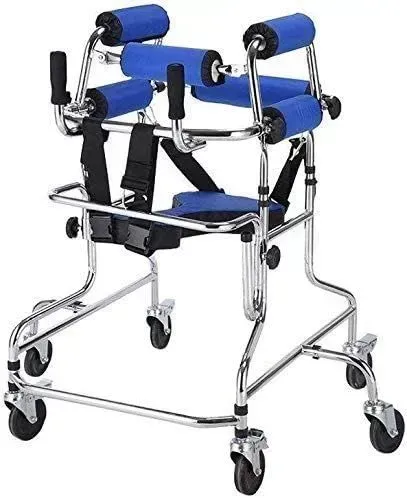
- The child's therapy goal is supported stepping or walking: assess a pediatric gait trainer rather than Peony.
- The child requires positioning outside Peony's support range, has a contraindication to standing, or cannot be safely transferred into the frame.
- A portable or battery-operated stander is essential: the standard Peony is 220V AC mains-powered.
Measurements and Information to Share Before Ordering
- Age, body height and weight.
- Hip/pelvic width, trunk length, shoulder height, lower-leg and foot measurements.
- Head control and trunk control; current posture in lying, sitting and supported standing.
- Joint range of motion, hip/knee/ankle positioning restrictions, previous fractures, pressure/skin concerns and relevant medical instructions.
- Current standing programme, tolerated tilt/standing angle and weight-bearing guidance.
- Transfer method and number of people currently needed for care.
- Room measurements, doorway access, storage and location of 220V supply.
Standard Adjustable Components
- Electric tilt from 0° to 90°.
- Adjustable head, trunk/chest, pelvic, knee, calf and foot supports.
- Foot positioning straps as described in the product's customization information.
- Adjustable therapy tray position as listed on the website; confirm whether tray is standard or optional.
Configuration and Customization Review
Morecare can review the child's measurements and therapist guidance to advise on fit and support placement.
Any non-standard frame alteration, support addition or accessory change must be technically approved and priced in writing before purchase.
Important Fit Limit
The 60 kg weight rating and published user-height range do not ensure every child fits.
The current product FAQ refers to 80–120 cm while the confirmed technical specification is 60–137 cm; the obsolete FAQ range should be replaced when publishing this pack.
Before Every Standing Session
- Confirm that standing is prescribed for the child and that the planned angle, duration and weight-bearing progression follow the rehabilitation professional's instructions.
- Verify the child is within the maximum 60 kg capacity and fits the head, trunk, pelvic, knee, calf and foot supports.
- Inspect the steel frame, support board, cushions, straps, buckles, fasteners, caster locks, electrical cable, handset and actuator for damage or unusual operation.
- Position the standing frame on a stable, level indoor floor and engage all available caster wheel locks.
- Ensure that the transfer/assisted recovery procedure, appropriate caregivers and mains power are available before positioning the child.
- Fit the child with the frame at the required starting angle. Secure and check all supports before any powered tilt movement.
During Electric Tilt and Standing
- A trained caregiver or qualified therapist must remain with the child throughout the session. Never leave the child unattended in the frame.
- Use the supplied wired handset only for the manufacturer-approved electric tilt function.
- Increase or decrease the standing angle gradually, within the therapist-prescribed limits and the published 0°–90° travel range.
- Monitor breathing, head position, comfort, skin pressure, limb alignment, dizziness, fatigue and signs of pain or distress.
- Keep hands, clothing, cables and nearby objects clear of the actuator, hinges and moving mechanisms.
- Stop if the child becomes uncomfortable or the frame shifts, binds, becomes unstable or operates abnormally.
- Do not reposition the frame on its casters during an occupied standing session unless the exact manual expressly permits that procedure.
Power Failure and Assisted Recovery
- Standard operation requires 220V AC mains power; do not assume the frame has a battery backup.
- Morecare's previously confirmed power-loss behaviour is that the frame holds the angle at which it stops.
- During a mains outage the electric tilt mechanism cannot be operated until power is restored. A manual emergency lowering feature is not established by the uploaded product record.
- Use the current written, manufacturer-approved assisted-recovery and transfer procedure; do not improvise adjustment of the actuator or release mechanical joints under load.
Cleaning and Maintenance
- Disconnect the electrical supply before cleaning or maintenance.
- Wipe the powder-coated steel frame with a damp, soft cloth and mild cleaner.
- Clean PU cushions using mild soap and water; dry thoroughly and keep electrical parts dry.
- Inspect all straps, buckles, support pads, fasteners, brakes and moving components regularly.
- Keep the actuator, cable and wired handset free of moisture and damage. Never pressure-wash the device or use abrasive cleaners or solvents.
- Clean castors of dust and hair and test wheel locks periodically.
- Stop use if any electrical problem, unusual noise, looseness, instability, or damage is found, and arrange support through Morecare.
- Store on a stable dry indoor floor, protected from excess moisture and heat.
Important Use Limits
- Peony is a supported standing rehabilitation system, not a patient lift or walking trainer.
- A single caregiver may be able to operate electric tilt after training, but transfer staffing must follow the child's individual handling assessment.
- Do not make unapproved frame modifications or exceed the 60 kg rating.
Shipping & Dispatch
- Orders are typically dispatched within 2–3 working days after order confirmation.
- Products are securely packed to minimize the risk of transit damage.
- Tracking details are shared once the order has been dispatched.
- Estimated delivery is 4–5 working days after dispatch, depending on the delivery location.
- Large rehabilitation equipment may require additional transit time based on destination and logistics availability.
Installation & Setup
- Ships in knock-down condition for safe transportation.
- Assembly typically takes approximately 30 minutes.
- A detailed product installation video is provided.
- Free virtual installation support is available via phone or video call.
- Our support team can assist with assembly, positioning, adjustments, and initial setup.
Returns, Replacement & Refunds
- Returns are accepted only for manufacturing defects or transit damage.
- Transit damage must be reported within 48 hours of delivery with clear photographs or videos of the product and packaging.
- Approved returns due to change of mind or personal preference are subject to a 20% restocking fee.
- Product exchanges are available with a 5% processing and shipping charge.
- Orders cancelled before dispatch are subject to a 5% cancellation fee.
- Please retain the original packaging during the eligible return period.
- Customized, made-to-order, and special-order products are non-returnable and non-refundable.
Warranty
- 12-month warranty against manufacturing defects under normal operating conditions.
- Warranty is valid from the date of purchase.
- A valid purchase invoice is required for all warranty claims.
- Warranty does not cover normal wear and tear, upholstery, straps, cushions, wearable components, misuse, overloading, improper installation, accidents, neglect, unauthorized repairs or modifications, or electrical damage caused by improper power supply or misuse of the electric linear actuator.
After-Sales Support
- Lifetime virtual technical support via phone or video call.
- Assistance with product assembly, setup, positioning, and adjustments.
- Guidance on safe operation and routine maintenance.
- Troubleshooting support for mechanical and electrical components.
- Genuine Morecare spare parts and accessories are available at an additional cost.
- Paid repair and servicing are available after the warranty period.
- Ongoing customer support for product-related queries and technical assistance.
Product Showcase & Reviews
Watch clinical insights and customer experiences.


Every Choice Has a Story
Choosing the right rehabilitation equipment is about finding the right fit for your family. Read why families chose this product
FAQs related to Peony – Electric Pediatric Supine Standing Frame
Find quick answers to common questions about this product.
Peony is an electric supine standing frame for selected children who need extensive support for gradual positioning from lying to upright standing. The previously confirmed age reference is approximately 4–18 years, the recommended height range is 60–137 cm, and maximum user weight is 60 kg. Children with CP and other neurological or neuromuscular conditions require individual standing and fitting assessment.
Peony supports the child from behind while its electric linear actuator moves the frame gradually from horizontal (0°) towards upright (90°). This can be useful when a child needs progressive positioning rather than being placed directly into a fixed-upright stander. A therapist decides the appropriate angles, duration and weight-bearing plan.
The product record lists adjustable head, trunk/chest, pelvic, knee, calf and foot supports, together with an adjustable-position therapy tray. The documentation does not explicitly separate the tray into standard and optional inclusions, so confirm its inclusion with Morecare when ordering. Positioning components must be fitted for the individual child.
Peony may be used in a suitable home or clinical setting after a professional standing assessment, correct setup and caregiver training. The published product lists single-caregiver electric operation, but whether one person can safely transfer and position the child depends on the child's handling needs. The frame is supplied knock-down, with an estimated 30-minute assembly and virtual installation guidance.
Standard Peony runs from 220V AC mains power with a wired handset; no battery-powered function is confirmed for the base version. Morecare has previously confirmed that the frame remains at its current angle if power fails, while electric repositioning is unavailable until mains power returns. An approved assisted-recovery plan is essential; do not assume manual emergency lowering.
The published policy lists dispatch in around 2–3 working days after confirmation and delivery approximately 4–5 working days after dispatch, with longer transit possible for large equipment or some locations. It provides a 12-month manufacturing-defect warranty, installation guidance and lifetime virtual technical support under its stated conditions. Returns and customized orders are subject to Morecare's published policy.
Need Help Finding the
Right Solution?
Our rehabilitation experts are here to help you choose the right product or create a customized solution tailored to your needs.
Explore Similar Products
Compare similar models to find the best fit