Understanding Hospital Bed Movements: What Actually Changes?
Before comparing hospital beds, it helps to understand which part of the bed moves.
Most adjustable bed functions fall into five categories.
1. Backrest elevation
The upper section of the bed rises, helping the person move from a flat position towards supported sitting.
2. Knee and leg adjustment
The knee or leg section changes angle, providing different lower-limb resting positions. Knee bending is not the same as raising the entire leg section horizontally.
3. Bed-height adjustment
The whole sleeping surface moves vertically up or down without necessarily changing the person's reclining position.
4. Whole-bed tilting
The bed surface tilts from head to foot while remaining relatively straight. This includes Trendelenburg and Reverse Trendelenburg.
5. Side-to-side movement
Selected nursing beds and specialized therapy systems can tilt or rotate the patient towards one side.
These movements serve different purposes.
For example, an adjustable backrest may help with supported sitting, while bed-height adjustment may be important for caregiver access and certain transfers.
Important: A bed described as electric, motorized or multifunctional does not automatically include every movement listed above. Always confirm the individual functions.
Fowler, Semi-Fowler, High Fowler, Chair Position and Zero Gravity
These terms primarily describe how the upper body and legs are positioned.
Low Fowler Position — Approximately 15–30°
The upper body is slightly elevated above a flat lying position.
This provides modest backrest elevation and may be used when a person requires a partially raised resting posture.
Semi-Fowler Position — Approximately 30–45°
The head and upper body are raised to a moderate angle.
Semi-Fowler is commonly discussed in nursing care, respiratory positioning and supported resting. Its suitability depends on the patient's condition and clinical instructions.
Fowler Position — Approximately 45–60°
The person rests in a more upright position, with greater elevation of the upper body.
This may be used during selected care activities or when additional upright support is appropriate.
High Fowler / Full Fowler — Approximately 60–90°
The upper body is raised towards a near-sitting position.
High Fowler may be relevant to selected breathing, feeding or care activities, but adequate trunk support and protection against sliding are important.
The angle ranges above are commonly used references; terminology varies across nursing materials and equipment manufacturers.
Cardiac Chair or Chair Position
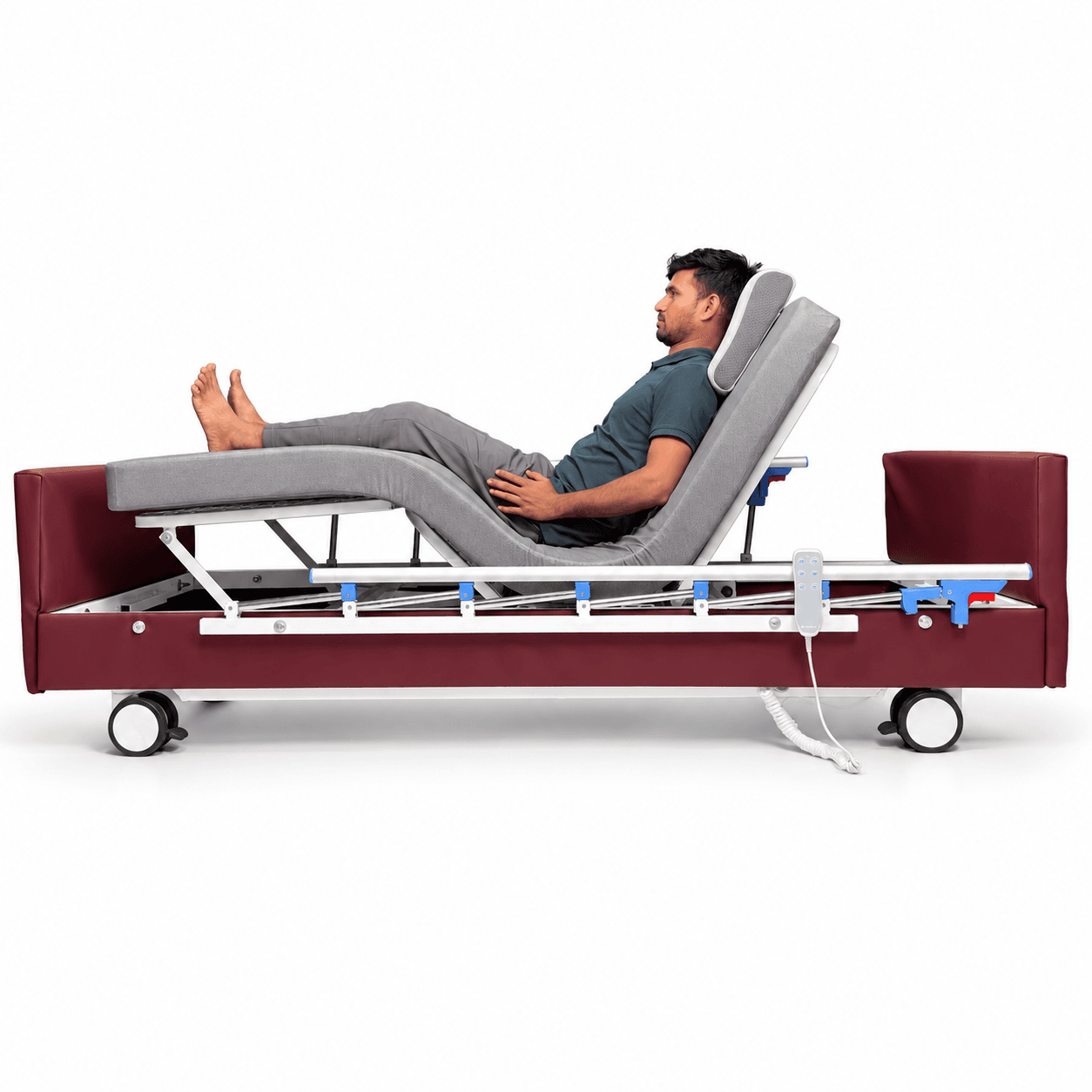
A chair-position bed adjusts multiple sections to create a sitting-like posture.
Depending on the model, this may involve raising the backrest, bending the knees, changing the leg section or altering other bed movements.
A backrest that simply rises to 80° does not necessarily provide a complete cardiac-chair function.
Zero Gravity Position
Zero gravity is a term frequently used for adjustable beds in which the upper body and legs are elevated in a coordinated reclining posture.
Unlike Fowler positions, zero gravity does not describe one universally standardized clinical angle.
Its exact configuration varies between manufacturers. It should not be assumed to provide medical pressure relief or treatment benefits.
What buyers should check: Ask for the actual backrest angle, knee adjustment range, whether the sections move independently, and whether advertised chair or zero-gravity positions are genuinely supported.
Hi-Low, Low Beds and Ultra-Low Beds Explained
Unlike Fowler positions, these terms describe the height of the bed rather than the angle of the upper body.
Hi-Low Bed
A Hi-Low bed allows the entire sleeping surface to move vertically.
The lower position may help selected patients with bed access, while a higher position may improve caregiver access for certain nursing activities.
Height adjustment may also be relevant when aligning a bed with wheelchairs or transfer equipment.
However, not every transfer requires the same bed height.
Low Bed
A low bed is designed to provide a relatively low sleeping surface.
This may be considered for certain patients with bed-exit or fall-related concerns, depending on their mobility and care plan.
Ultra-Low Bed
An ultra-low bed can lower substantially closer to floor level than many conventional hospital beds.
This may help reduce the consequences of some low-height falls, but it does not prevent falls or replace supervision.
The term "ultra-low" does not guarantee a particular height. Manufacturers may use different measurements.
What Is the Difference Between Hi-Low and Ultra-Low?
Hi-Low describes the ability to adjust bed height.
Ultra-low describes how close to the floor a bed can be lowered.
Some beds provide both functions.
A very low bed may be unsuitable for certain transfers or caregiver tasks unless it can also be raised appropriately.
What buyers should check: Confirm the minimum and maximum floor-to-sleeping-surface heights, the mattress thickness used for those measurements, maximum load, transfer compatibility and whether height adjustment is electric or manual.
Trendelenburg, Reverse Trendelenburg, Lateral Tilt and Rotation
These functions move the bed differently from ordinary backrest adjustment.
Trendelenburg Position
In Trendelenburg, the entire bed tilts so that the head is lower than the feet.
The body remains relatively straight along the inclined bed surface.
It is a specialized clinical position and should not be confused with simply raising the legs.
Trendelenburg can affect breathing, circulation and pressure within the body. It should only be used when clinically indicated.
Reverse Trendelenburg Position
Reverse Trendelenburg tilts the entire bed in the opposite direction, with the head higher than the feet.
Unlike Fowler positioning, the upper body is not necessarily bent at the waist.
This distinction matters when a patient's care plan requires the whole body to remain relatively straight.
Lateral Tilt
Lateral tilt moves the support surface towards the patient's left or right side.
Depending on the system, this may assist with selected positioning or caregiving activities.
Lateral tilt does not necessarily mean the bed turns the patient completely onto their side.
Lateral Rotation
Lateral rotation describes a more extensive side-to-side movement or positioning function.
Some specialized systems perform repeated or programmed lateral rotation as part of a clinical therapy programme.
A bed with a manual left/right tilt mechanism is not automatically a continuous lateral rotation therapy bed.
Automatic Turning Beds
Some specialized beds or mattress systems can assist with changing the person's side-to-side orientation.
These functions should not be confused with basic tilting, and they do not automatically eliminate pressure-injury risks or the need for clinical assessment.
What buyers should check: Confirm which sections move, maximum tilt angle, whether movement is manual or powered, whether continuous rotation is actually available, and what supervision or operating restrictions apply.
Electric Bed Functions, Safety Features and What to Check Before Buying
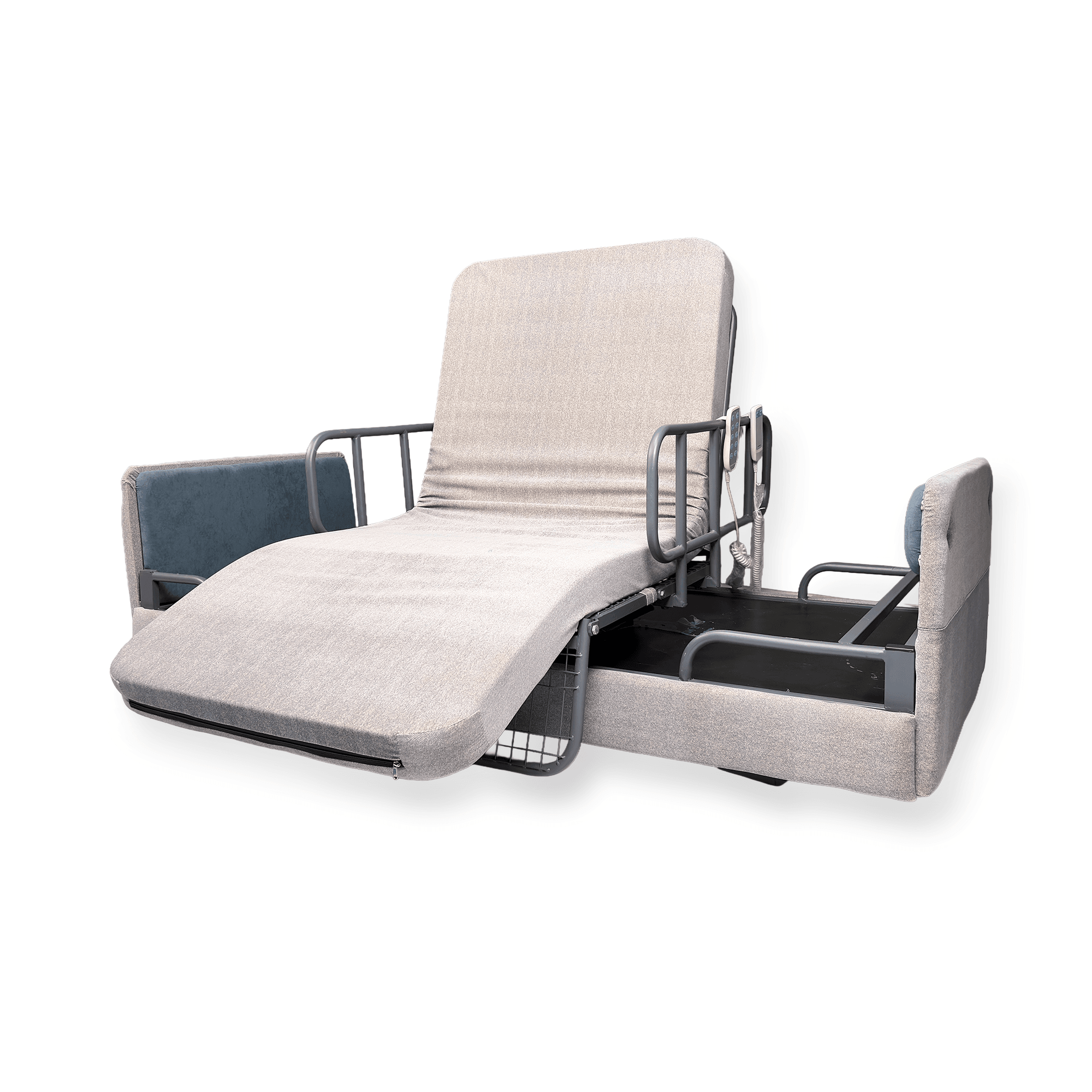
Hospital beds are also advertised using terms such as two-function, three-function, five-function, fully electric and semi-electric.
These labels can be confusing because manufacturers may count functions differently.
Understanding Function Counts
A two-function bed might provide backrest and knee adjustment.
Another manufacturer may advertise a three-function bed with backrest, knee and height adjustment.
More advanced models may include Trendelenburg, lateral tilt or other movements.
However, there is no reason to assume that every five-function bed includes the same five functions.
Always ask for the exact list of independent movements.
Other Important Terminology
Electric Actuator: The powered mechanism that moves a bed section.
Manual Crank: A mechanical handle used by a caregiver to adjust a bed.
Semi-Electric: A combination of powered and manually adjusted functions.
Fully Electric: Advertised adjustment functions are powered, although the actual functions depend on the model.
Auto-Contour: Coordinated adjustment of the back and knee sections according to the bed's design.
CPR Release: A mechanism that allows relevant bed sections to return rapidly towards a flat position during emergency procedures.
Battery Backup: A system that operates specified functions when mains power is unavailable.
Safe Working Load: The rated load the equipment can support under stated conditions. This may include the patient, mattress and accessories, so it should not be confused with maximum patient weight.
Bed Side Rails: Components that may assist selected movements or provide support, but can also introduce entrapment or injury risks.
Pressure-Redistributing Mattress: A mattress intended to redistribute pressure for selected patients. It is not the same as an adjustable bed mechanism.
Do You Need Every Function at Home?
Not necessarily.
A person who primarily needs supported sitting and knee positioning may not require a complete hospital bed.
For such requirements, Morecare BedMate Motorized Back & Knee Rest can introduce powered positioning into a compatible existing bed.
BedMate provides motorized back and knee adjustment. It does not provide overall bed-height adjustment, Trendelenburg positioning, lateral rotation or automatic patient turning.
For more complex nursing requirements, a complete hospital-style bed may be necessary.
Before buying, check:
- Which movements are included and their adjustment ranges.
- Whether bed-height adjustment is needed for transfers or caregiving.
- Maximum patient capacity and safe working load.
- Mattress dimensions, thickness and compatibility.
- Bed-rail compatibility and entrapment risks.
- Power failure behavior and emergency controls.
- Bedroom space, access and installation requirements.
The best bed is not necessarily the one with the most functions. It is the one that provides the functions required for the patient's care while maintaining safety, comfort and practical usability at home.