What Is the Difference Between an Electric and Manual Gait Trainer?
Gait trainers are rehabilitation devices designed to provide assistance during standing and walking activities.
However, not every gait trainer provides the same type of support.
Manual gait trainers
Manual gait trainers generally use a frame with adjustable handles, body supports or harnesses. They do not use an electric motor to raise the patient or control their walking movements.
The user must have sufficient physical ability to participate in standing and stepping, with assistance from a therapist or caregiver when needed.
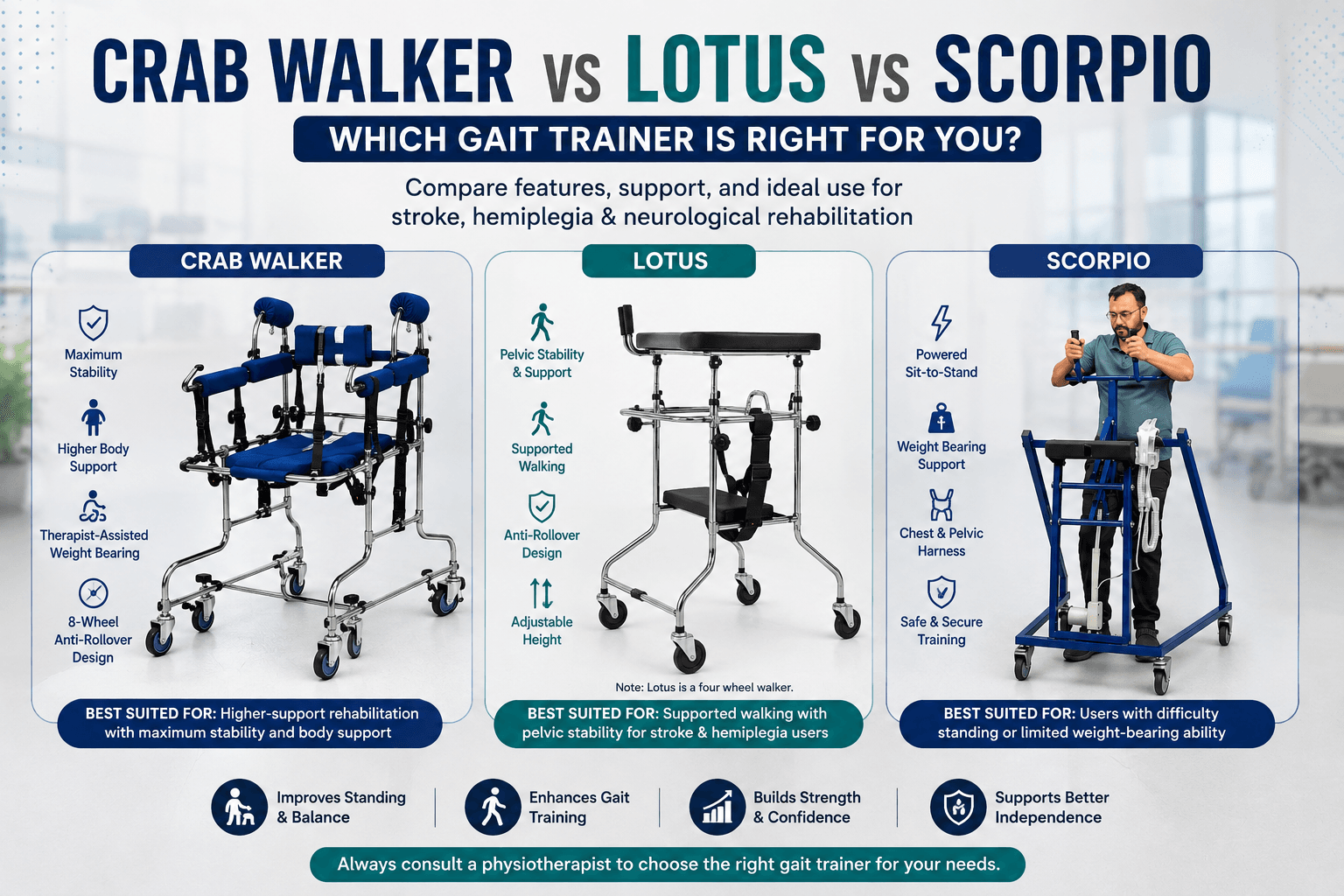
Examples include the Morecare Lotus and Crab Walker.
Electric sit-to-stand gait trainers
These systems include a powered mechanism that assists the transition from sitting to standing.
This can be valuable when a patient has difficulty rising from a chair but may be able to participate in supported standing or stepping once appropriately positioned.
The Morecare Scorpio is an example.
Motorized body-weight-support gait trainers
These devices use a powered suspension system to reduce the amount of body weight supported through the patient's legs.
They may be considered when controlled unloading is needed during rehabilitation.
The Morecare i-Gait belongs to this category.
An electric motor does not necessarily drive the patient's legs. Each device's specific powered function must be understood before purchase.
When May a Manual Gait Trainer Be Appropriate?
A manual gait trainer may be considered for a patient who can already participate in standing and stepping but needs additional support for balance, posture or stability.
For example, an adult recovering from stroke may have some ability to move the legs but struggle with trunk stability.
A supportive walker may provide a structured environment for therapist-guided walking practice.
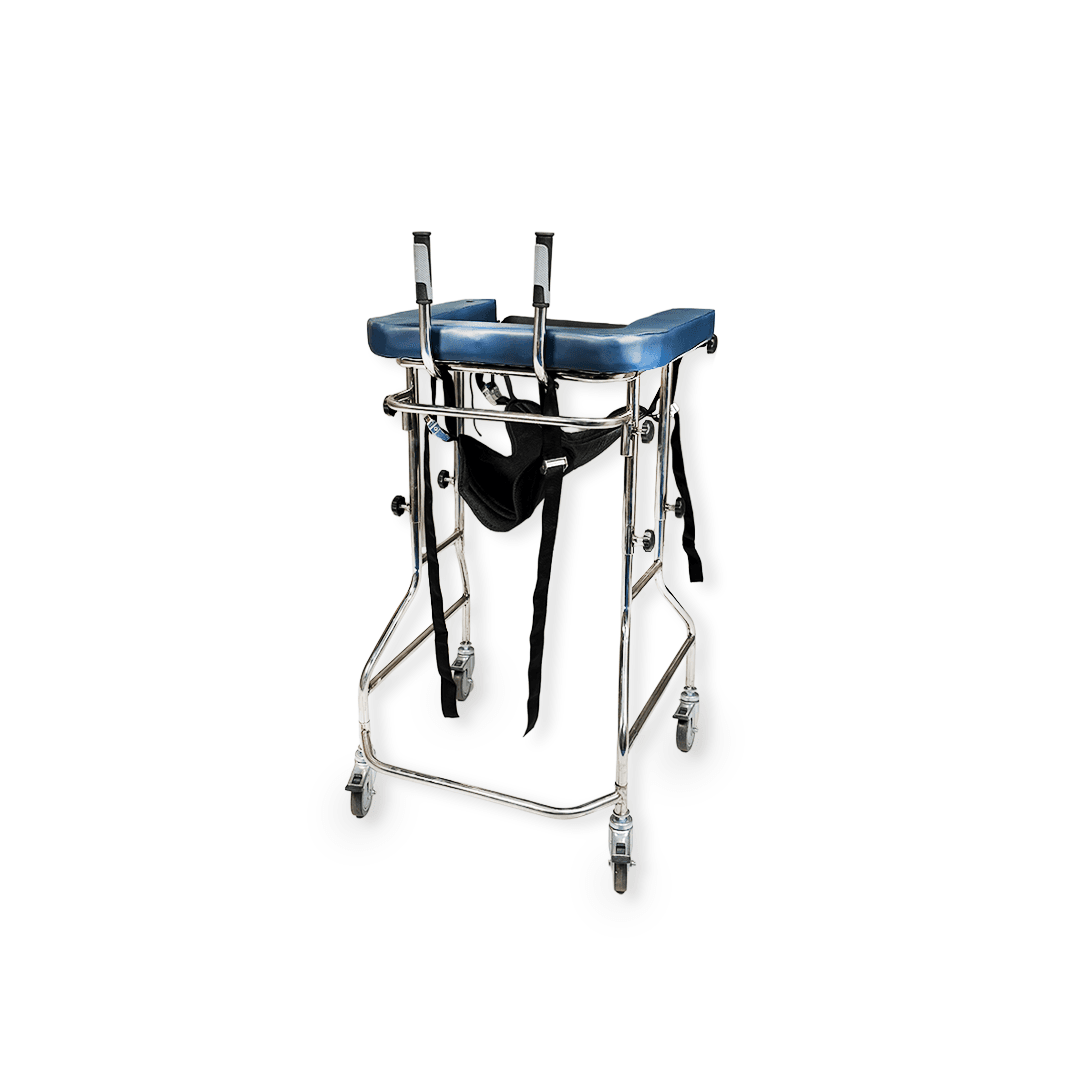
The Morecare Lotus is an anterior gait trainer designed for adults with neurological mobility limitations.
It includes:
Adjustable walking support.
Pelvic positioning sling.
Padded back support.
Wheeled frame with locking mechanisms.
A two-piece structure for transport and storage.
Lotus may be considered for users who need additional pelvic positioning and balance assistance during prescribed walking practice.
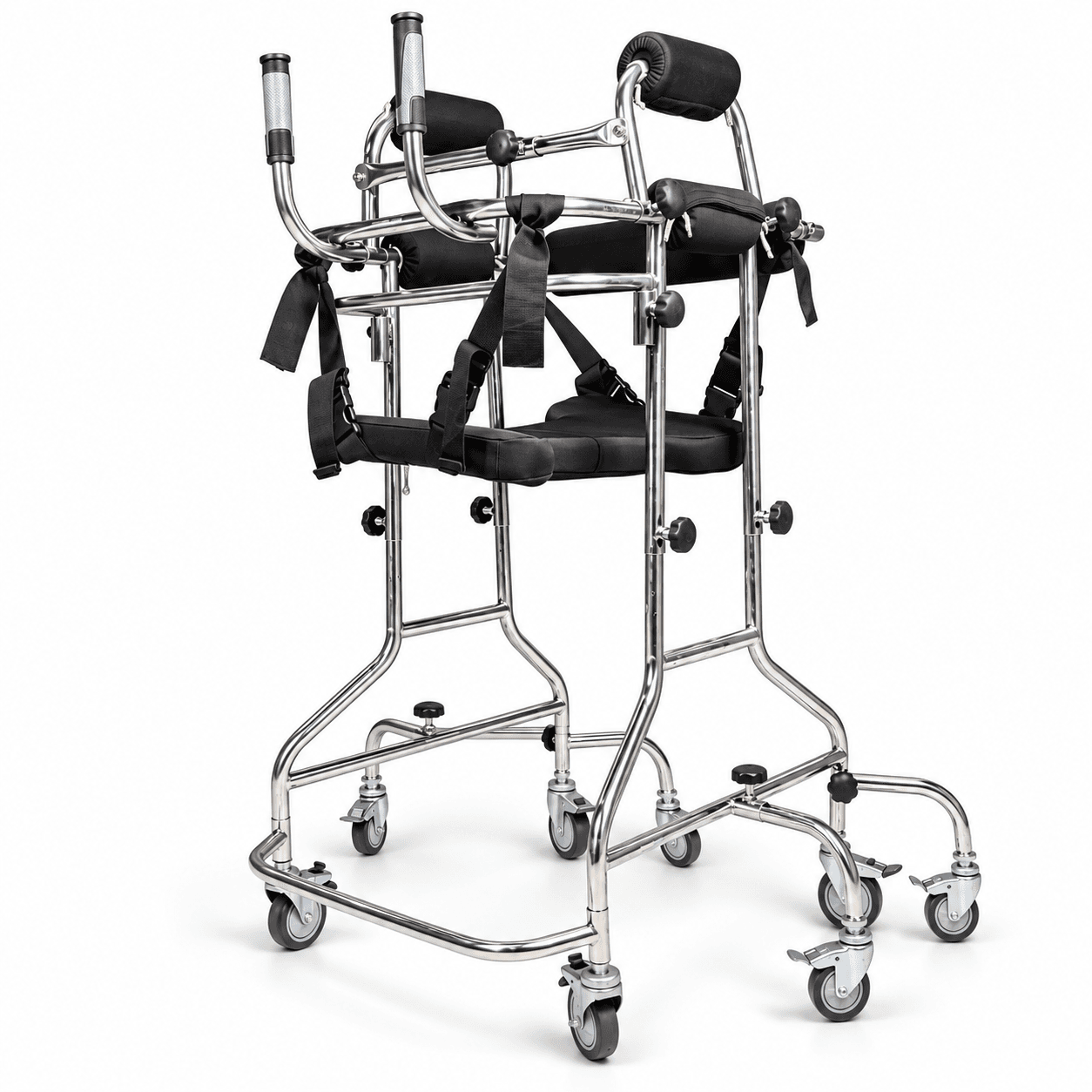
For patients requiring more extensive chest and arm positioning, the Morecare Crab Walker offers another configuration.
Its eight-wheel structure incorporates padded chest support, arm supports and a pelvic sling.
These devices do not raise a patient electrically from a seated position.
The pelvic supports should not be assumed to provide full-body suspension.
A therapist must assess whether the user's lower-limb loading capacity, standing ability and trunk control are sufficient for the selected manual trainer.
When Does Powered Sit-to-Stand Assistance Become Useful?
Some patients have difficulty reaching standing even when they retain some lower-limb movement.
For example, a stroke survivor may be unable to rise from a wheelchair because of weakness, impaired balance or poor coordination.
A person may also require substantial caregiver assistance during the initial standing transition.
In these situations, a powered sit-to-stand rehabilitation system may be considered.
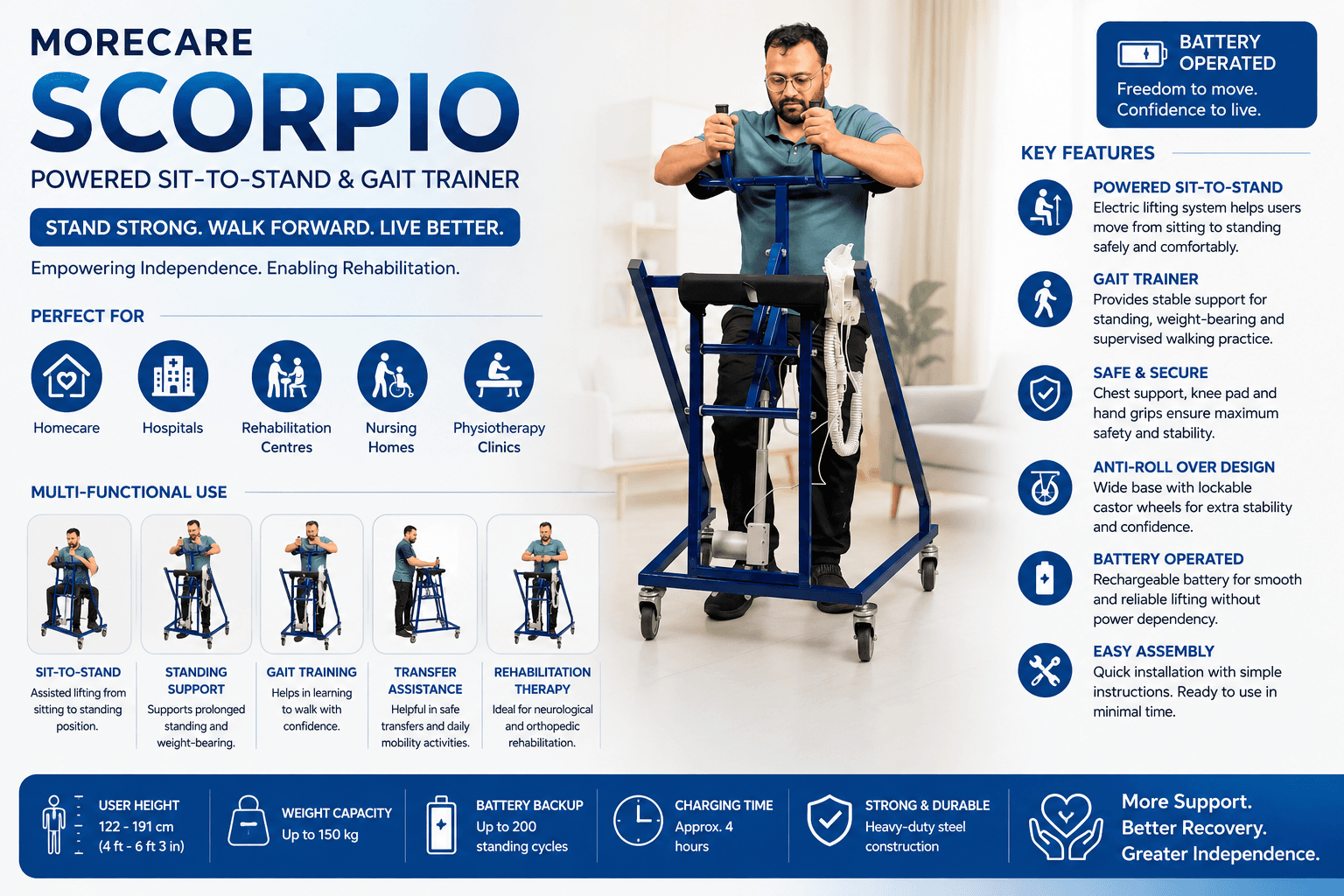
The Morecare Scorpio Electric Sit-to-Stand & Gait Training System uses a battery-powered linear actuator to assist the transition from sitting into standing.
Its support arrangement includes:
Adjustable arm supports
Provide upper-limb positioning options.
Adjustable knee supports
Help position the lower limbs during the prescribed standing activity.
Chest harness
Provides upper-body positioning support.
Pelvic harness
Helps maintain the intended pelvic position.
Electric standing mechanism
Assists movement from sitting towards supported standing through a wired controller.
Once standing, an appropriately assessed patient may participate in supported balance, weight-shifting or stepping activities.
However, Scorpio does not automatically move the legs during walking.
It is also not a general-purpose full-body patient hoist.
Powered standing assistance should be used to support appropriate rehabilitation goals, not as a substitute for active movement practice when the patient can participate safely.
When Is Motorized Body-Weight Support More Appropriate?
Not every patient has enough lower-limb weight-bearing ability to use a conventional supportive walker.
Some individuals require substantial assistance to maintain standing, while others need controlled unloading during gait training.
An overhead body-weight-support system uses a harness connected to an appropriate suspension mechanism.
Depending on the model, this can reduce the load passing through the patient's legs during standing and stepping activities.
The Morecare i-Gait Motorized Unweight Gait Mobility Trainer uses an electrically operated suspension system.
Its published configuration provides up to 50% adjustable body-weight unloading, subject to the approved harness, patient weight and system limits.
It also includes adjustable parallel bars and harness arrangements for therapist-supervised rehabilitation.
This type of equipment may be considered when:
The patient needs controlled body-weight unloading.
Lower-limb loading must be progressively adjusted.
Additional support is required during repeated stepping.
The rehabilitation plan includes appropriately supervised overground or treadmill gait training.
However, overhead body-weight support is not automatically equivalent to complete patient suspension.
The maximum allowed unloading and approved operating procedures must be checked for the specific equipment.
A full-body transfer hoist may still be required when the person needs complete assistance during everyday transfers.
Comparing Morecare Lotus, Crab Walker, Scorpio and i-Gait
Morecare offers different rehabilitation systems for different levels of assistance.
The most important distinction is what type of support each device provides.
Feature
Lotus
Crab Walker
Scorpio
i-Gait
Main category
Manual gait trainer
Manual supported gait trainer
Powered standing trainer
Motorized unloading trainer
Electric standing assistance
No
No
Yes
Motorized suspension positioning
Chest support
Not standard
Yes
Harness
Body harness
Pelvic support
Positioning sling
Partial-assistance sling
Pelvic harness
Suspension harness
Arm support
Handles
Padded supports
Adjustable supports
Parallel bars
Knee supports
No
No
Yes
Not standard
Powered walking movement
No
No
No
No
Calibrated body-weight unloading
No
Not specified
Not specified
Up to 50% published
Main purpose
Supported walking
Greater external positioning support
Sit-to-stand plus supported gait practice
Controlled unloading during gait training
How to understand these differences
Choose Lotus for consideration when:
The patient can participate in standing and stepping but requires additional pelvic positioning and walking support.
Choose Crab Walker for consideration when:
The patient requires additional chest, arm and pelvic support during supervised standing and gait training.
Choose Scorpio for consideration when:
The patient has difficulty rising from a seated position and may benefit from powered standing assistance before appropriate rehabilitation activities.
Choose i-Gait for consideration when:
The rehabilitation programme requires controlled unloading through an overhead harness system.
These are selection starting points, not clinical prescriptions.
The patient's actual support requirements, safe loading capacity, measurements and rehabilitation objectives must be assessed before purchase.
An electric mechanism or a larger frame does not automatically provide a higher level of safety.
Seven Questions to Ask Before Buying a Gait Trainer
Before purchasing equipment, families should review the following questions with the treating rehabilitation professional.
- Can the patient stand with assistance?
Determine whether the person can reach standing with manual assistance or requires an approved powered mechanism.
- How much weight can the patient bear through the legs?
This helps identify whether positioning support is sufficient or controlled unloading is required.
- Does the patient have adequate trunk control?
Poor trunk stability may require additional chest or pelvic positioning support.
- Can the patient initiate stepping?
Some patients can actively move the legs, while others require specialized assistance or a different rehabilitation approach.
- Is the main difficulty standing up or walking?
A powered sit-to-stand trainer addresses a different problem from a manual walking-support frame.
- Will the equipment be used at home or in a clinic?
Consider doorways, flooring, available space, supervision and caregiver training.
- What happens if the patient becomes fatigued or the equipment stops working?
Confirm the approved recovery procedure, braking instructions, electrical safety and emergency plan.
A physiotherapist may also recommend different equipment as the patient's functional abilities change.
The goal is not to progress through devices according to price or technical complexity.
It is to match the available assistance to the person's current rehabilitation needs.
Clinical References
NICE. Stroke Rehabilitation in Adults (NG236).
https://www.nice.org.uk/guidance/ng236/chapter/Recommendations
National Clinical Guideline for Stroke. Motor Recovery and Physical Effects of Stroke, 2023.
https://www.strokeguideline.org/chapter/motor-recovery-and-physical-effects-of-stroke/
Canadian Stroke Best Practice Recommendations. Lower Extremity, Balance, Mobility and Aerobic Training, 2025.
https://www.strokebestpractices.ca/recommendations/stroke-rehabilitation-delivery/4-lower-extremity-balance-mobility-and-aerobic-training
Morecare Mobility & Rehabilitation Solutions. Scorpio, Lotus, Crab Walker and i-Gait Product Information.
https://morecare.in/scorpio/
https://morecare.in/lotus/
https://morecare.in/crab-walker/
https://morecare.in/i-gait/
Medical Disclaimer: This article provides general rehabilitation and equipment-selection information. Individual standing and walking programmes require assessment by qualified rehabilitation professionals. Follow the approved manufacturer specifications, operating instructions and safety procedures for each device.