Why Are Standard Walkers Not Suitable for Every Patient?
A conventional walker generally provides a frame that the user can hold or lean on while standing and walking.
For some people, this is sufficient.
However, others require additional assistance to maintain balance, stabilize the pelvis or support the upper body.
Poor Trunk Control
Some patients cannot maintain an upright trunk without external support.
They may lean forward, sideways or backward when attempting to stand.
A conventional walker does not necessarily provide the required trunk positioning.
Reduced Pelvic Stability
The pelvis plays an important role in standing balance and walking.
When the user cannot maintain sufficient pelvic control, a walking frame alone may not provide the needed assistance.
Limited Upper-Limb Strength
Some patients cannot support themselves effectively through their hands and arms.
A walker requiring substantial grip or arm loading may therefore be unsuitable.
Difficulty Bearing Weight Through the Legs
Certain patients cannot safely support their full body weight during gait practice.
They may need a dedicated body-weight-support system rather than an ordinary walker.
Significant Balance Impairment
A user may be unable to recover from loss of balance or maintain an appropriate position inside the walker.
Additional support or closer supervision may be necessary.
Unusual Body Dimensions
Standard height, width or support adjustment ranges may not accommodate the person's body proportions.
Restricted Mobility Environment
The device may need to pass through doorways, operate within a clinic or accommodate a particular therapeutic environment.
A standard walker that is too wide, too tall or unsuitable for the available space may not work.
These situations require different solutions.
Adding a harness to an unsuitable frame does not automatically make the equipment safe.
The therapist must determine the functional support required, and the manufacturer must establish whether the proposed configuration can provide it safely.
Which Medical Conditions May Need Customized Gait-Training Equipment?
Gait-training equipment is used for different rehabilitation goals.
A medical diagnosis can help explain the person's difficulties, but the appropriate device depends on functional assessment.
Cerebral Palsy
Children and adults with cerebral palsy may experience muscle weakness, spasticity, dystonia, impaired coordination or reduced postural control.
Depending on their abilities, they may need:
Pelvic positioning support.
Trunk or chest support.
Adjustable forearm positioning.
A suitably sized walking frame.
An individualized harness arrangement.
Dedicated body-weight support when indicated.
Some children may require a gait trainer primarily to support supervised participation in stepping activities.
Others may be working on specific walking goals with their physiotherapist.
The equipment should match the child's actual abilities rather than be selected solely from age or GMFCS classification.
Stroke and Hemiplegia
Adults recovering from stroke may experience one-sided weakness, impaired balance, altered muscle tone or reduced walking coordination.
Some require additional upper-body or pelvic support during supervised gait practice.
A physiotherapist should assess the person's standing balance, lower-limb function, arm-control limitations and need for assistance.
Spinal Cord Injury
Individuals with spinal cord injuries have widely varying movement and weight-bearing abilities.
Some may participate in supported standing or gait training, while others require substantial external support.
The appropriate system depends on injury-related impairment, medical stability, joint condition and rehabilitation goals.
Traumatic Brain Injury
Brain injuries can affect balance, coordination, muscle tone, cognition and walking ability.
Gait-training equipment may need to accommodate these difficulties while allowing suitable therapist supervision.
Multiple Sclerosis
Some people with multiple sclerosis experience weakness, fatigue, spasticity or impaired coordination.
The rehabilitation plan should account for their current abilities, fatigue and changing symptoms.
Parkinsonian and Other Neurological Conditions
Balance difficulties, movement initiation problems or altered gait patterns may create a need for supervised walking practice.
However, a customized gait trainer is not automatically the appropriate intervention.
Other Complex Mobility Conditions
People with developmental disabilities, selected orthopedic limitations or uncommon neurological disorders may have rehabilitation needs outside standard walker dimensions and support arrangements.
In every case, the therapist should establish whether the intended activity is standing practice, stepping training, balance work or functional mobility.
Different goals may require different equipment.
What Features Can Be Customized in a Gait Trainer?
A gait trainer should provide the right type of support without unnecessarily restricting movement.
Morecare evaluates customization requests involving several functional and mechanical components.
- Frame Height
The frame must accommodate the user's body dimensions and intended support positions.
A frame that is too high or low may prevent appropriate arm, trunk or pelvic positioning.
- Frame Width and Walking Clearance
The user needs sufficient room to stand and move their legs within the equipment.
However, unnecessarily wide frames may be difficult to maneuver.
Any dimensional change must preserve the device's stability and structural capacity.
- Pelvic Support
Some gait trainers use a pelvic sling or support to help maintain the user's position.
The support must fit the pelvis appropriately and should not create excessive pressure.
- Chest and Trunk Support
Additional upper-body positioning may be appropriate for users with reduced trunk control.
The location and shape of the support should allow safe breathing and accommodate the person's posture.
- Forearm Supports
Patients with limited grip strength or difficulty using conventional handles may require an alternative forearm-support arrangement.
The configuration must remain stable and suitable for the intended loading.
- Harness Size
A harness that is too small, too large or poorly positioned can create discomfort and safety risks.
The correct dimensions and attachment points are important.
- Support Attachment Height
Some gait-training systems use overhead suspension.
The hook height, harness geometry and frame clearance must accommodate the person and intended activity.
- Wheel Configuration
Caster size, wheel arrangement and braking functions can affect maneuverability.
Changing these components can also alter stability and must be technically evaluated.
- Folding and Storage
Selected families need equipment that can be moved or stored between therapy sessions.
Folding components must maintain appropriate strength and secure locking.
- Clinical Accessories
A therapist may request additional positioning or therapy components for a specific rehabilitation objective.
Not every accessory can be safely combined with every frame.
What About Body-Weight Support?
This requires an important distinction.
A pelvic sling that helps stabilize the user or mitigate a sudden loss of support is not necessarily designed to continuously unload a defined percentage of body weight.
A dedicated body-weight-support system uses an appropriately engineered suspension or lifting mechanism.
It must be evaluated for the intended loading, harness compatibility, frame stability and user safety.
Morecare should not represent a standard pelvic-support walker as an equivalent substitute for a dedicated unloading system.
How Can Families and Therapists Choose a Suitable Gait-Training Platform?
Different mobility problems may require different types of gait-training equipment.
Morecare has several existing platforms that can serve as starting points for a feasibility discussion.
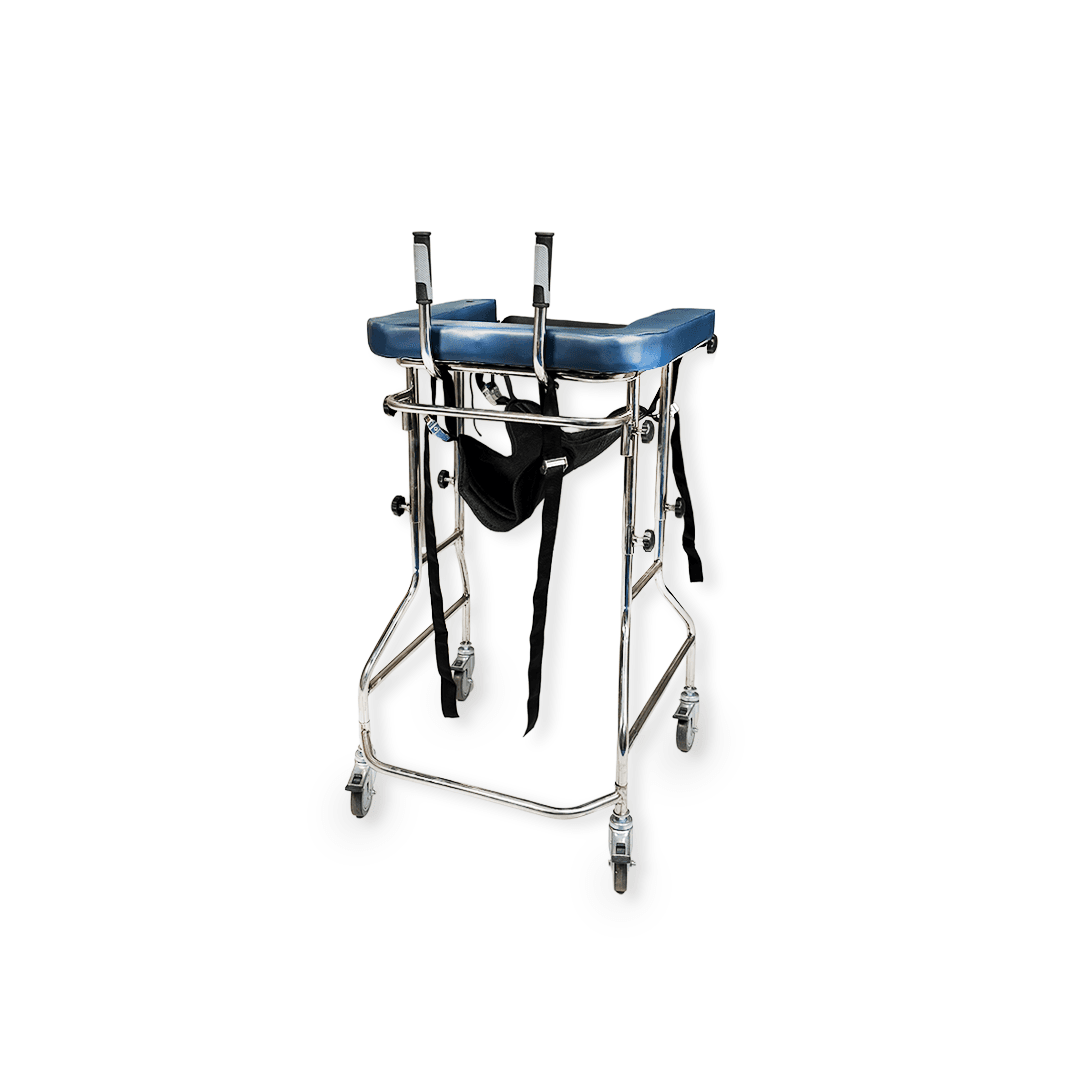
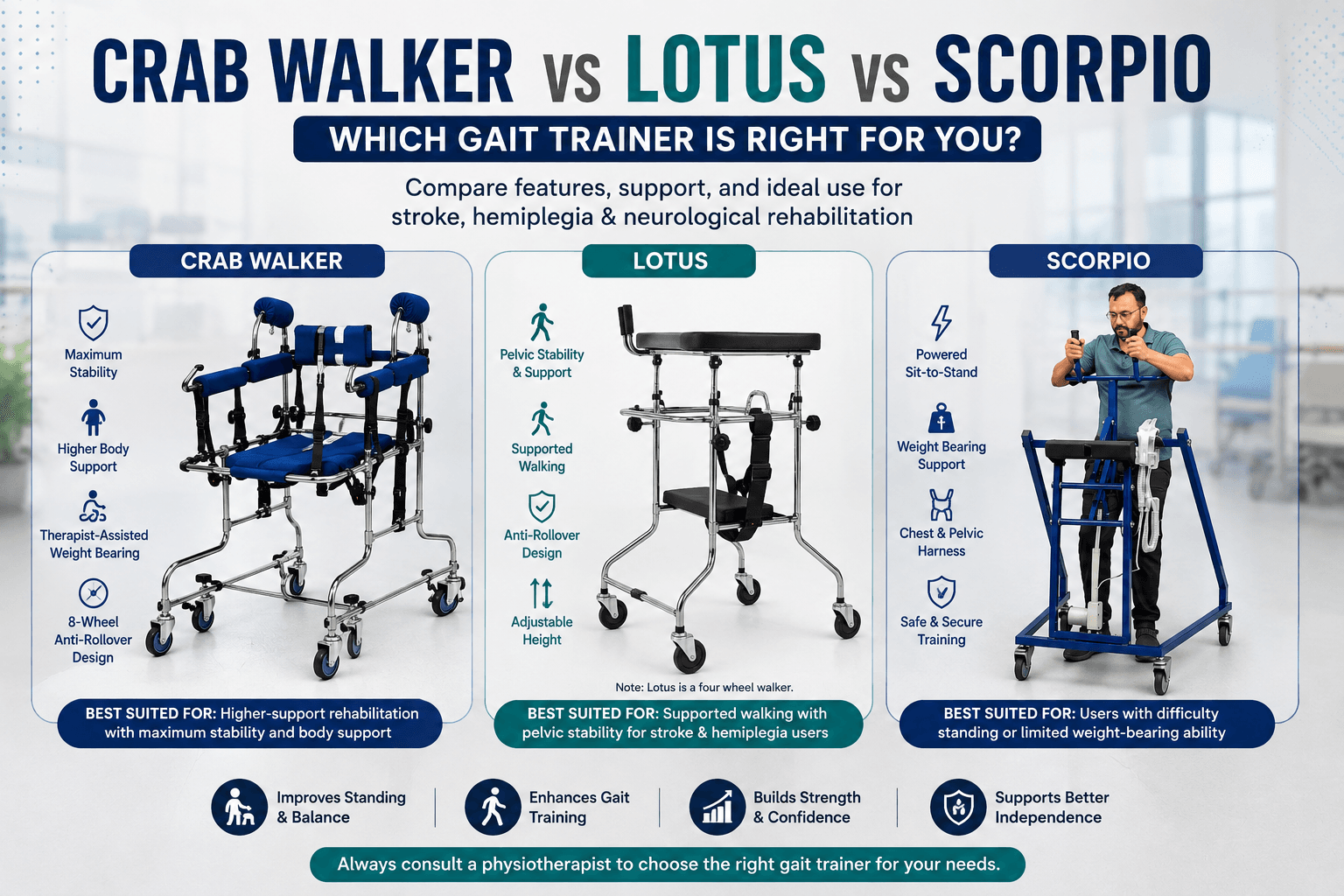
Morecare Lotus — Adult Supported Gait Trainer
Lotus is designed for selected adults who require pelvic stability and additional balance support during gait practice.
Its published specifications include:
Adult user configuration.
Approximate height suitability from 5 feet to 6 feet and above.
Maximum published user weight of 120 kg.
Pelvic support.
Back support.
Foldable frame.
The Lotus pelvic sling provides positioning and support during approved use.
It is not a dedicated continuous body-weight-unloading mechanism.
A patient who requires substantial unloading through a suspended harness may need a different system.
Morecare Crab Walker — Adult Standing and Gait Training Walker
Crab Walker uses an eight-wheel frame with additional upper-body and pelvic positioning options.
Its published customization options include:
Frame-height adjustments.
Chest-support positioning.
Pelvic sling or seat sizing.
Selected wheel configurations.
Additional clinical accessories.
It may be worth evaluating for adults needing more extensive support than a basic walking frame.
However, suitability and load capacity must be confirmed for the specific configuration.
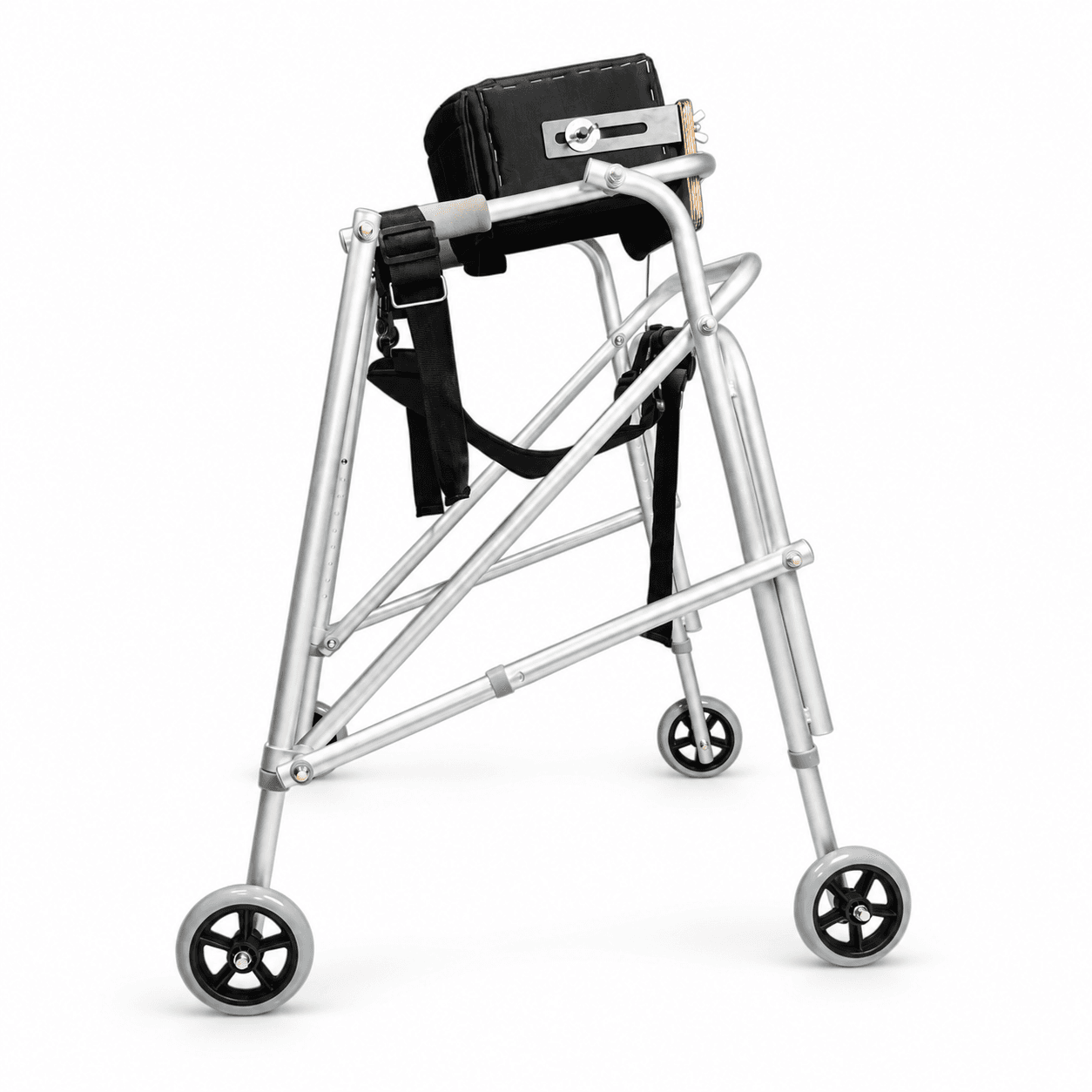
Morecare Poppy — Pediatric Gait Trainer
Poppy is a pediatric walking aid with anterior and posterior configurations.
Its published customization areas include:
Height adjustment range.
Chest-support size.
Pelvic sling size.
Wheel configuration.
Additional positioning supports.
It may provide a starting point when a child's body dimensions or support requirements do not match a standard pediatric walker.
Morecare Pediatric LiteGait — Body-Weight-Support Trainer
Pediatric LiteGait is a distinct category of gait-training equipment.
It includes an electrically adjustable support mechanism and harness system for supervised gait practice.
Morecare lists customization options involving:
Frame dimensions.
Harness configurations.
Height modifications.
Additional clinical accessories.
This type of system should be considered when a child's therapy programme requires dedicated suspension or partial body-weight support.
Morecare i-Gait — Motorized Unweight Gait Trainer
i-Gait provides a powered body-weight-support platform for selected adolescent and adult rehabilitation requirements.
Published customization options include:
Patient-size configurations.
Frame dimensions.
Harness sizes.
Parallel-bar dimensions.
Additional therapy accessories.
The appropriate user load, support arrangement, movement environment and operational safety must be confirmed for the chosen configuration.
What If None of These Products Fits?
The requirement may need a different frame, support arrangement or engineering concept.
Morecare's customization service allows families and therapists to submit an unusual requirement for feasibility evaluation.
A custom solution should only proceed when the functional objective, technical design and necessary validation can be established.
How Does Morecare Develop a Customized Gait Trainer?
A made-to-order gait trainer requires coordination between the user's functional requirements and the mechanical design of the equipment.
Morecare's customization service provides a process for evaluating these projects.
Step 1: Understand the Walking Difficulty
The customer or therapist describes the problem.
Examples include:
The patient cannot maintain the pelvis in position.
The child leans forward during supported walking.
Standard handles cannot be used because of arm weakness.
The frame does not accommodate the user's height.
A conventional walker provides inadequate stability.
The therapy programme requires partial body-weight support.
A standard device does not fit the clinic or home environment.
Step 2: Collect Patient and Equipment Information
Useful details include body measurements, current walking ability, existing equipment and the intended rehabilitation activity.
A short supervised standing or walking video may help with preliminary screening when safely obtainable and appropriately consented to.
Step 3: Review Clinical Requirements
The treating physiotherapist should clarify:
Whether the patient can bear weight through the legs.
How much physical assistance is required.
Whether head, trunk or pelvic support is needed.
Which joints have relevant movement restrictions.
Whether a dedicated unloading system is indicated.
What supervision and safety arrangements are necessary.
Step 4: Evaluate Engineering Feasibility
Morecare assesses whether an existing gait trainer can be appropriately configured or whether a custom design is required.
Changes affecting load capacity, suspension points, wheel geometry or stability require specific engineering attention.
Step 5: Propose a Configuration
Where feasible, the proposed solution should define frame dimensions, supports, harness arrangement, operating limits and intended use.
Step 6: Confirm Price and Timeline
The project quotation should identify the agreed configuration, extra charges, estimated manufacturing schedule and applicable warranty conditions.
Step 7: Manufacture and Inspect
The equipment is fabricated or configured according to the approved project scope.
Safety-relevant checks should cover the relevant load-bearing and moving components, brakes, stability and support attachments.
Step 8: Fit and Train
The user should be fitted appropriately and introduced to the equipment through supervised use.
Caregivers and therapists should understand the approved operation, limitations, inspection routine and emergency procedures.
Morecare's engineering experience and rehabilitation product range can support evaluation of individualized requirements.
However, no custom gait trainer should be presented as safe or clinically appropriate until its specific configuration has been properly assessed.
How Much Does a Custom Gait Trainer Cost, and What Should You Send Morecare?
Customized gait-training equipment can involve very different levels of manufacturing work.
A harness-size adjustment is not equivalent to modifying an overhead suspension system or developing a new frame.
The quotation should therefore depend on the actual requirement.
What Determines the Cost?
Base equipment
The starting platform may be a standard walker, a supported gait trainer or a dedicated body-weight-support system.
Dimensions
Non-standard frame height, width or geometry may require different fabrication work.
Positioning components
Special harnesses, trunk supports, forearm supports and pelvic components can affect material and fitting requirements.
Electrical equipment
Powered lifting and suspension mechanisms involve additional electrical and mechanical design considerations.
Engineering and testing
Safety-critical modifications may require calculations, prototype development, inspection and validation.
Quantity
A one-off patient-specific unit may have different costs from a small institutional order.
How Long Does Customization Take?
Timelines depend on the project scope.
Simple adjustments to an existing configuration may be completed sooner than a newly developed gait-training device.
Morecare should provide a realistic estimate after evaluating dimensions, components, feasibility and testing requirements.
What Should Families or Therapists Share?
Prepare the following information.
Patient age, height and weight.
Medical condition and relevant movement limitations.
Current walking ability and need for assistance.
Head and trunk control.
Ability to bear weight through the legs.
Pelvic, hip, knee or ankle positioning difficulties.
Hand and arm strength, including grip ability.
Current walker or gait trainer and its limitations.
Photographs, measurements or a safe supervised demonstration video.
Therapist's goals and recommendations.
Intended setting: home, school, physiotherapy clinic or hospital.
Available space, budget and urgency.
What Should Customers Expect From the Review?
Morecare can evaluate whether a standard configuration, suitable modification or more extensive made-to-order solution is appropriate.
If the project is feasible, the written quotation should specify:
Approved product configuration.
Custom components and dimensions.
Intended use and operating limits.
Additional charges.
Estimated manufacturing timeline.
Warranty and support conditions.
Any required fitting or clinical validation.
Some requests may not be feasible within the available platform or safety requirements.
In these situations, a different rehabilitation system may be the more appropriate recommendation.
The purpose of customization is to make gait practice more suitable for the individual—not to promise walking outcomes that equipment alone cannot guarantee.
Clinical and Technical References
World Health Organization. Package of Interventions for Rehabilitation: Cerebral Palsy.
https://www.who.int/publications/i/item/9789240071131
NICE. Rehabilitation for Chronic Neurological Disorders Including Acquired Brain Injury in People Aged 16 and Over.
https://www.nice.org.uk/guidance/ng252
Morecare Mobility & Rehabilitation Solutions. Customization Services.
https://morecare.in/customization-services
Morecare Mobility & Rehabilitation Solutions. Lotus Adult Supported Gait Trainer.
https://morecare.in/lotus/
Morecare Mobility & Rehabilitation Solutions. Crab Walker.
https://morecare.in/crab-walker/
Morecare Mobility & Rehabilitation Solutions. Pediatric LiteGait and i-Gait Product Information.
https://morecare.in/litegait/
https://morecare.in/i-gait/
Medical and Engineering Disclaimer: This article provides general information about gait-training equipment and customization. Walking rehabilitation, weight-bearing, body-weight support and device selection require individualized assessment by qualified rehabilitation professionals. Changes to harness suspension, structural frames, brakes, load-bearing components or powered systems require appropriate engineering verification. Use approved equipment under the supervision specified for the individual patient. Customization does not guarantee independent walking or a particular rehabilitation outcome.