Why Can Travelling With a Child With Cerebral Palsy Be Challenging?
Travelling with a child who has limited mobility often involves more planning than simply getting into a vehicle.
Parents may need to assist their child from a bed or chair, arrange suitable transport, carry mobility equipment and manage movement through public spaces.
For some children, difficulty walking is only one concern.
They may also experience:
Poor head or trunk control.
Difficulty maintaining sitting balance.
Involuntary movements or muscle stiffness.
Reduced ability to reposition independently.
Fatigue during outings.
Difficulty keeping their legs and feet comfortably positioned.
A standard stroller may not provide enough support for these needs.
At the same time, a full-featured rehabilitation wheelchair can sometimes be difficult for caregivers to lift, fold or store in a vehicle.
This creates a practical challenge: families need equipment that supports their child's position without making every journey unnecessarily complicated.
A suitable travel wheelchair may help address part of this problem.
The goal is to make mobility and participation more accessible while maintaining safe, appropriate seating.
What Should Parents Look for in a Travel Wheelchair?
A pediatric travel wheelchair should be evaluated for both portability and the child's physical requirements.
Lightweight construction
A lighter frame may reduce the effort required to lift the empty wheelchair into a car or move it into storage.
However, product weight alone does not determine how easy a wheelchair is to handle.
The frame's shape, folded dimensions and lifting points also matter.
Folding mechanism
A compact folding design can be useful for families who frequently travel by car.
Parents should check how the wheelchair folds, whether the mechanism locks securely and whether the folded chair fits their vehicle.
Head support
Some children require a headrest because they cannot maintain a comfortable head position throughout an outing.
The appropriate head support depends on the child's individual abilities.
Trunk positioning
A child who leans forward or sideways may require additional external support.
A chest harness can provide positioning assistance when correctly fitted, but it is not a substitute for an appropriately designed seating system.
Lower-limb support
Footrests, leg straps or other positioning components may help maintain an appropriate leg and foot position.
Caregiver control
Attendant brakes and parking locks are important for controlled movement and safe stationary use.
The best travel wheelchair is not necessarily the lightest model available.
It is the one that combines manageable transportation with suitable individual fitting and positioning.
Why Are Head, Trunk and Leg Supports Important?
Children with cerebral palsy have different levels of sitting control.
Some can maintain an upright position with minimal assistance. Others require external support around the trunk, head or pelvis.
During travel, changes in direction, movement of the wheelchair and fatigue can make maintaining posture more challenging.
Head positioning
An adjustable headrest may provide additional assistance for children who struggle to maintain a comfortable head position.
However, a standard headrest may not be sufficient for children with very limited head control.
Trunk support
A properly fitted chest harness can help maintain the intended upper-body position.
The harness must not be excessively tightened or used as a substitute for complete trunk support when more complex seating is required.
Pelvic stability
The pelvis provides the foundation for sitting posture.
A suitable seat and individualized positioning arrangement should help maintain pelvic alignment without creating uncomfortable pressure.
Leg and foot positioning
Some children experience difficulty keeping their legs comfortably positioned.
Appropriate straps, abduction support and footrests may help organize lower-limb positioning when prescribed.
These supports should not force the child's joints into an uncomfortable position or be promoted as treatments for spasticity.
A pediatric physiotherapist or occupational therapist should assess whether the wheelchair provides sufficient support for the child.
How Can a Lightweight Folding Wheelchair Help During Everyday Outings?
For families who travel frequently, the ability to fold and transport an empty wheelchair can be an important practical advantage.
Consider a child who attends physiotherapy several times a week.
The caregiver may need to move the wheelchair between home, vehicle and clinic repeatedly.
A lightweight folding design may make these journeys easier to manage.
Similar benefits may apply during:
Hospital appointments
Moving through accessible hospital corridors, waiting areas and consultation spaces.
School journeys
Transporting the wheelchair between home and school when the child's seating and accessibility requirements are suitable.
Family outings
Visiting relatives, shopping centres or accessible public spaces.
Short community activities
Participating in family and social activities where caregiver-assisted mobility is required.
Vehicle storage
Folding the empty wheelchair for storage in a suitable car boot.
However, several precautions remain essential.
The wheelchair should only be used on surfaces appropriate for its design. Families should avoid unsupported travel on stairs, steep slopes or unstable terrain.
Children must be transferred into an appropriate certified vehicle seating or restraint arrangement.
A travel wheelchair should not be used as a child car seat or passenger restraint unless the complete wheelchair and transport system have specific approval for that purpose.
Caregivers should also plan regular seating checks and appropriate breaks according to the child's individual needs.
How Is Morecare EasyGo Designed for Pediatric Travel?
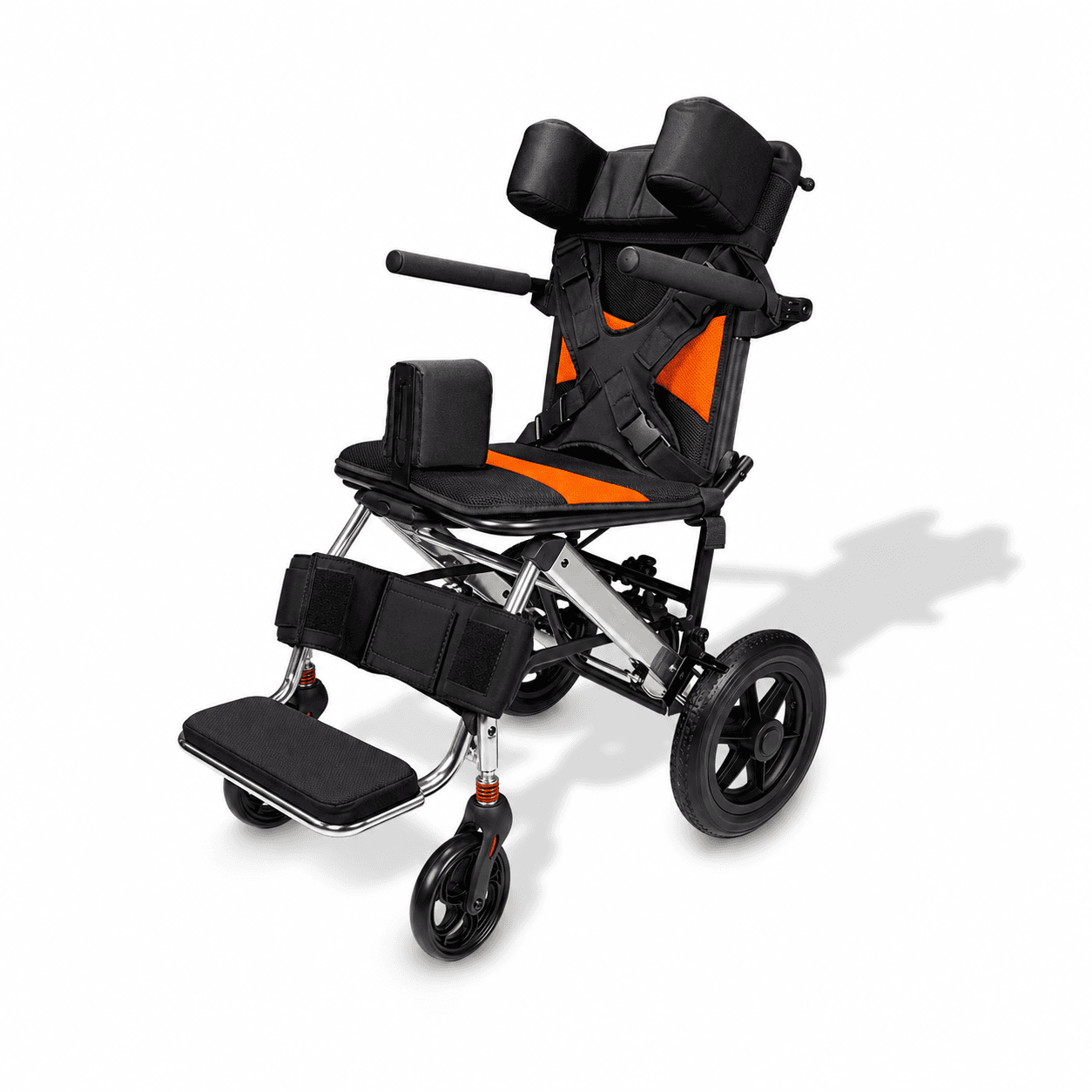
The Morecare EasyGo Lightweight CP Travel Wheelchair is designed for selected children who require caregiver-assisted mobility with additional head, trunk and lower-limb positioning support.
Its main advantage is combining a lightweight folding structure with rehabilitation-oriented seating features.
8 kg aluminium frame
The lightweight frame is intended to make carrying and storing the unoccupied wheelchair more manageable.
Umbrella folding mechanism
The chair folds using a rear lock-release arrangement, making it more convenient to transport when suitable vehicle space is available.
Adjustable contoured headrest
A removable, height-adjustable headrest provides additional positioning options.
Four-point butterfly chest harness
The padded harness helps provide upper-body positioning support according to the child's assessed needs.
Padded leg straps
Adjustable leg straps provide additional lower-limb positioning options.
Removable abduction support
The abductor may be used when appropriate for the child's leg positioning requirements.
Cushioned, adjustable footrest
Supports foot positioning and helps keep the feet away from moving wheels.
Caregiver braking system
Attendant hand brakes and rear parking locks support supervised wheelchair movement and stationary positioning.
Customization options
Alternative harness sizes, backrest height adjustments and selected additional positioning components can be discussed after fitting assessment.
EasyGo is generally intended for children aged 4–8 years, with customization considered for selected older children up to approximately 12 years.
Its standard seat width and depth are both 14 inches.
Although the published maximum user weight is 80 kg, this rating does not mean that every child below 80 kg will fit.
The child's pelvic width, seated thigh length, trunk height, head control and lower-limb positioning requirements must all be reviewed.
EasyGo is intended primarily for shorter supervised outings.
It does not provide the same comprehensive positional adjustment as a specialized tilt-in-space or long-duration adaptive wheelchair.
How Should Parents Choose the Right Travel Wheelchair?
Before purchasing a pediatric travel wheelchair, families should identify their child's actual mobility and seating needs.
A physiotherapist or occupational therapist can help assess whether a lightweight travel chair is suitable.
- What is the child's primary mobility requirement?
Determine whether the wheelchair will mainly be used for school journeys, therapy visits, family outings or prolonged daily seating.
- How much head and trunk support is needed?
Children with substantial postural instability may require more advanced seating than a lightweight travel wheelchair can provide.
- Does the child fit the seat correctly?
Measure the child's seated hip width, thigh length, trunk height and lower-leg length.
Age and body weight alone are insufficient for selecting a wheelchair.
- Does the child require tilt or recline?
Some children need regular positional changes or specialized postural support.
A tilt-in-space rehabilitation wheelchair may be more appropriate in these situations.
- Can caregivers transport the wheelchair safely?
Check the empty chair's weight, folding procedure, car boot dimensions and the caregiver's ability to lift the equipment.
- Is the intended travel environment accessible?
Review flooring, ramps, doorways, road conditions and other common routes.
- Is there a suitable plan for vehicle travel?
The child must use an appropriate vehicle restraint or seating arrangement. The wheelchair should be transported according to applicable safety guidance.
A travel wheelchair should be selected for the child's functional needs, not simply because it is easy to fold or available at an attractive price.
When correctly chosen, it may become a useful addition to the family's mobility routine.
Clinical References
World Health Organization. Wheelchair Provision Guidelines, 2023.
https://www.who.int/publications/i/item/9789240074521/
NICE. Cerebral Palsy in Under 25s: Assessment and Management (NG62).
https://www.nice.org.uk/guidance/ng62/chapter/Recommendations
Morecare Mobility & Rehabilitation Solutions. EasyGo Lightweight CP Travel Wheelchair — Product Specifications and Selection Guide.
https://morecare.in/easygo/
Medical Disclaimer: This article provides general pediatric rehabilitation and wheelchair-selection information. Individual wheelchair suitability, fitting, positioning and safe use should be assessed by qualified rehabilitation professionals. A travel wheelchair must not be used as a vehicle passenger restraint without specific approval for that purpose.