Why Can Sitting Difficulties Affect Play and Learning?
Sitting provides a position from which children can observe their surroundings, interact with objects and communicate with others.
During play, a child may need to turn their head, reach towards a toy or use both hands to manipulate an object.
These activities require coordination between the head, trunk, pelvis and upper limbs.
For children with cerebral palsy, impaired postural control can make this coordination difficult.
A child who constantly struggles to remain upright may have limited opportunity to use their hands for other activities.
For example, one hand may be occupied supporting the body while the other attempts to reach for a toy.
Some children may lose their seated position whenever they lift an arm or turn their head.
Appropriate external support may help establish a more stable position for selected activities.
However, play and learning are not dependent on independent sitting. Children can also participate through other suitable positions, adapted toys, communication aids and caregiver interaction.
The objective is to provide accessible opportunities rather than requiring every child to perform activities in the same way.
How Can Supported Sitting Help With Reaching and Hand Activities?
Reaching for objects requires more than movement of the arms.
The body must adjust its position as the arm moves forward, upward or sideways.
For a child with limited trunk control, these movements may be difficult while sitting without assistance.
A correctly fitted supportive seat may provide an external base of support, making it possible for some children to participate more effectively in hand activities.
Examples of suitable activities include:
Reaching for a brightly coloured toy.
Touching or activating a simple cause-and-effect toy.
Holding large, easy-to-grasp objects.
Turning the pages of a sturdy picture book with assistance.
Playing with large blocks or textured objects.
Using adapted switches or communication toys.
The activities should be selected according to the child's movement, vision, sensation and cognitive abilities.
A child does not need to perform every activity independently for the experience to be meaningful.
Caregiver assistance and adaptive equipment may remain necessary.
Supported seating should also allow appropriate movement. Excessively restrictive positioning may interfere with the very reaching activities it is intended to support.
Why Is Floor-Level Play Important for Children With Cerebral Palsy?
Many childhood activities naturally take place near floor level.
Children may play with blocks, interact with siblings or participate in games while sitting on a mat.
For a child who cannot maintain an unsupported floor-sitting position, joining these activities may require additional assistance.
A floor-level therapeutic seating system can provide an alternative position for selected children.
When appropriately fitted, it may allow the child to participate in activities at a similar height to other children.
This can create opportunities for:
Social interaction
Playing alongside siblings, responding to family members or participating in shared games.
Exploration
Looking at objects, touching different textures and interacting with suitable toys.
Communication
Using gestures, eye gaze, vocalizations, pictures or communication devices during activities.
Occupational therapy
Practising individualized functional tasks selected by a therapist.
However, floor-level positioning is not suitable for every child or every activity.
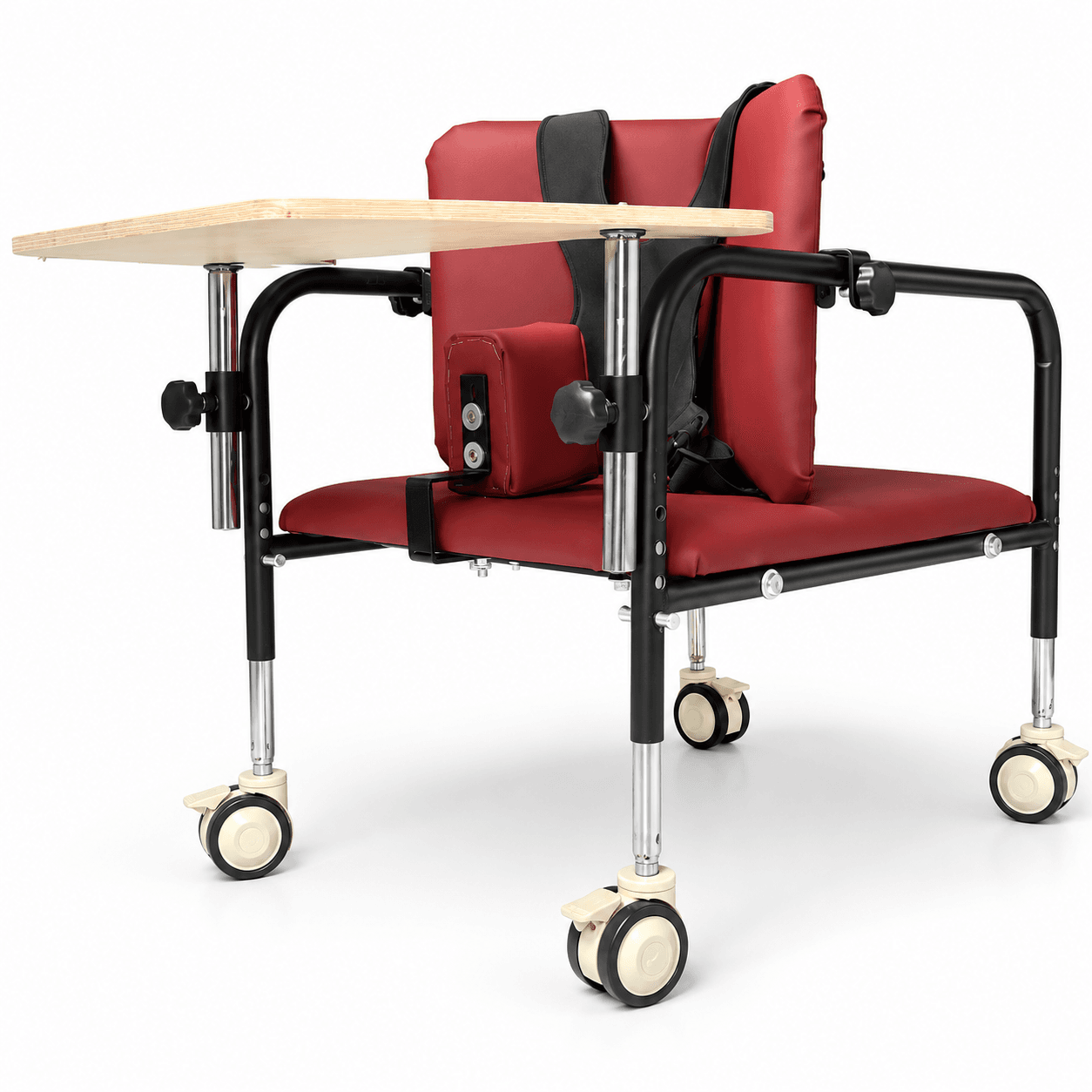
Some children may need an elevated adaptive chair, specialized head support or an adjustable activity surface.
The correct seating arrangement should be determined by the child's needs rather than assuming that floor seating is always preferable.
Five Supported Sitting Activities Parents Can Discuss With a Therapist
Parents can incorporate meaningful play into a child's daily routine, provided the activities and positioning have been reviewed by the rehabilitation team.
The following examples are general activity ideas rather than a prescribed exercise programme.
Activity 1: Reaching for a favourite toy
Place a suitable toy within the child's comfortable visual and reaching range.
Encourage participation without forcing the arm into movement.
A therapist can advise how to adapt the activity if the child has limited shoulder control or asymmetrical movement.
Activity 2: Playing with large building blocks
Offer lightweight, easy-to-handle blocks or similar objects.
The child may participate by touching, selecting, holding or releasing objects with assistance.
Activity 3: Picture-book interaction
Position a picture book where the child can comfortably see it.
Encourage looking, pointing, vocalizing or using an alternative communication method.
Activity 4: Cause-and-effect play
Use a large-button toy or adapted switch that responds to the child's movement.
This can provide an accessible way to participate even when fine finger control is limited.
Activity 5: Shared family play
Include the child in simple interactive activities with siblings or caregivers.
Use positioning and toys appropriate to the child's abilities and communication preferences.
For every activity, monitor comfort, fatigue, breathing and signs of distress.
Stop or modify an activity when the child becomes uncomfortable.
A qualified therapist should recommend appropriate seating duration, positioning adjustments and activity progression.
How Can Morecare Sunflower Support Floor-Based Activities?
Some children require external support around the trunk and pelvis to participate comfortably in seated play.
The Morecare Sunflower Therapy Corner Floor Seating System is designed for selected children who need additional positioning assistance while sitting near floor level.
Its three-sided corner structure provides padded support around the child's back and sides.
Several adjustable components can help tailor the seating arrangement.
Padded corner structure
Provides external support around the trunk during supervised seated activities.
Height-adjustable headrest
Offers additional head positioning assistance when required.
Four-point butterfly chest harness
Provides upper-body positioning support for children who need it, subject to professional fitting.
Pelvic positioning belt
Helps maintain the intended pelvic position while sitting.
Removable abductor
Allows additional lower-limb positioning when recommended by a therapist.
Customizable seating dimensions
Morecare offers customization of seat dimensions, backrest height, padding and selected positioning components.
Sunflower is generally recommended for children aged 2–7 years, subject to individual measurements and clinical suitability.
The system may be incorporated into appropriately supervised floor-based activities at home or in a therapy setting.
It does not automatically improve hand function, balance or cognitive development.
Children should not be left unattended in the seat, and its supports must never be used in a way that compromises comfort or breathing.
How Should Parents Choose Supportive Seating for Play and Learning?
Choosing supportive seating begins with understanding what the child needs to do while seated.
A physiotherapist or occupational therapist can assess the child's posture and functional abilities.
Important considerations include:
Head and trunk control
Determine how much assistance the child needs to maintain a suitable sitting position.
Pelvic and lower-limb positioning
Check whether the hips, pelvis and legs can be positioned comfortably without excessive pressure or forced alignment.
Upper-limb movement
Consider whether the seating arrangement permits the child to reach, handle objects or use communication devices.
Activity height
Floor-level seating may suit certain activities, while a height-adjustable chair or activity table may be more practical for others.
Comfort and tolerance
The child should be able to participate without pain, excessive fatigue or breathing difficulty.
Growth and adjustability
Review whether the equipment can accommodate the child's current measurements and future changes.
A supportive seat should be part of a broader rehabilitation and participation plan.
Children should have opportunities to use different positions, move actively when appropriate and take part in activities suited to their interests and abilities.
The objective is meaningful participation—not simply maintaining the same seated posture for long periods.