Why Can Daily School and Therapy Journeys Be Challenging?
Many children with cerebral palsy attend regular physiotherapy, occupational therapy, educational programmes or medical appointments.
These activities may take place at different locations and require frequent movement between home, transport vehicles and buildings.
For a child who uses a wheelchair, the journey may involve several separate tasks.
Preparing for the day
Caregivers may need to assist with dressing, personal care, seating and positioning.
Transferring into a vehicle
Some children require physical assistance or specialized transfer equipment when moving between the wheelchair and an appropriate vehicle seat.
Loading the wheelchair
The empty wheelchair may need to be folded, lifted and stored in the vehicle.
Reaching the destination
Parents may need to navigate parking areas, ramps, corridors and doorways.
Managing the return journey
The same activities must often be repeated after the child has spent several hours at school or participated in therapy.
For families using bulky rehabilitation wheelchairs, equipment handling can be particularly inconvenient.
However, the solution is not automatically to choose the lightest available chair.
The child's physical needs, caregiver abilities and accessibility of the daily route must be considered together.
A pediatric physiotherapist or occupational therapist can help families determine which mobility equipment and transfer arrangements are suitable.
How Can a Lightweight Folding Wheelchair Make Daily Travel More Practical?
For families who repeatedly transport mobility equipment, practical handling features can make a difference.
A wheelchair's weight, shape and folding mechanism influence how it can be transported and stored.
Lightweight construction
A lighter unoccupied wheelchair may be easier for some caregivers to lift into a car or move into storage.
However, even a lightweight chair can be difficult to manage if the caregiver has limited strength or the vehicle has a high loading point.
Folding mechanism
A foldable design can reduce the storage space required when the wheelchair is not in use.
Parents should understand how to operate the folding mechanism correctly and how to confirm that the frame is fully locked after unfolding.
Folded dimensions
The actual folded length, width and height matter when choosing equipment for a particular vehicle.
A chair described as compact may not fit every car.
Removable accessories
Headrests, trays and foot supports may affect the folding procedure or storage dimensions.
Parents should check whether accessories must be removed before folding.
Everyday durability
Frequent journeys place demands on the wheels, folding joints, brakes and seating components.
The wheelchair should be inspected regularly and maintained according to the manufacturer's instructions.
A lightweight travel wheelchair may be especially useful for selected children whose families already have a more comprehensive seating system but need a portable option for shorter journeys.
However, all transfers and lifting procedures must be carried out safely.
Never fold or lift a wheelchair with a child seated inside unless a specific manufacturer-approved procedure explicitly permits the intended activity.
What Seating Support Does a Child Need During School and Therapy Travel?
A wheelchair used for daily journeys must provide more than convenient transportation.
Children with cerebral palsy may need assistance maintaining a comfortable position because of muscle weakness, increased muscle tone, involuntary movement or reduced postural control.
The required support differs between children.
Head positioning
Some children can maintain their head position independently, while others benefit from an adjustable headrest.
A standard headrest may not be sufficient for children with substantial head-control limitations.
Trunk support
Children who repeatedly lean forward or sideways may require chest positioning support, lateral trunk supports or another individualized seating arrangement.
Pelvic positioning
The pelvis should be supported appropriately, taking into account the child's flexibility, sitting posture and seat dimensions.
Leg and foot support
Adjustable footrests and properly selected lower-limb positioning components may help the child maintain a comfortable seated posture.
Seating tolerance
The child should not experience excessive pressure, pain, skin irritation or breathing restrictions.
Support straps should not be tightened to force a child into an uncomfortable position.
A child who sits comfortably for a short journey may still need a different arrangement for an entire school day.
Therefore, families should distinguish between travel seating and specialized classroom seating.
A school occupational therapist or treating rehabilitation professional may recommend a separate activity chair or wheelchair configuration for prolonged classroom participation.
What Should Schools and Therapy Centres Prepare for Wheelchair Users?
The wheelchair is only one part of an accessible school or rehabilitation environment.
Even a compact wheelchair may be difficult to use if the building has narrow entrances, unsuitable flooring or insufficient transfer space.
Before beginning a new school routine or visiting a therapy centre, parents should discuss practical arrangements with staff.
Accessible entrances
Check whether suitable ramps, lifts or level entrances are available.
Classroom access
Confirm that the wheelchair can move through the necessary doorways and pathways.
Seating arrangements
Determine whether the child can use the travel wheelchair for the intended activity or requires a specialized classroom chair.
Toileting and changing facilities
Check whether appropriate space, equipment and trained assistance are available.
Caregiver or staff assistance
Clarify who will assist with transfers, positioning and mobility during the day.
Emergency arrangements
The school should have an individualized plan for evacuation and other situations requiring prompt assistance.
Therapy appointments
Ask whether the rehabilitation facility provides appropriate treatment surfaces, transfer equipment and space for the wheelchair.
Parents should communicate the child's support requirements clearly, including any important positioning instructions.
Where possible, the child's therapist, school and family should work together to establish a practical routine.
A wheelchair should support participation, not become the sole means of managing the child's educational or rehabilitation needs.
How Does Morecare EasyGo Support Frequent Short-Distance Travel?
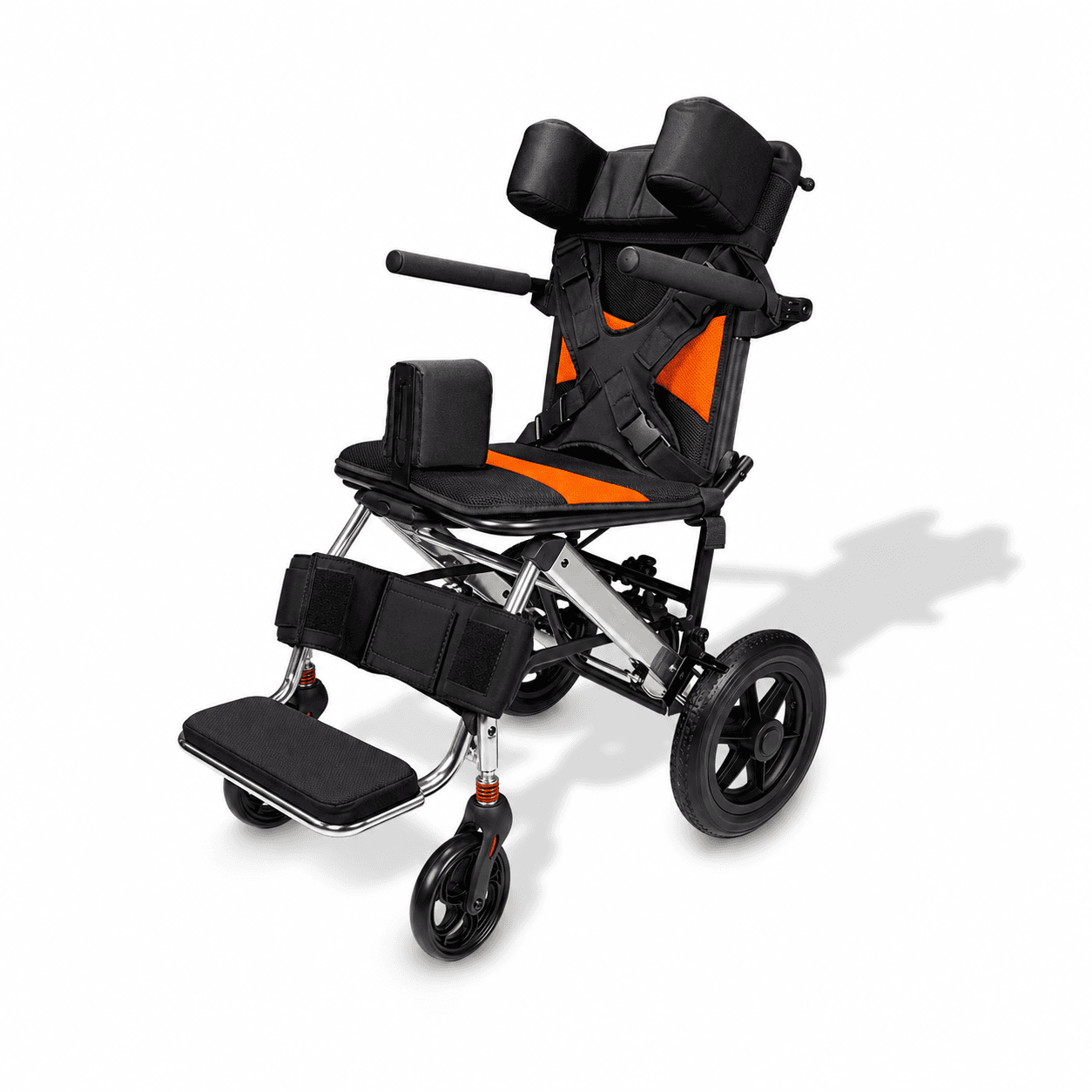
The Morecare EasyGo Lightweight CP Travel Wheelchair is designed for selected children who need caregiver-assisted mobility with additional positioning support during shorter outings.
Its travel-oriented design may be useful for appropriate school commutes, physiotherapy appointments and hospital visits.
Approximately 8 kg aluminium frame
The lightweight frame may make handling and carrying the empty wheelchair more manageable than heavier alternatives.
Umbrella-folding design
The rear lock-release folding mechanism allows the wheelchair to fold for transport and storage.
Adjustable contoured headrest
The headrest provides an additional positioning option for selected children who require head support.
Four-point butterfly chest harness
The padded harness helps maintain the intended upper-body position when correctly fitted.
Padded leg straps
These provide additional lower-limb positioning options according to the child's assessed needs.
Removable abduction support
May be used for selected children when appropriate for their hip mobility and seated position.
Adjustable cushioned footrest
Supports the feet during caregiver-assisted mobility.
Attendant brakes and rear wheel locks
These features provide caregiver control during approved wheelchair movement and stationary use.
EasyGo has a standard seat measuring approximately 14 inches wide and 14 inches deep.
It is generally recommended for children aged 4–8 years, with customization considered for selected older children up to approximately 12 years.
Its published maximum user weight is 80 kg, but seating measurements and individual postural requirements are essential when establishing suitability.
EasyGo is primarily a travel-focused wheelchair.
It does not offer the same tilt-in-space, recline or extensive positioning adjustments as a comprehensive adaptive wheelchair.
Therefore, families should not assume that it can replace a child's prescribed full-day classroom seating system.
The wheelchair is also not automatically approved for use as an occupied vehicle passenger seat.
A suitable child vehicle restraint or professionally assessed transport system is required during car journeys.
How Can Parents Build a More Manageable School and Therapy Routine?
A consistent routine can help families identify problems before they disrupt the journey.
The following steps may be useful.
Step 1: Review the child's seating requirements
Ask the treating therapist whether the selected travel wheelchair provides sufficient support for the intended journey.
Step 2: Check the daily travel route
Consider the distance between home, vehicle parking and the school or therapy centre.
Identify ramps, narrow passages, uneven ground and other accessibility concerns.
Step 3: Confirm the vehicle arrangement
Ensure the child has an appropriate approved in-car restraint or seating arrangement.
Check how the unoccupied wheelchair will be folded and secured during transport.
Step 4: Establish safe transfer procedures
Caregivers and relevant school staff should understand how the child can be transferred safely.
Do not improvise lifting methods or pull the child using wheelchair harnesses.
Step 5: Coordinate with teachers and therapists
Clarify whether the child needs different seating equipment during therapy or classroom activities.
Discuss comfort, communication, fatigue and personal care requirements.
Step 6: Inspect the wheelchair regularly
Check the brakes, wheels, folding locks, harnesses and foot supports.
Report damage or changes in equipment operation before continuing use.
Step 7: Review the routine as the child grows
A child's body measurements, posture and functional abilities can change.
A wheelchair that was previously suitable may eventually require adjustment or replacement.
The objective is to build a routine that supports the child's participation without creating avoidable physical demands or safety risks.
For some families, a portable travel wheelchair will be useful alongside a more supportive everyday seating system.
Clinical References
World Health Organization. Wheelchair Provision Guidelines, 2023.
https://www.who.int/publications/i/item/9789240074521
NICE. Cerebral Palsy in Under 25s: Assessment and Management (NG62).
https://www.nice.org.uk/guidance/ng62/chapter/Recommendations
Morecare Mobility & Rehabilitation Solutions. EasyGo Lightweight CP Travel Wheelchair.
https://morecare.in/easygo/
Morecare Mobility & Rehabilitation Solutions. Blueflax Tilt & Recline CP Wheelchair.
https://morecare.in/blueflax/
Medical Disclaimer: This article provides general educational information about pediatric mobility, wheelchair selection and school travel. Appropriate seating, transfers and equipment use require individual assessment by qualified rehabilitation professionals. Follow the manufacturer's instructions and applicable vehicle passenger safety requirements.