Why Do Some Children With Cerebral Palsy Have Poor Head and Trunk Control?
Maintaining an upright seated position requires coordinated activity between the muscles of the head, neck, trunk and pelvis.
When a child sits in a wheelchair, the body must continuously respond to small movements and changes in position.
Cerebral palsy can affect this coordination.
Some children have muscle weakness or reduced postural control. Others experience spasticity, dystonia or involuntary movements that make maintaining a consistent position difficult.
Parents may notice that their child:
Frequently leans their head forward or sideways.
Struggles to maintain an upright trunk position.
Falls towards one side while sitting.
Slides forward in the wheelchair seat.
Becomes tired from maintaining posture.
Needs frequent physical repositioning.
Has difficulty keeping their hands available for activities because they are trying to maintain balance.
These difficulties vary from child to child.
For example, one child may have adequate head control when well supported through the trunk but struggle when the pelvis slides forward.
Another may have significant neck-control limitations even when the trunk is supported.
A pediatric physiotherapist or occupational therapist should assess these problems before recommending equipment.
The child's diagnosis or GMFCS level alone does not determine the exact seating support required.
Why Is Pelvic and Trunk Positioning Important for Head Support?
Parents often focus on the headrest when their child's head repeatedly falls forward or sideways.
However, head control is closely connected to the position of the trunk and pelvis.
The pelvis forms the foundation of sitting posture.
When the pelvis slides forward or tilts excessively, the trunk may become rounded or unstable.
This can make maintaining a comfortable head position more difficult.
Likewise, if the child consistently leans sideways, simply adding a headrest may not address the underlying seating difficulty.
A comprehensive assessment may consider:
Seat width and depth
The seat should accommodate the child's body without creating excessive space or pressure.
Pelvic positioning
The pelvis should be supported in an appropriate position according to the child's flexibility and postural requirements.
Trunk stability
Additional lateral support, a chest harness or specialized seating components may be required.
Head positioning
The headrest should be positioned according to the child's neck control, trunk alignment and comfort.
Lower-limb support
Foot and leg positioning can contribute to the overall seated posture.
The objective is not to force the child into a rigid or perfectly straight position.
Some children have flexible postural difficulties, while others have fixed musculoskeletal limitations.
Supports should accommodate the child's assessed needs without creating pain, excessive pressure or breathing restrictions.
A headrest should not be used to push the head into an uncomfortable position.
What Should Parents Look for in a Wheelchair With Head and Trunk Support?
Not every wheelchair with a headrest provides the same level of support.
Parents should examine how the seating components work together.
Adjustable headrest
The headrest should be positioned appropriately for the child's height and movement requirements.
Depending on the child's abilities, a standard contoured headrest may be sufficient, or specialized lateral head support may be necessary.
Trunk positioning supports
A chest harness or adjustable trunk supports may provide additional assistance when the child cannot maintain a stable upper-body position.
Suitable pelvic positioning
The seat and approved positioning components should help maintain the intended pelvic alignment.
Foot and lower-limb support
Correct lower-limb positioning can be important for comfort and overall posture.
Appropriate seat dimensions
The child's body measurements should determine whether the wheelchair fits.
Seating adjustability
Some children require changes in seat orientation, backrest angle or tilt to manage their positioning needs.
Caregiver control
Brakes, accessible handles and suitable wheel configuration are important for safe assisted mobility.
A lightweight travel wheelchair may provide some of these features while remaining portable.
However, a child who needs extensive positioning adjustments, specialized head support or frequent posture changes may require a different rehabilitation wheelchair.
Equipment should be selected according to the required level of assistance rather than the number of accessories advertised.
When Is a Lightweight Travel Wheelchair Not Enough?
A lightweight travel wheelchair can be useful for selected children, but portability should not override the child's seating requirements.
Some children need more comprehensive support than a compact folding wheelchair can provide.
A reassessment may be necessary when:
The head repeatedly falls outside the available support
A standard headrest may not provide adequate assistance for significant head or neck instability.
The child leans strongly to one side
Additional lateral trunk support or a customized seating arrangement may be necessary.
The child cannot maintain a comfortable pelvic position
Persistent sliding or pelvic asymmetry may require specialized positioning components.
The child has significant involuntary movements
The seating system may need to accommodate changing muscle activity and movement patterns.
The child requires frequent positional changes
Tilt-in-space or recline may be clinically appropriate for some children.
The child experiences pressure-related discomfort
More comprehensive cushioning, postural management or pressure redistribution may be required.
The child needs specialized seating throughout the day
A travel-focused wheelchair may not offer the adjustments needed for prolonged everyday use.
In these circumstances, parents should discuss more comprehensive seating options with a rehabilitation professional.
For example, the Morecare Blueflax Tilt & Recline CP Wheelchair offers tilt-in-space and backrest recline alongside additional positioning options.
However, Blueflax also requires individualized fitting and should not automatically be considered suitable for every child with severe postural limitations.
The correct choice depends on the child's actual abilities and medical needs.
How Does Morecare EasyGo Provide Head and Trunk Support?
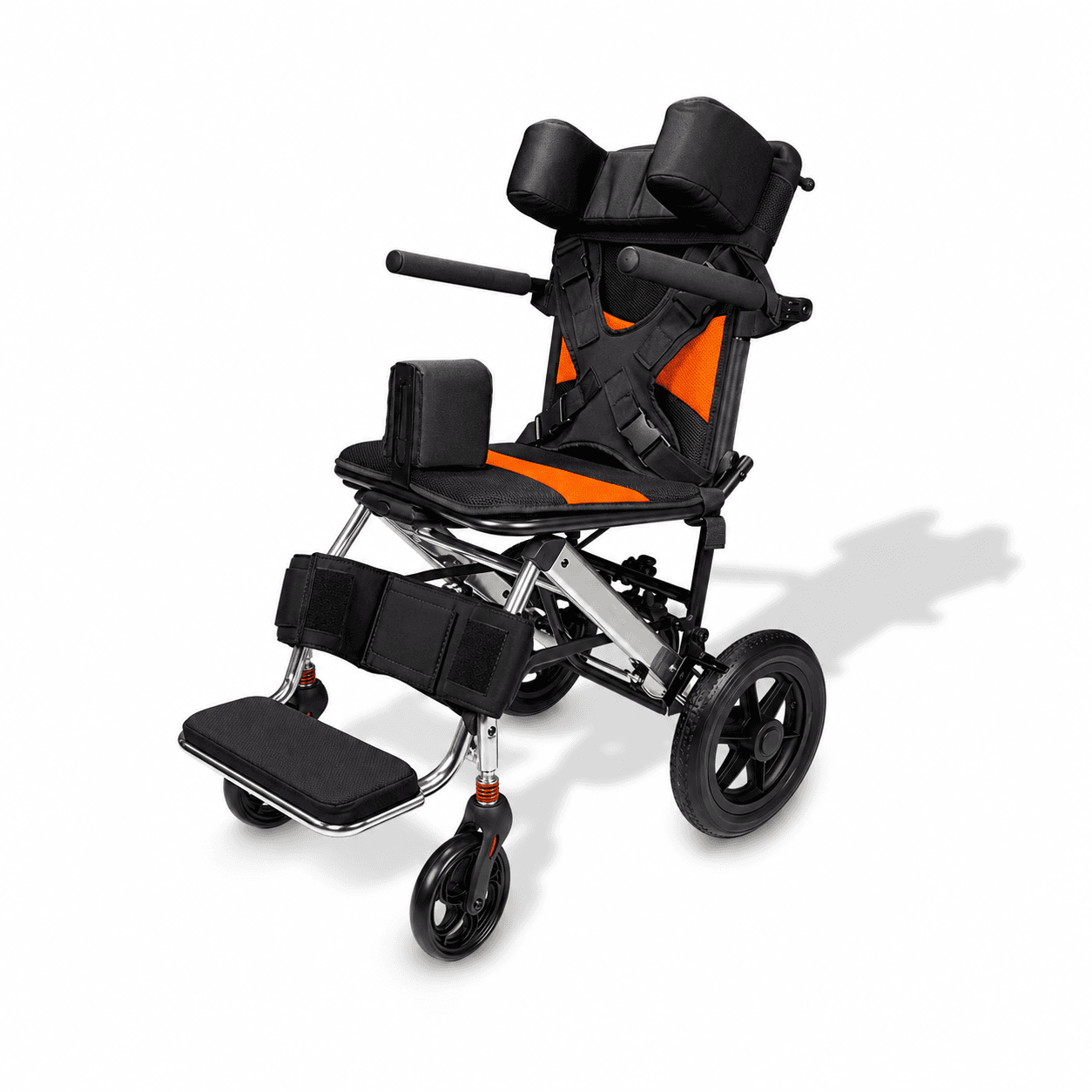
The Morecare EasyGo Lightweight CP Travel Wheelchair is designed for selected children who require portable, caregiver-assisted mobility with additional positioning support.
Its main features include:
Adjustable contoured headrest
The headrest is height-adjustable and removable. It provides an additional head-positioning option when the child's needs can be accommodated by its configuration.
Four-point butterfly chest harness
The padded harness provides upper-body positioning assistance when correctly fitted and adjusted.
Cushioned seating surface
The foam-cushioned seat provides a supported sitting surface, subject to appropriate body measurements and positioning.
Adjustable padded leg straps
These provide additional options for maintaining the intended lower-limb position.
Removable abduction support
The abduction component may be used when recommended for the child's specific positioning needs.
Adjustable cushioned footrest
This helps support the feet during caregiver-assisted mobility.
Lightweight aluminium frame
The approximately 8 kg frame is designed for easier handling and transportation when unoccupied.
Umbrella folding mechanism
Allows the empty wheelchair to fold for travel and storage.
EasyGo's standard seating dimensions include:
Seat width: 14 inches.
Seat depth: 14 inches.
Backrest height: 16 inches.
Seat height: 18 inches.
It is generally recommended for children aged 4–8 years, with customization considered for selected older children up to approximately 12 years.
The published maximum user weight is 80 kg, but this does not establish that the seating dimensions will fit every child below that weight.
EasyGo may be appropriate for selected children who need additional positioning during shorter supervised outings.
However, the standard headrest and butterfly harness may not provide enough support for children with severe head and trunk instability.
The product should not be represented as equivalent to a tilt-in-space wheelchair or a comprehensive seating system.
How Can Parents Decide Whether EasyGo Provides Enough Support?
Before choosing a travel wheelchair, parents should review the child's seating needs with a pediatric physiotherapist or occupational therapist.
The assessment should consider several important questions.
- Can the child maintain their head position with appropriate support?
Determine whether a standard adjustable headrest is sufficient or specialized support is required.
- Does the child lean forward or sideways?
Evaluate the direction and severity of trunk instability and whether additional lateral positioning is needed.
- Can the pelvis be positioned comfortably?
Check for sliding, asymmetry, restricted joint movement or discomfort.
- Does the child require tilt-in-space or recline?
Some children need more extensive positional adjustments than a lightweight travel wheelchair provides.
- Will the chair primarily be used for travel?
EasyGo may be considered for shorter journeys, therapy appointments and family outings rather than prolonged specialized seating.
- Do the child's measurements match the chair?
Seat width, depth, back height, headrest position and lower-leg length must be checked.
- Can the caregiver use the chair safely?
Review braking, folding, transfers, supervision and any additional positioning instructions.
For children with substantial head-control difficulties, an in-person seating assessment may be especially important.
Photographs or video consultations can help with preliminary screening but may not reveal every issue involving tone, joint restrictions, pressure or dynamic movement.
The objective is to choose a wheelchair that supports appropriate posture and participation without compromising comfort or safety.
Clinical References
World Health Organization. Wheelchair Provision Guidelines, 2023.
https://www.who.int/publications/i/item/9789240074521
NICE. Cerebral Palsy in Under 25s: Assessment and Management (NG62).
https://www.nice.org.uk/guidance/ng62/chapter/Recommendations
Morecare Mobility & Rehabilitation Solutions. EasyGo Lightweight Pediatric Travel Wheelchair.
https://morecare.in/easygo/
Morecare Mobility & Rehabilitation Solutions. Blueflax Tilt-in-Space CP Wheelchair Cum Stroller.
https://morecare.in/blueflax/
Medical Disclaimer: This article provides general pediatric rehabilitation and wheelchair-selection information. The suitability of seating, positioning supports and wheelchair features must be determined through individualized assessment by qualified rehabilitation professionals. Support devices should be fitted and used according to the manufacturer's approved instructions.