Why Does Travelling With a Child With Cerebral Palsy Require Extra Planning?
Cerebral palsy affects movement and posture in different ways.
Some children can walk short distances with assistance, while others depend on a wheelchair for mobility.
Children may also experience difficulties involving head control, trunk stability, muscle tone, fatigue, pain or communication.
These needs can influence how the family prepares for travel.
For example, a child who cannot maintain sitting balance may need careful positioning during a hospital visit.
Another child may tolerate sitting well but require significant physical assistance when moving between a wheelchair and a car seat.
Parents often need to plan several activities before the journey begins:
Preparing the child for travel.
Transferring into an appropriate vehicle seat.
Loading and securing mobility equipment.
Managing the child's personal care needs.
Checking wheelchair access at the destination.
Planning rest and repositioning opportunities.
Arranging help when the caregiver cannot safely manage alone.
The goal is not to create a complicated routine for every outing.
It is to identify which arrangements the child and caregiver actually need.
A pediatric physiotherapist or occupational therapist can help families plan safe mobility, transfers and positioning according to the child's abilities.
How Should Parents Prepare Their Child and Wheelchair Before Leaving Home?
A useful travel routine begins before the wheelchair is folded or the car is loaded.
Check the child's seating needs
Make sure the wheelchair remains appropriately fitted and provides the support the child requires for the intended outing.
Inspect the wheelchair
Check the wheels, folding locks, brakes, footrest and any removable positioning components.
Review the head and trunk supports
Confirm that the approved headrest and harness are correctly adjusted.
Check leg and foot positioning
Ensure the child's feet can be safely supported and that no straps create uncomfortable pressure.
Prepare essential belongings
Depending on the child's needs, parents may require water, prescribed medication, personal care supplies, spare clothing or other items recommended by the healthcare team.
Plan for weather
Consider heat, rain, sun exposure and the child's ability to regulate temperature and communicate discomfort.
Confirm caregiver assistance
A second trained caregiver may be required for transfers or other activities, depending on the individual handling assessment.
Families should also consider the expected duration of the outing.
A wheelchair intended primarily for travel may not be appropriate for prolonged continuous seating without a suitable positioning and pressure-management plan.
If the child becomes uncomfortable, shows signs of pain or cannot maintain an appropriate position, caregivers should reassess the situation rather than simply tightening the harness.
How Can Parents Safely Travel by Car With a Wheelchair?
Car journeys involve two separate considerations:
How the child is safely seated and restrained inside the moving vehicle.
How the wheelchair is transported when not in use.
These should never be treated as the same problem.
Safe seating for the child
A pediatric travel wheelchair is not automatically an approved car seat.
The child should travel in an appropriate vehicle seating and restraint arrangement that meets the relevant safety requirements and accommodates their individual needs.
Some children may require a specialized child restraint or another professionally assessed transport arrangement.
An ordinary wheelchair positioning harness should not be used as a substitute for a vehicle seat belt or approved child restraint.
Safe wheelchair storage
After the child has been transferred out, the empty wheelchair can be folded according to the manufacturer's instructions.
The chair should then be placed securely in a suitable storage area.
Caregivers should avoid leaving heavy or unsecured equipment where it could move during sudden braking or a collision.
Checking car compatibility
Before purchasing a folding wheelchair, parents should measure:
The car boot opening.
Available boot width, height and depth.
The height at which the wheelchair must be lifted.
Space needed for other essential equipment.
The Morecare EasyGo has an umbrella-folding design intended to make transporting the empty wheelchair more practical.
However, its exact folded dimensions should be confirmed before promising compatibility with any particular car.
Safe transfers
Moving the child between the wheelchair and the vehicle seat may require specific transfer techniques.
The correct method depends on the child's ability to participate, weight, muscle tone, joint movement and caregiver capacity.
Parents should obtain practical training from an appropriate rehabilitation professional rather than lifting or pulling the child using wheelchair straps.
If a suitable safe transfer cannot be performed, the family may need specialized vehicle equipment or assistance.
What Should Families Check at the Destination?
A successful outing depends on more than getting the wheelchair into the car.
The destination should also be reasonably accessible for the child and caregiver.
Hospital and therapy appointments
Before travelling, check whether the facility has accessible entrances, lifts, ramps and sufficient waiting-area space.
Allow additional time for transfers and movement between departments.
School visits
Consider the route from the vehicle drop-off point to the classroom.
Check doorway widths, ramps, toilet access and whether trained staff can provide the assistance the child requires.
A lightweight travel wheelchair may be convenient for journeys, but the child may need a different seating system for prolonged classroom activities.
Shopping and family outings
Choose venues with accessible pathways and adequate turning space.
Avoid relying on routes that require lifting the occupied wheelchair over stairs or other obstacles.
Outdoor environments
Check whether the pathway is smooth and stable.
Small-wheel travel wheelchairs may not perform adequately on loose gravel, sand, broken roads or difficult terrain.
Families should also identify suitable locations for rest, personal care and repositioning.
When possible, contact the destination before leaving to clarify accessibility arrangements.
Practical preparation can help reduce interruptions and make outings more enjoyable for the child and family.
How Can Morecare EasyGo Help During Everyday Travel?
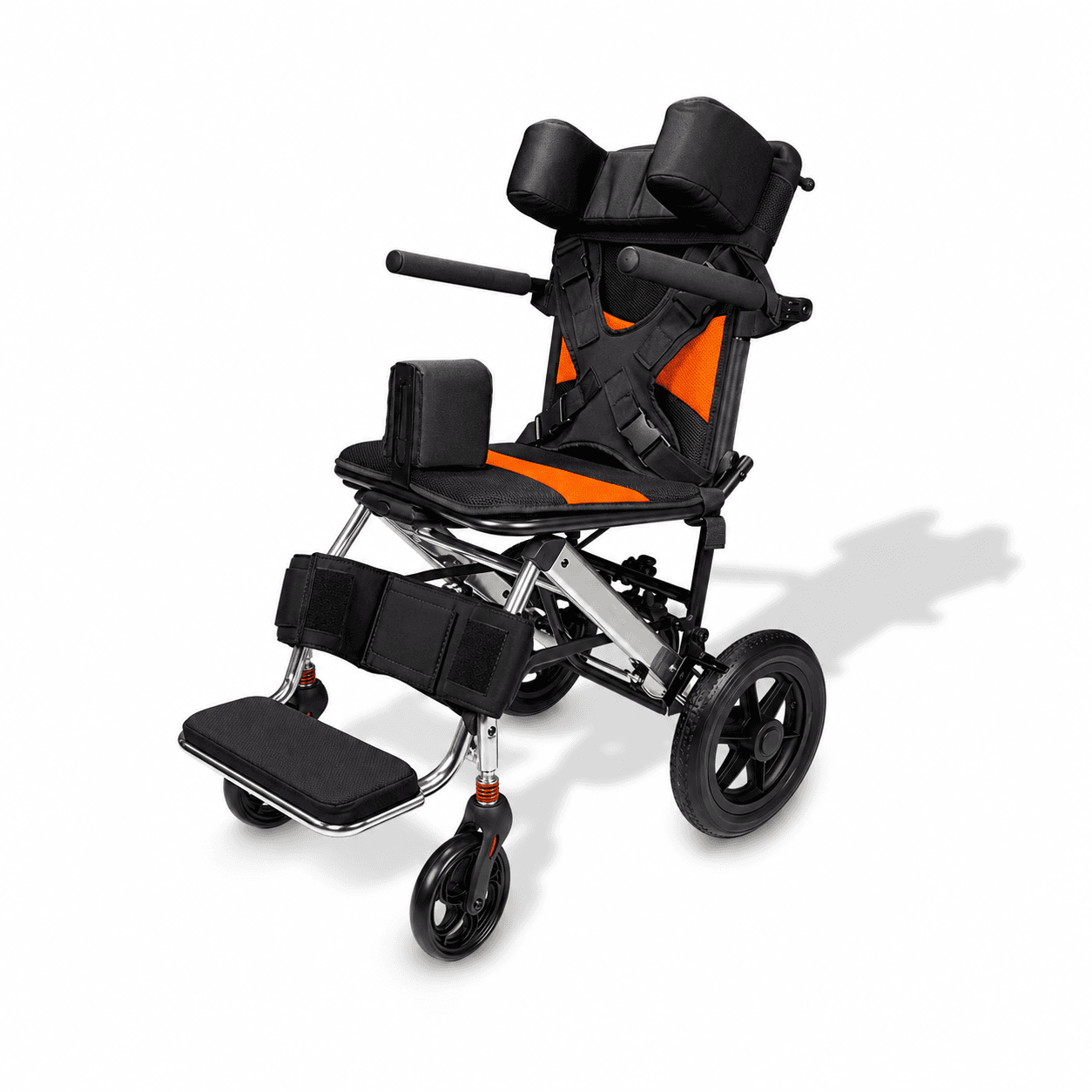
The Morecare EasyGo Lightweight CP Travel Wheelchair is designed for selected children who need caregiver-assisted mobility during shorter outings.
It combines a portable folding structure with additional seating and positioning features.
Approximately 8 kg aluminium frame
The lightweight frame may make lifting and handling the unoccupied wheelchair more manageable than heavier alternatives.
Umbrella-folding mechanism
The rear lock-release mechanism allows the empty chair to fold for transportation and storage.
Adjustable contoured headrest
Provides additional head-positioning options for children whose support needs can be accommodated by its configuration.
Four-point butterfly chest harness
Offers upper-body positioning assistance when correctly fitted.
Padded leg-positioning straps
Provide additional options for maintaining an assessed lower-limb position.
Removable abduction support
May help selected children maintain a suitable thigh position when recommended by a therapist.
Adjustable cushioned footrest
Provides support for the feet during caregiver-assisted mobility.
Attendant hand brakes and rear parking locks
Help caregivers control movement and secure the wheelchair during approved stationary activities.
The standard EasyGo seat measures approximately 14 inches wide and 14 inches deep.
The product is generally recommended for children aged 4–8 years, with selected customization options for older children.
Although the published maximum user weight is 80 kg, suitability depends on the child's body dimensions, positioning needs and the equipment's approved configuration.
EasyGo may be useful for appropriate family outings, therapy appointments, school journeys and hospital visits.
However, it is not designed to replace a certified vehicle child restraint.
It also does not provide the same extensive positional adjustment as a tilt-in-space or reclining rehabilitation wheelchair.
Children requiring complex postural support or specialized long-duration seating may need a more comprehensive mobility system.
What Should Be on a Parent's Travel Checklist?
Before leaving home, families can use the following checklist and adapt it to their child's individual needs.
Child and seating preparation
The child's wheelchair fit and support needs have been assessed.
Head, trunk, pelvic and lower-limb positioning are appropriate.
The child is comfortable, without visible pressure or distress.
Required personal care supplies and prescribed medical items are ready.
Wheelchair preparation
Wheels and brakes have been checked.
Folding locks and accessories are secure.
The approved folding procedure is understood.
The empty wheelchair can be handled safely by the caregiver.
Car and transfer preparation
An appropriate vehicle seating and restraint arrangement is available.
The child's transfer method has been assessed.
Required caregiver assistance is available.
The wheelchair can be secured safely during transport.
The car boot has enough usable space for the equipment.
Destination planning
Accessible entrances and pathways have been checked.
Toileting and changing arrangements are suitable.
Rest and repositioning opportunities are available.
The route is appropriate for the wheelchair's wheels and approved surfaces.
A plan is available if the child becomes uncomfortable or the outing needs to end early.
Families do not need to purchase the most complicated wheelchair to manage every journey.
They need equipment and a travel routine that are appropriate for their child's mobility, positioning and safety requirements.
For some children, a lightweight folding wheelchair may be a useful travel solution alongside another seating system used at home or school.
Clinical and Safety References
World Health Organization. Wheelchair Provision Guidelines, 2023.
https://www.who.int/publications/i/item/9789240074521
NICE. Cerebral Palsy in Under 25s: Assessment and Management (NG62).
https://www.nice.org.uk/guidance/ng62/chapter/Recommendations
U.S. National Highway Traffic Safety Administration. Child Passenger Safety and Transportation Considerations for Children With Special Healthcare Needs.
https://www.nhtsa.gov/sites/nhtsa.gov/files/2023-10/CT_FY24HSP-tag.pdf
Morecare Mobility & Rehabilitation Solutions. EasyGo Lightweight CP Travel Wheelchair.
https://morecare.in/easygo/
Medical Disclaimer: This guide provides general information about mobility equipment and travelling with children who have cerebral palsy. Individual transfer methods, seating arrangements and vehicle restraint systems should be assessed by qualified professionals. Follow applicable vehicle safety requirements and the manufacturer's approved wheelchair instructions.