Why Might a Regular Baby Stroller Become Unsuitable?
Most ordinary baby strollers are designed for general child transportation.
They commonly include a seat, backrest, safety harness and folding frame.
For many children, these features provide suitable support within the stroller's approved age, size and weight limits.
However, children with cerebral palsy can have different physical requirements.
Some experience impaired muscle coordination, low muscle tone, spasticity or involuntary movements that affect their ability to maintain an appropriate seated position.
As the child grows, these difficulties may become more noticeable.
For example, parents may observe:
The child's head repeatedly leaning to one side.
The trunk collapsing forward or sideways.
The pelvis sliding towards the front of the seat.
The child's legs crossing or moving out of position.
Difficulty maintaining comfortable foot placement.
Fatigue or discomfort during outings.
These signs do not automatically mean every conventional stroller is unsuitable.
Some children with mild mobility limitations may use an appropriately fitted ordinary stroller.
The concern arises when the stroller's dimensions or support arrangement no longer meets the child's individual needs.
A pediatric physiotherapist or occupational therapist can help determine whether the current stroller requires adjustment or replacement.
Five Signs Your Child May Need More Supportive Seating
Parents should observe how their child sits during ordinary outings rather than evaluating the stroller solely by its appearance.
- Frequent sideways leaning
The child repeatedly falls towards one side and cannot comfortably maintain their trunk position.
This may indicate that the current seat provides insufficient lateral support.
- Difficulty maintaining head position
The child's head falls forward, sideways or backwards during sitting.
An adjustable headrest may help selected children, although severe head-control difficulties can require more comprehensive positioning.
- Sliding forward in the seat
The child's pelvis moves forward, changing the seated posture.
The seating system may need reassessment of seat depth, pelvic support, trunk alignment and other positioning factors.
- Legs or feet moving out of position
Some children with spasticity or impaired movement control have difficulty keeping their lower limbs comfortably positioned.
A suitable seating arrangement may need additional footrests, leg supports or individually prescribed positioning components.
- Increasing discomfort during travel
The child may show signs of fatigue, pressure, irritation or difficulty maintaining a suitable position.
Discomfort should not simply be managed by tightening straps or adding more pillows.
A therapist should assess the underlying cause and determine whether a different seating configuration is needed.
How Is an Adaptive CP Stroller Different From a Regular Stroller?
Adaptive strollers and pediatric travel wheelchairs are designed for children who need mobility assistance and, in some models, additional positioning components.
Their features vary significantly.
A regular stroller may offer standard seating adjustments and restraint straps.
An adaptive travel wheelchair may provide more individualized positioning options.
Head support
Selected adaptive chairs include adjustable headrests to help accommodate children with reduced head control.
Trunk support
A padded chest harness or other positioning components may help maintain an appropriate upper-body position.
Pelvic positioning
Some adaptive systems include pelvic belts or specialized seating components to assist alignment.
Lower-limb positioning
Footrests, leg straps and other accessories may help maintain an appropriate leg and foot position.
Customization
Certain models allow adjustments to harness size, backrest height or other seating dimensions.
However, not every adaptive stroller provides comprehensive postural support.
Some lightweight travel models prioritize portability, while more specialized rehabilitation wheelchairs offer tilt-in-space, recline or extensive positioning adjustments.
The term "special needs stroller" should therefore not be treated as proof that the product is suitable for every child with cerebral palsy.
Individual assessment and correct fitting remain essential.
Why Should Parents Avoid Improvised Seating Modifications?
When a stroller does not provide enough support, families may try adding cushions, rolled towels, pillows or extra straps.
Although positioning aids may be used in professionally designed seating plans, improvised modifications can create safety problems.
For example, added cushions may change the child's seated position or affect the function of the original harness.
Unapproved straps may create pressure around the chest or abdomen.
Poorly positioned supports may also push the child into an uncomfortable position or interfere with breathing.
Parents should avoid:
Using improvised chest restraints.
Tightening harnesses excessively to prevent leaning.
Forcing the legs apart or into a fixed position.
Altering stroller frames or folding mechanisms.
Adding unsupported headrests.
Ignoring pressure, discomfort or breathing changes.
Some children require a structured seating assessment rather than a simple accessory.
A rehabilitation professional can determine whether adjustments to the existing stroller are appropriate or whether the child needs specialized seating.
If the child has complex postural asymmetry, hip problems, spinal deformity or substantial loss of head control, a more comprehensive adaptive wheelchair may be required.
The aim is to provide appropriate positioning, not simply to make the child appear upright.
How Does Morecare EasyGo Address Common Travel Seating Needs?
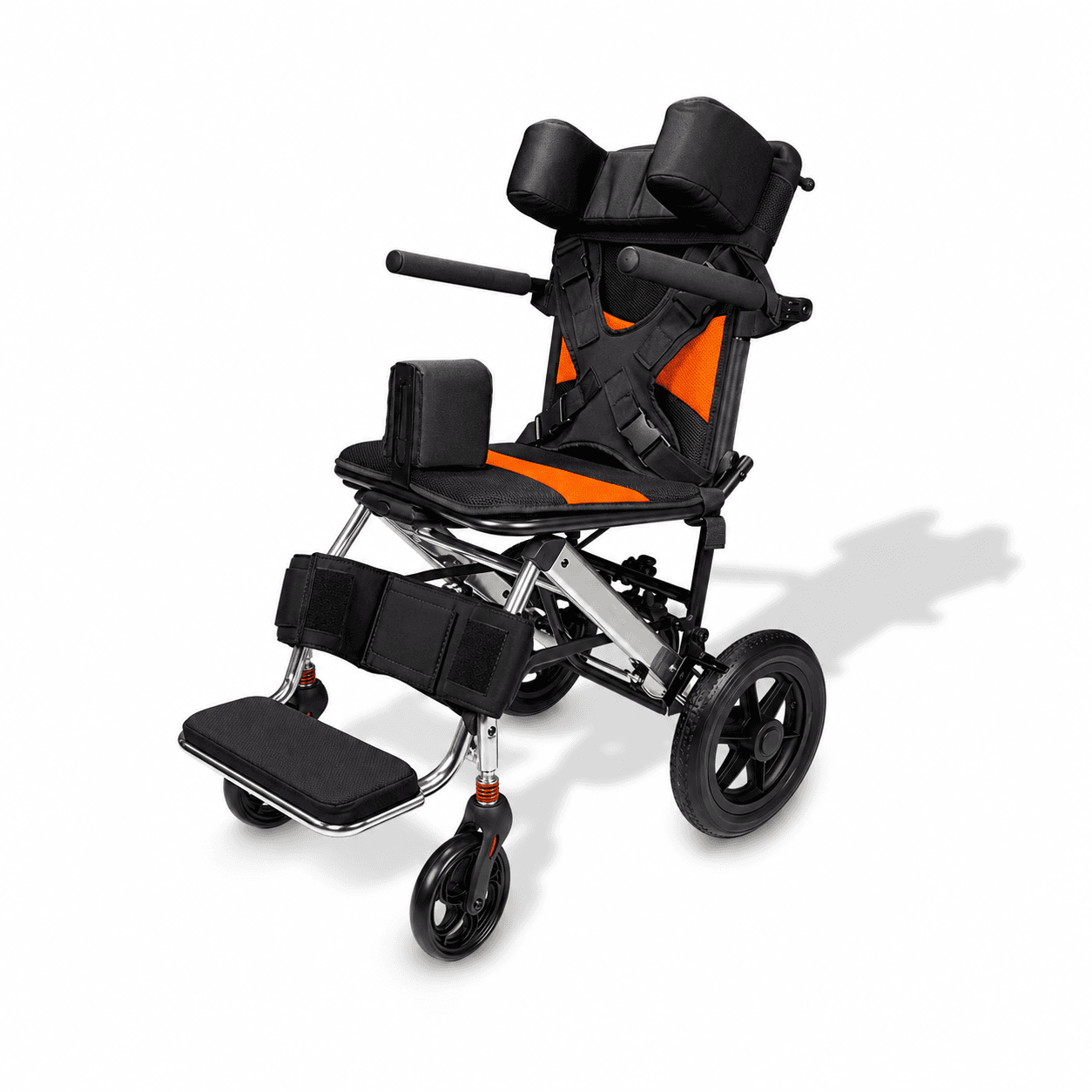
The Morecare EasyGo Lightweight CP Travel Wheelchair is designed for selected children who need caregiver-assisted mobility with additional head, trunk and lower-limb positioning support.
Its construction combines a lightweight folding frame with several pediatric seating features.
8 kg aluminium frame
The lightweight frame may make handling and carrying the empty wheelchair easier during travel.
Umbrella folding mechanism
The rear lock-release folding design supports compact storage and transportation, subject to actual vehicle space.
Adjustable contoured headrest
The removable, height-adjustable headrest provides additional positioning options.
Four-point butterfly chest harness
The padded harness can help maintain the intended upper-body position when correctly fitted.
Adjustable leg straps
Padded straps provide additional options for lower-limb positioning.
Removable abduction support
This component may be used when appropriate for the child's assessed leg-positioning requirements.
Height-adjustable footrest
The cushioned, foldable footrest helps support the feet and maintain clearance from moving wheels.
Attendant brakes and parking locks
These features support caregiver-controlled movement and stationary positioning on appropriate surfaces.
EasyGo has a standard usable seat width and depth of 14 inches and is primarily recommended for children aged 4–8 years.
Customized fitting may be considered for selected older children up to approximately 12 years.
The published maximum user weight is 80 kg, but body measurements and positioning requirements remain more important than the weight rating alone when establishing fit.
EasyGo is intended mainly for shorter supervised outings, such as therapy visits, hospital appointments and family travel.
It does not offer the same range of positioning adjustments as a specialized tilt-in-space wheelchair and should not be assumed suitable for prolonged daily seating.
How Do Parents Know Whether to Choose an Adaptive Travel Wheelchair?
The decision should begin with the child's physical requirements rather than the product category.
Before purchasing, families should consider the following questions.
How much head and trunk control does the child have?
A child who needs substantial support may require a more specialized seating system than a lightweight travel wheelchair provides.
Does the child maintain a comfortable pelvic position?
Sliding, rotation or significant asymmetry may indicate the need for additional seating assessment.
Are the hips, legs and feet appropriately supported?
Lower-limb positioning should be comfortable and based on individual joint mobility and clinical needs.
What will the chair be used for?
A travel wheelchair may suit shorter outings, while extended daily seating may require a more comprehensive rehabilitation wheelchair.
Does the child's body fit the chair?
Seat width, depth, back height and lower-leg length must be checked against actual measurements.
Will the family transport the chair frequently?
The weight, folding method, folded dimensions and caregiver's lifting ability should be considered.
Does the child need tilt-in-space or recline?
Some children require positional adjustments for comfort, postural management or other clinical reasons.
In these situations, a different adaptive wheelchair may be more appropriate.
Parents should also remember that a travel wheelchair is not automatically a certified vehicle passenger restraint.
Children should use an appropriate approved seating and restraint arrangement while travelling in a motor vehicle.
Choosing the right equipment involves balancing portability, comfort, positioning and safety.
Clinical References
World Health Organization. Wheelchair Provision Guidelines, 2023.
https://www.who.int/publications/i/item/9789240074521/
NICE. Cerebral Palsy in Under 25s: Assessment and Management (NG62).
https://www.nice.org.uk/guidance/ng62/chapter/Recommendations
Morecare Mobility & Rehabilitation Solutions. EasyGo Lightweight CP Travel Wheelchair.
https://morecare.in/easygo/
Medical Disclaimer: This article provides general educational information about pediatric mobility and seating. Individual wheelchair suitability should be established through assessment by a qualified physiotherapist, occupational therapist or rehabilitation professional. The choice of mobility equipment should follow the manufacturer's approved specifications and the child's individual needs.