Why Do Some Children With Cerebral Palsy Have Feeding Difficulties?
Eating and drinking involve several coordinated activities.
A child must manage food or liquid in the mouth, move it towards the throat, swallow and protect the airway.
Cerebral palsy can affect the muscles and neurological coordination involved in these processes.
Children may experience difficulty with chewing, controlling saliva, moving food inside the mouth or coordinating swallowing.
Some may also have limited control over their head and trunk.
Parents might observe:
Difficulty maintaining an upright position during meals.
Food spilling from the mouth.
Prolonged mealtimes.
Coughing or choking while eating or drinking.
Changes in breathing during feeding.
Fatigue or distress during meals.
These symptoms do not necessarily have the same cause.
For example, a child may have poor sitting balance without significant swallowing impairment. Another child may appear well-positioned but still have difficulty swallowing safely.
A speech and language therapist trained in pediatric dysphagia assessment can evaluate swallowing difficulties and recommend an individualized management plan.
Postural support should be considered alongside, not instead of, this assessment.
How Do Head and Trunk Control Affect Feeding Position?
The head, neck, trunk and pelvis work together to establish a stable sitting position.
For some children with cerebral palsy, maintaining this position requires considerable physical effort.
A child with poor trunk control may lean sideways or collapse forward.
Another child may extend the head backwards or struggle to maintain a consistent head position.
These difficulties can complicate assisted feeding.
For example, a caregiver may need to support the child's upper body while also presenting food or assisting with utensils.
An appropriately fitted seating system may reduce the amount of continuous physical positioning assistance required for some children.
However, no single head or neck position is appropriate for every child.
The position used during feeding should be determined by the child's individual posture, movement abilities, respiratory condition and swallowing assessment.
Parents should avoid forcibly tilting the child's head backwards or pushing it into a fixed position during feeding.
If the child has coughing, choking, breathing changes or suspected aspiration, feeding safety must be reviewed by a qualified clinician.
Why Are Pelvic Stability and Trunk Support Important During Meals?
The pelvis forms the foundation of sitting posture.
When the pelvis is poorly supported, the child's trunk may slide, lean or rotate.
This can make it harder to maintain a comfortable and consistent position.
Some children require additional external support around the pelvis and trunk.
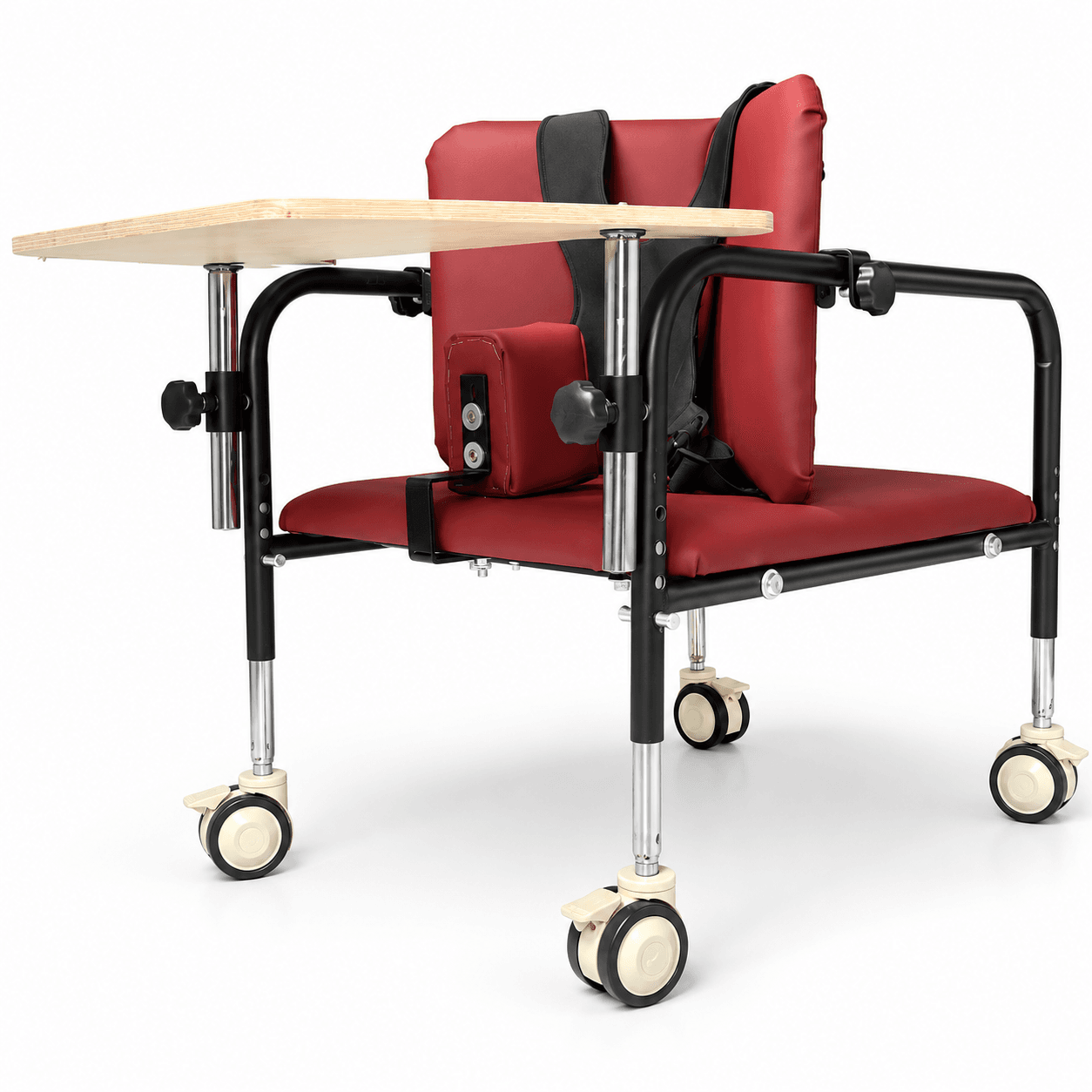
A therapeutic seating arrangement may include:
An appropriately sized sitting surface
Seat width and depth should accommodate the child's body while allowing suitable positioning.
Pelvic positioning support
A correctly fitted pelvic belt may help maintain the intended seated position.
Trunk support
Additional chest or lateral supports may be needed when a child cannot maintain trunk alignment independently.
Head positioning support
Selected children may require a headrest or other support prescribed by their therapist.
Lower-limb positioning
Appropriate leg and foot support may also contribute to an individualized seating arrangement.
These components should not be used to force the child's body into a rigid position.
Poorly adjusted straps or excessive pressure can cause discomfort and may interfere with breathing or movement.
A physiotherapist or occupational therapist can assess seating posture, while a dysphagia-trained clinician determines whether the position is suitable for eating and drinking.
Five Feeding Warning Signs Parents Should Not Ignore
Positioning difficulties and swallowing difficulties can occur together, but they must be assessed separately.
Parents should seek professional assessment when they notice the following signs.
- Frequent coughing or choking during meals
Coughing or choking while eating or drinking may indicate difficulty managing food or liquid safely.
- Changes in breathing or colour
Noisy breathing, breathing difficulty or changes in skin colour during feeding are important warning signs.
- Recurrent chest infections
Repeated respiratory infections may sometimes be associated with aspiration, including situations where obvious choking is not observed.
- Very long or distressing mealtimes
If meals regularly take an unusually long time or cause significant fatigue, distress or difficulty, further assessment may be needed.
- Poor weight gain or reduced food intake
Inadequate intake can affect a child's nutritional status and growth.
These signs should not be managed by purchasing a different chair alone.
A pediatrician and a speech and language therapist experienced in swallowing disorders can determine whether further investigation or changes to the feeding plan are necessary.
If a child is actively choking, unable to breathe normally or showing severe respiratory distress, seek emergency medical assistance immediately.
Even when a child appears to swallow without coughing, aspiration may sometimes occur silently.
Parents should therefore follow the child's individualized feeding recommendations rather than relying only on visible symptoms.
Can Morecare Sunflower Be Used for Supported Seating During Meals?
The Morecare Sunflower Therapy Corner Floor Seating System is designed for selected children who require additional positioning assistance while sitting close to floor level.
The product includes several support components that may be relevant to individualized seating needs.
Three-sided padded corner support
Provides external support around the back and sides of the child's trunk.
Height-adjustable headrest
Allows additional head positioning assistance when appropriate.
Four-point butterfly chest harness
Provides upper-body positioning support when correctly fitted and recommended.
Pelvic positioning belt
Helps maintain the intended pelvic position during supervised sitting.
Removable abductor
Provides an additional lower-limb positioning option.
Customizable seating dimensions
Seat size, backrest height and other selected positioning components may be customized according to individual requirements.
Sunflower is generally recommended for children aged 2–7 years, subject to individual fitting.
Its floor-level design may be suitable for certain supervised activities.
However, Sunflower should only be used during meals when the child's treating professionals have confirmed that the specific seating configuration and feeding arrangement are appropriate.
The presence of a headrest, pelvic belt or chest harness does not establish swallowing safety.
Children who require specialized feeding positions, a suitable feeding surface, comprehensive postural support or complex respiratory management may need a different adaptive seating system.
Sunflower is not a medical treatment for dysphagia and must never be promoted as preventing aspiration or choking.
How Can Families Choose Appropriate Seating for Mealtimes?
Before purchasing seating equipment for a child with feeding difficulties, the family should understand both the child's postural needs and swallowing requirements.
Several questions can help guide the assessment.
Can the child maintain a suitable head position?
Determine whether additional positioning support is required and whether the chosen arrangement is appropriate for swallowing.
How much trunk assistance is needed?
Evaluate whether the child leans forward, sideways or backwards during meals.
Is pelvic support required?
A therapist can assess whether the pelvis needs additional positioning assistance.
Does the child have diagnosed or suspected swallowing difficulties?
If so, the feeding plan should be developed by appropriately trained professionals.
Is floor-level seating practical for feeding?
Consider caregiver access, feeding surface height, utensil use and the child's overall positioning requirements.
Can the seating system accommodate the child's measurements?
Seat dimensions, support placement and growth requirements should be reviewed before purchasing.
The best equipment is not necessarily the chair with the greatest number of supports.
It is the seating arrangement that meets the child's assessed physical and functional needs while supporting safe and appropriate mealtime care.