Why Do Some Children With Cerebral Palsy Have Difficulty Positioning Their Legs?
Sitting in a wheelchair requires coordinated positioning of the pelvis, hips, knees, ankles and feet.
For some children with cerebral palsy, maintaining this position is difficult because of changes in muscle tone and motor control.
The child may experience increased muscle stiffness, involuntary movements, weakness or difficulty coordinating movements.
These factors can affect how the legs rest on the seating surface.
Parents may observe:
Knees moving towards one another.
Legs crossing during sitting.
One leg repeatedly moving away from the intended position.
Feet slipping off the footrest.
Difficulty keeping both feet supported.
Uneven positioning of the thighs.
Discomfort when the legs are moved or repositioned.
However, not every positioning difficulty results from spasticity.
An unsuitable seat depth, insufficient foot support, pelvic instability or fixed joint restriction may also contribute.
A pediatric physiotherapist or occupational therapist should assess the child's posture and movement before recommending accessories.
The aim is to understand why the legs move out of position rather than simply restraining the movement.
What Is Scissoring in Children With Cerebral Palsy?
Scissoring is a movement or postural pattern in which the thighs move towards or across the body's midline.
It is often associated with excessive activity or spasticity in the hip-adductor muscles.
These muscles normally help move the legs towards one another.
When their activity is abnormally increased, the child may have difficulty maintaining a comfortable separation between the legs.
Scissoring can occur during standing, walking, assisted movement or sitting.
Its severity varies considerably between children.
Some children have flexible movement patterns that change with posture or activity.
Others may develop muscle shortening, joint restrictions or additional orthopaedic problems.
Parents should understand that scissoring is a clinical movement problem rather than simply a wheelchair fitting issue.
A padded abduction support may help maintain an appropriate position in selected circumstances, but it does not reduce the underlying spasticity or cure the movement disorder.
Forcing the knees apart can cause pain or injury, particularly when the child has limited hip movement.
A rehabilitation professional should determine whether an abduction support is appropriate and how it should be adjusted.
Why Do Pelvic Alignment and Foot Support Matter?
Leg positioning is closely related to the position of the pelvis and the dimensions of the wheelchair seat.
If the pelvis slides forward, the hips and knees may move into a different position.
Similarly, when the seat is too deep or the footrest is incorrectly adjusted, the child may struggle to keep the feet supported.
A seating assessment may consider several factors.
Pelvic positioning
The pelvis should be supported in an appropriate position according to the child's physical abilities and flexibility.
Seat width
The seat should provide enough space for the child's pelvis and thighs without excessive compression or instability.
Seat depth
The sitting surface should support the thighs appropriately without creating uncomfortable pressure behind the knees.
Footrest height
The feet should receive suitable support without forcing the hips or knees into an uncomfortable position.
Lower-limb symmetry
A therapist may assess whether the legs can be positioned comfortably and whether any asymmetry is flexible or fixed.
Pressure and skin condition
Straps, cushions and foot supports should not create harmful pressure or rubbing.
Correct positioning does not necessarily mean forcing both legs into perfectly symmetrical alignment.
Some children require individualized accommodations because of joint restrictions, pelvic obliquity or other musculoskeletal conditions.
The overall seating arrangement should support comfort and participation rather than impose a rigid posture.
How Do Leg Straps, Abduction Supports and Footrests Work?
Different wheelchair accessories serve different positioning purposes.
Understanding their functions helps families avoid using them incorrectly.
Padded Leg Positioning Straps
Leg straps may help maintain the intended position of the lower limbs.
They can be useful when a child repeatedly moves their legs away from an assessed position or has difficulty keeping them supported.
However, straps should not be tightened to suppress strong involuntary movements or force a joint into alignment.
Abduction Support
An abduction support, sometimes called a pommel or separator, is placed in an appropriate position to assist lower-limb alignment.
For selected children, it may help limit unwanted movement of the thighs towards the midline.
However, it is not a treatment for hip-adductor spasticity and cannot be relied upon to prevent hip displacement.
It must never be used to force apart painful, rigid or restricted hips.
Adjustable Footrest
A footrest provides a surface for supporting the feet during wheelchair use.
When correctly positioned, it may help maintain a more comfortable lower-limb arrangement.
The feet should be supported without excessive pressure, and the footrest should not interfere with transfers.
Additional Clinical Supports
Some children may require orthoses, specialist seating components or other interventions.
These should be prescribed according to the child's clinical requirements.
Parents should avoid adding unapproved straps, rigid separators or improvised restraints to a wheelchair.
If the child experiences pain, increased stiffness, skin irritation or difficulty breathing while positioned, the equipment should be reassessed promptly.
How Does Morecare EasyGo Provide Lower-Limb Positioning Support?
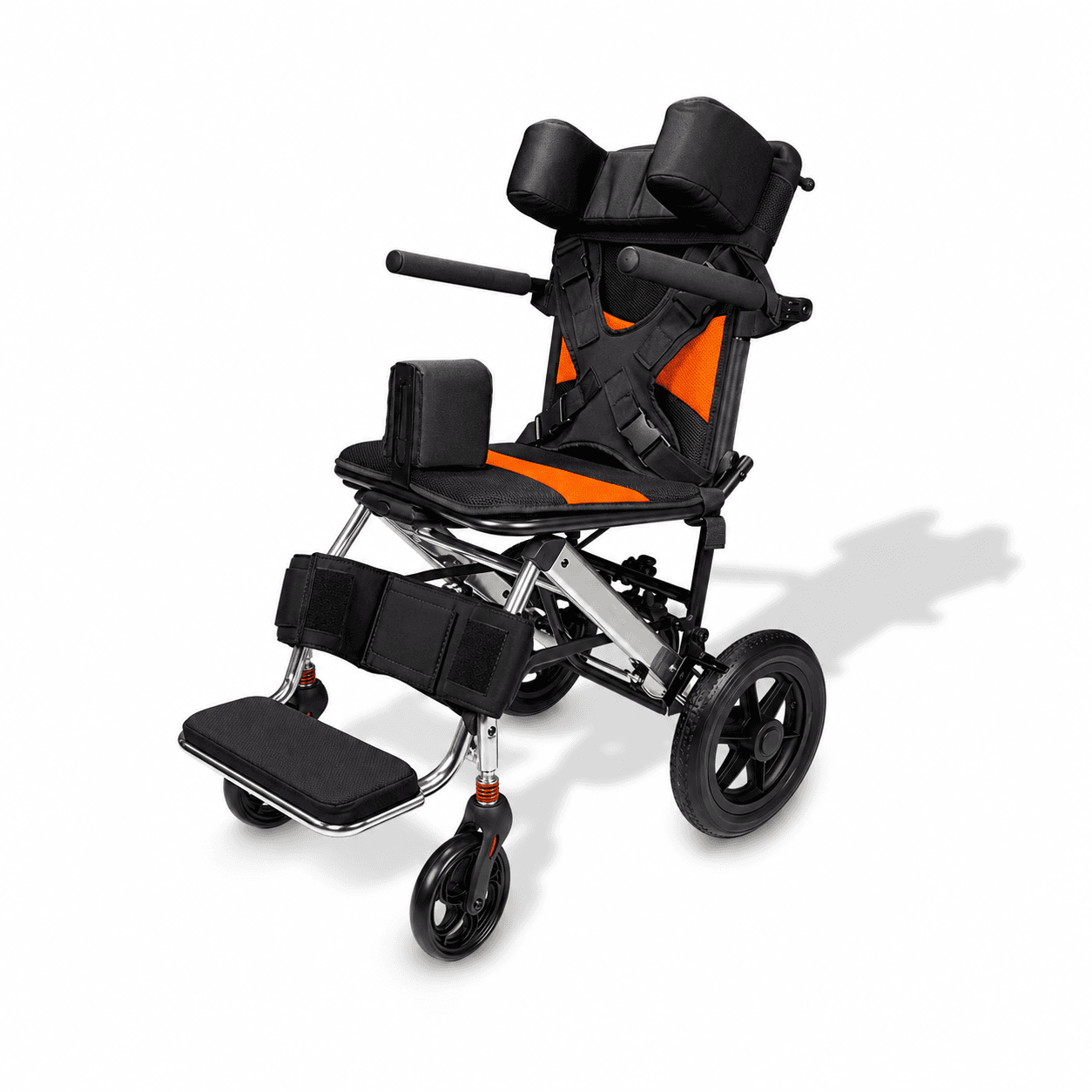
The Morecare EasyGo Lightweight CP Travel Wheelchair is designed for selected children who need caregiver-assisted mobility with additional positioning support.
Along with its adjustable headrest and butterfly chest harness, EasyGo includes several lower-limb positioning components.
Adjustable Padded Leg Straps
The straps provide additional assistance in maintaining the intended leg position during supervised wheelchair use.
Removable Leg Abduction Support
This component offers a positioning option for selected children who require assistance with thigh alignment.
Its use should be based on the child's hip movement, comfort and therapist's recommendations.
Cushioned Foot Support
The foot support provides a padded surface for the child's feet.
Height-Adjustable and Foldable Footrest
The footrest can be adjusted according to the approved configuration to accommodate individual lower-leg measurements.
Foam-Cushioned Seat
The seat provides a supported sitting surface, subject to appropriate fitting and individual positioning needs.
Lightweight Travel Frame
EasyGo uses an approximately 8 kg aluminium frame with an umbrella-folding mechanism for easier transport when unoccupied.
The standard seating dimensions are 14 inches wide and 14 inches deep.
EasyGo is generally recommended for children aged 4–8 years, with customization considered for selected older children.
These features may help selected children maintain a more appropriate seated position during shorter supervised outings.
However, EasyGo's leg straps and abduction support do not treat muscle spasticity, correct fixed deformities or prevent hip displacement.
Children with substantial hip restrictions, painful positioning or complex lower-limb needs may require a more comprehensive adaptive seating system.
When Should Parents Seek a Professional Seating or Hip Assessment?
Some lower-limb positioning difficulties can be addressed through appropriate wheelchair fitting.
Others may indicate a need for medical or rehabilitation assessment.
Parents should seek advice when they observe:
Increasing difficulty moving the hips
Reduced hip abduction or noticeable stiffness may require assessment.
Pain during positioning
A child who cries, resists movement or shows signs of distress when the legs are repositioned should not be forced into the desired posture.
Increasing leg crossing
Changes in muscle tone or positioning patterns may indicate a need to review the rehabilitation plan.
One leg appearing different in length or position
A clinically significant change may require further assessment.
Deterioration in sitting tolerance
A child who previously sat comfortably but now experiences increasing discomfort or difficulty may need a review.
Skin pressure or irritation
Redness, rubbing or pressure from straps and supports should be addressed.
Concerns about hip development
Children with cerebral palsy have an increased risk of hip displacement, particularly when motor limitations are more severe.
The American Academy for Cerebral Palsy and Developmental Medicine recommends systematic hip surveillance based on age, motor classification and clinical findings.
This monitoring may include physical examination and appropriate pelvic radiographs.
A wheelchair abduction support does not replace hip surveillance.
A pediatric rehabilitation specialist or orthopaedic professional should determine whether additional assessment or treatment is needed.
The goal is to identify safe, comfortable positioning while monitoring the child's musculoskeletal health.
Clinical References
NICE. Spasticity in Under 19s: Management (CG145).
https://www.nice.org.uk/guidance/cg145/chapter/Recommendations
American Academy for Cerebral Palsy and Developmental Medicine. Hip Surveillance in Cerebral Palsy Care Pathway.
https://www.aacpdm.org/publications/care-pathways/hip-surveillance-in-cerebral-palsy
NICE. Cerebral Palsy in Under 25s: Assessment and Management (NG62).
https://www.nice.org.uk/guidance/ng62/chapter/Recommendations
Morecare Mobility & Rehabilitation Solutions. EasyGo Lightweight CP Travel Wheelchair.
https://morecare.in/easygo/
Medical Disclaimer: This article provides general educational information about cerebral palsy, wheelchair seating and lower-limb positioning. It does not replace individualized assessment by a pediatric physiotherapist, occupational therapist, rehabilitation physician or orthopaedic specialist. Never force a child's joints into a painful position or use wheelchair straps as treatment for spasticity.