Why Does Parkinson's Make Getting Out of Bed Difficult?
Getting out of bed requires several coordinated movements: turning the body, moving the legs, sitting upright and preparing to stand.
Parkinson's disease can interfere with each of these steps.
Muscle rigidity
Stiffness in the trunk and limbs can make it harder to roll onto one side or reposition the legs.
Bradykinesia
Slowness of movement can make everyday actions take longer, including moving from lying down into sitting.
Difficulty initiating movement
Some people know what movement they want to perform but struggle to begin it.
Balance and postural changes
Reduced balance or a forward-leaning posture can make unsupported sitting or standing more challenging.
Fluctuating mobility
Movement may be easier at certain times of day and more difficult when medication effects have worn off or the person is tired.
For example, an elderly parent may walk short distances with a walker after getting up, yet need considerable help moving their body towards the edge of the bed.
This does not necessarily mean their walking ability and bed mobility are the same. Each requires separate assessment.
Why Isn't Raising the Backrest Always Enough?
An adjustable backrest can raise the upper body into a supported sitting position.
However, someone with Parkinson's may still struggle with the movements needed to leave the bed.
They may have difficulty:
- Turning the hips and shoulders together.
- Moving both legs towards the bedside.
- Shifting their body into a suitable sitting position.
- Maintaining balance while their feet approach the floor.
- Initiating standing once seated.
The person may remain dependent on a caregiver despite having an electric adjustable backrest.
This is an important distinction when choosing a homecare bed.
Raising the upper body and preparing the entire body for a bed exit are different functions.
For some patients, positioning equipment that addresses more of the bed-exit sequence may be useful.
However, equipment selection should account for the person's trunk control, ability to follow instructions, balance and transfer requirements.
What Can Make Bed Exits Easier for Someone With Parkinson's?
Not every person with Parkinson's needs a specialized hospital bed.
Several practical strategies and mobility aids may help, depending on the person's abilities.
Physiotherapy and movement strategies
A Parkinson's-experienced physiotherapist can teach techniques for turning in bed, moving towards sitting and preparing to stand.
Practising movements at appropriate times may improve familiarity and confidence.
Reviewing medication-related mobility changes
If getting out of bed is particularly difficult in the morning or before the next dose of medication, discuss the pattern with the treating clinician. Do not change medication timing or doses independently.
Suitable bed mobility aids
Selected users may benefit from bed rails designed for repositioning, mattress raisers or other equipment assessed by an occupational therapist.
These aids must be compatible with the bed and the person's abilities. Improperly fitted rails can create safety risks.
Choosing the right transfer equipment
Some patients can stand with appropriate assistance. Others may need a standing aid, wheelchair transfer equipment or patient hoist.
Allowing adequate time
Rushing someone with Parkinson's can increase anxiety and make movement more difficult. Caregivers should follow the person's assessed movement and transfer plan.
When these approaches are insufficient, or when substantial manual repositioning is repeatedly required, a rotating homecare bed may be worth evaluating.
How Can Morecare Coral Help With Bed-Exit Preparation?
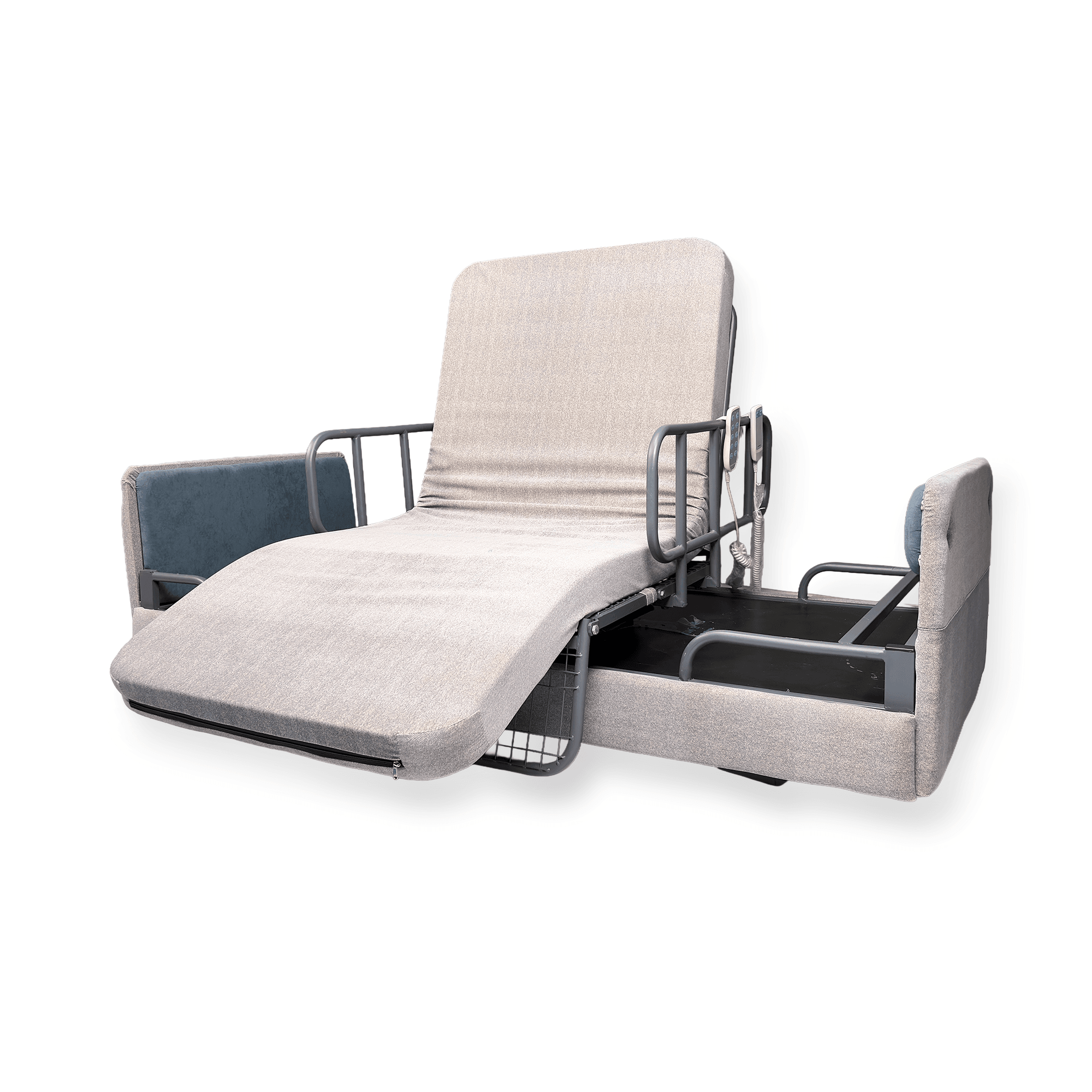
The Morecare Coral Electric Rotating Homecare Bed is designed to assist selected adults who find it difficult to move from lying down towards a bedside sitting position.
Unlike a conventional adjustable bed that mainly raises the backrest, Coral combines four electric movements:
1. Backrest adjustment
Raises the upper body towards a supported sitting position.
2. Knee-rest adjustment
Provides controlled adjustment of lower-limb positioning.
3. 90° chair rotation
Moves the seating section into an outward-facing chair-like position at the side of the bed.
4. Hi-Low height adjustment
Allows the bed height to be adjusted between its published range of 18 and 30 inches.
For a person with Parkinson's who struggles to turn their body and move their legs towards the side of the bed, these combined movements may reduce some of the manual repositioning required before an assisted bed exit.
Once positioned towards the bedside, the person may be ready for an assessed standing or wheelchair transfer.
However, Coral does not stand the person up, correct freezing episodes, treat Parkinson's symptoms or automatically transfer them into a wheelchair.
If the patient has severe postural instability, difficulty following instructions or cannot participate safely in transfers, caregiver assistance and additional equipment may be necessary.
When Is a Rotating Bed Suitable, and When Is More Help Needed?
The right equipment depends on what the person can do safely, not simply on their Parkinson's diagnosis.
Before considering a rotating bed, ask:
Can the person tolerate supported upright sitting?
Check whether they can remain safely positioned during adjustment and rotation.
Can they participate in standing?
Some people can stand with assistance once appropriately positioned. Others need mechanical transfer equipment.
Does freezing affect their movements?
Freezing during standing or walking needs specific strategies and supervision. Bed rotation does not resolve freezing.
Does their mobility change throughout the day?
Consider morning stiffness, fatigue and medication-related movement fluctuations.
What assistance can the caregiver provide?
The plan should identify whether one or more trained caregivers or a transfer aid is needed.
Is the bedroom suitable?
There must be adequate space for rotation, wheelchair access, walker positioning and caregiver movement.
For a person who mainly needs a raised backrest, a conventional adjustable bed may be sufficient.
For someone who struggles particularly with moving their body towards the bedside, a rotating chair-position bed may offer additional positioning assistance.
For someone who cannot safely participate in transfers, a suitable patient hoist or other assessed handling equipment may still be necessary.
The goal is to make daily bed exits more manageable while preserving safe movement and appropriate patient participation.