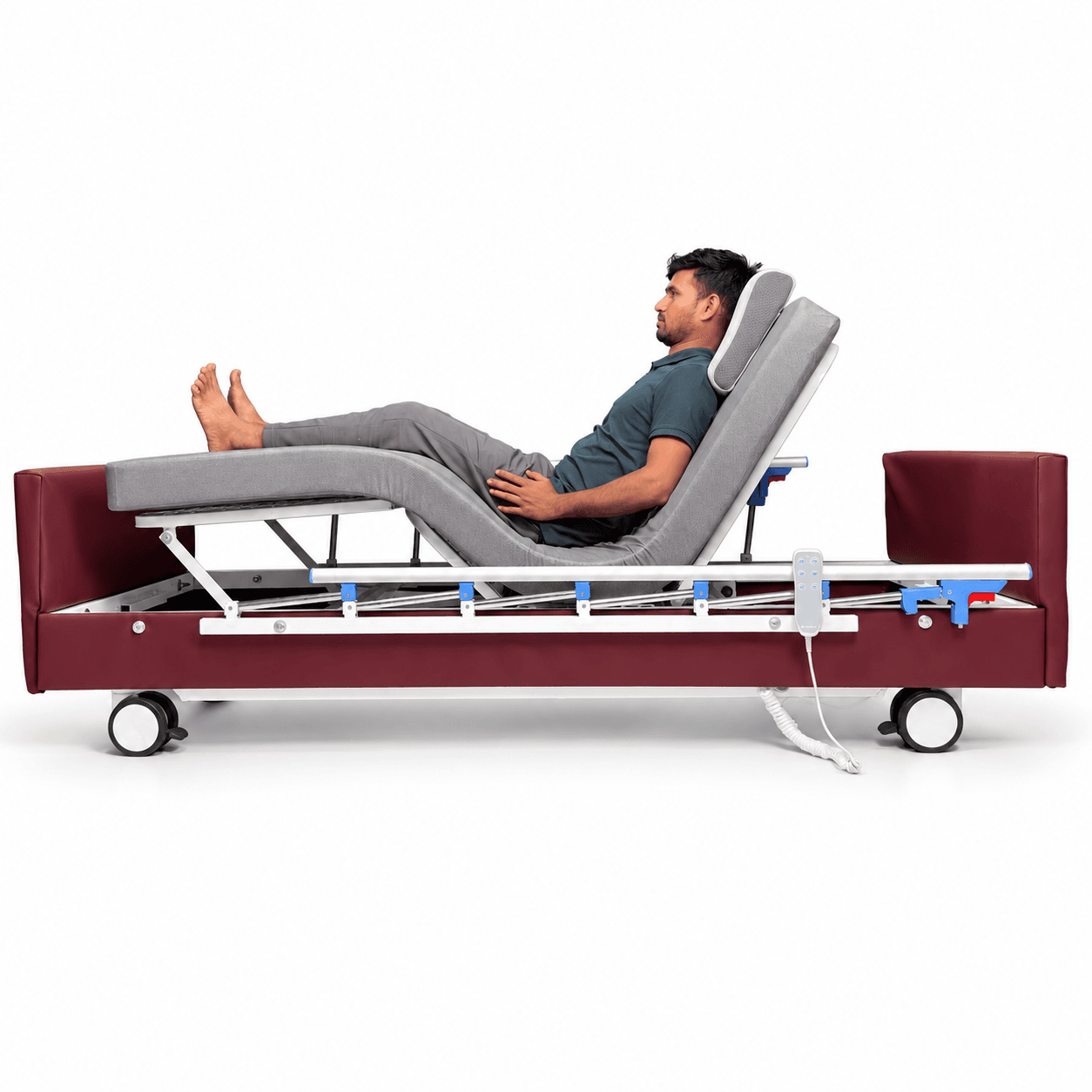
Can an Electric Bed Attachment Fit Any Normal Home Bed?
An electric bed attachment is designed to introduce selected adjustable positioning functions to a compatible existing bed.
Unlike a complete electric hospital bed, the attachment relies on the supporting furniture already present in the home.
This means the design and condition of the existing bed are important.
Two beds with similar external dimensions may have very different internal construction.
For example, a wooden bed may have thick side panels, a recessed sleeping surface or raised storage compartments.
Another bed may use a metal frame with widely spaced supporting bars.
Although both beds may be described as double beds, their usable installation space and structural suitability may differ significantly.
Wooden Beds
Some wooden beds may accommodate an electric attachment when they provide sufficient usable dimensions, stable structural support and suitable clearance.
However, bed frames with weak joints, unstable storage structures, damaged slats or unsuitable internal platforms may not be safe.
Metal Beds
Selected metal bed frames may also be compatible.
The supporting arrangement must be stable and capable of carrying the installed attachment and intended loads.
The presence of a metal frame alone does not establish adequate strength.
Storage Beds
Beds with drawers, hydraulic storage lids or box-storage arrangements need additional assessment.
Internal mechanisms, raised borders or moving storage components may interfere with installation or powered adjustment.
Platform Beds
A suitable platform bed may provide the required supporting surface, but its strength, dimensions and attachment stability must still be confirmed.
Old or Damaged Beds
Beds with uncertain structural strength, broken slats, loose joints or visible deformation should not be used until the defects have been properly addressed.
The correct question is not simply whether BedMate fits a wooden or metal bed.
It is whether the complete supporting structure is compatible with the attachment and safe for the intended patient.
How Should You Measure Your Existing Bed?
Correct measurements help determine whether an electric bed attachment can be installed.
For Morecare BedMate, two important published dimensions are:
Minimum usable bed width: 35 inches.
Adjustable attachment frame length: 72–82 inches.
However, dimensions alone do not guarantee safe installation.
Parents, caregivers or family members should measure the actual supporting area and identify possible obstructions.
Measurement 1: Usable Internal Width
Measure the clear width available for the attachment.
This is not necessarily the external width of the bed.
For example, a bed may have a wide outer wooden frame but thick side panels that reduce the usable internal space.
Measure between the nearest fixed structures that could interfere with the attachment.
For standard BedMate, at least 35 inches of usable width is required.
Measurement 2: Usable Supporting Length
Measure the clear available length between the head and foot ends of the bed.
BedMate has an adjustable frame length of approximately 72–82 inches.
The attachment must fit securely within the approved configuration without interference from fixed furniture components.
Measurement 3: Supporting Surface Height
Record the height of the existing bed platform from the floor.
This can help evaluate the overall installed arrangement and the patient's access requirements.
BedMate does not independently raise or lower the overall bed height.
Therefore, the height of the existing supporting bed remains an important consideration for transfers and caregiver assistance.
Measurement 4: Headboard and Footboard Clearance
Check whether fixed headboards, footboards or decorative panels project into the installation area.
These structures may obstruct the mattress or moving sections during elevation.
Measurement 5: Side Clearance
Measure the available space beside the bed.
Caregivers should have adequate room for intended care activities, access to the handset and safe movement around the equipment.
Measurement 6: Space for Electrical Components
Consider the intended location of the control box, cables and power connection.
Cables must not be stretched, crushed, trapped beneath moving components or routed through hazardous areas.
The final installation should follow Morecare's approved instructions.
A measuring tape and several clear photographs can provide useful preliminary information, but final compatibility must be reviewed by the manufacturer.
How Strong Must the Existing Bed Be?
Structural compatibility is just as important as dimensional compatibility.
An electric bed attachment places loads on the underlying furniture.
The existing bed must support these loads while the system is flat and during approved powered movement.
Morecare BedMate has a published maximum user-weight rating of 200 kg.
However, this rating applies to the product under its approved conditions.
It does not establish that every existing bed can safely carry a 200 kg patient with the attachment installed.
Consider the Complete Load
The supporting bed may need to accommodate:
The patient's weight.
The BedMate attachment, approximately 30 kg.
The included mattress.
Bedding and other applicable loads.
Forces associated with approved operation and patient movement.
Check Supporting Slats or Platform
A bed with widely spaced slats or insufficient support points may not adequately support the attachment.
Do not assume that the original bed was designed for an additional adjustable mechanism.
Inspect the Bed Frame
Check for damaged joints, loose fasteners, cracked wooden members, bending, rust or other signs of deterioration.
Review Existing Storage Mechanisms
Some beds have lifting storage platforms or internal hinges.
These mechanisms must not interfere with the electric attachment.
Avoid Unsupported Structural Modifications
Families should not cut supporting members, remove braces, weld additional parts or make improvised alterations without an approved engineering plan.
Such modifications may weaken the bed or create new hazards.
Confirm Manufacturer Approval
The original bed's load rating, where available, should be reviewed along with its structural condition.
Morecare should approve the proposed installation.
If the supporting bed is unsuitable, a complete hospital or homecare bed may be a safer choice.
Why Must Mattress, Side-Rail and Moving-Part Clearances Be Checked?
An electric bed attachment is a complete operating system involving the supporting frame, mattress, rails and adjustable sections.
These components must remain compatible as the bed moves between approved positions.
Mattress Compatibility
BedMate includes a 4-inch CNC-cut polyurethane foam mattress.
The mattress is designed for use with the attachment's moving sections.
Using an alternative mattress without approval may affect the folding movement, support arrangement or clearance around the rails.
Families should not assume that an existing thick mattress, spring mattress or additional mattress topper can be used safely.
Side-Rail Compatibility
BedMate includes two collapsible aluminium side rails.
Bed rails may have a role in selected care arrangements, but they can also create entrapment hazards.
Gaps can occur:
Between the mattress and side rail.
Within or beneath a rail.
Between a rail and fixed bed furniture.
Near the headboard or footboard.
When the mattress compresses or moves during adjustment.
The complete installation should be assessed for potentially hazardous openings.
Moving Sections
The powered backrest and knee-rest sections must move without hitting the headboard, footboard, supporting frame or nearby objects.
Keep hands, clothing, bedding and cables clear of the moving mechanism.
Rail Use Is Not Automatically Appropriate
Bed rails should not be treated as universal fall-prevention equipment.
Some patients may attempt to climb over them or become trapped in gaps.
Their use should be based on an individual risk assessment.
Test in All Approved Positions
A complete installation check should consider the bed in its flat and elevated configurations.
Mattress movement, support stability and rail gaps may change as the mechanism operates.
The equipment should not be used by a patient until the installer has completed the approved safety checks.
What Are the Installation Requirements for Morecare BedMate?
Morecare BedMate is designed to provide electric backrest and knee-rest positioning on a compatible existing home bed.
Its principal technical features include:
Adjustable Frame Length
The standard frame adjusts between approximately 72 and 82 inches.
Alternative dimensions may be discussed with Morecare when required.
Minimum Usable Bed Width
The existing bed must provide at least 35 inches of usable installation width.
Mild-Steel Supporting Frame
BedMate uses a powder-coated mild-steel frame.
The published product net weight is approximately 30 kg.
Two Electric Linear Actuators
Two 24V electric actuators operate the adjustable positioning mechanism.
Coordinated Back and Knee Movement
The backrest and knee-rest sections rise or lower together.
They do not have independent controls in the standard configuration.
Wired Handheld Controller
The user or caregiver operates the approved positioning functions through the wired handset.
Included Mattress
The standard package includes a 4-inch foam mattress with a removable cover.
Collapsible Side Rails
Two aluminium side rails are supplied.
Their correct positioning and safety must be assessed during installation.
Electrical Requirements
The system requires an appropriate electrical supply through its approved control equipment.
The standard configuration does not include battery backup.
Power-Failure Behaviour
If electrical power is interrupted, the mechanism remains in its current position.
The standard configuration does not provide manual emergency lowering.
Patients who may need urgent position changes during outages require a specific contingency plan or alternative equipment.
Installation and Setup
BedMate is supplied partly disassembled with instructions and virtual setup guidance.
The exact installation process depends on the existing bed.
Before occupied use, the installer should:
Confirm the supporting bed is approved and structurally suitable.
Position and secure the attachment as instructed.
Install the approved mattress and rail components.
Check the electrical connections and cable routing.
Test the movement through the permitted operating range without the patient.
Inspect clearance, stability and potential entrapment areas.
Train the caregiver in operation, inspection and the power-failure plan.
Do not begin occupied operation if the frame moves unexpectedly, any component is loose, cables are damaged or the rails do not function correctly.
What Information Should You Send Morecare Before Ordering?
A preliminary compatibility review can reduce uncertainty before the product is purchased.
Families should prepare the following information.
- Existing Bed Photographs
Send clear photographs showing:
The complete bed.
The supporting surface with bedding removed.
The headboard and footboard.
The internal frame or slats.
Any storage or moving mechanisms.
- Usable Bed Width
Provide the clear internal width available for installation.
Do not rely only on the furniture's advertised single-bed or double-bed designation.
- Usable Bed Length
Measure the available supporting length.
Identify any fixed structures that reduce the usable space.
- Supporting Bed Height
Record the approximate platform height from the floor.
This is useful when discussing transfer access and caregiver handling.
- Patient Height and Weight
These details help determine suitability and whether the configuration can accommodate the person.
- Main Positioning Requirement
Explain why the patient needs electric adjustment.
For example, the family may need assistance changing between flat and supported elevated resting positions.
- Transfer and Caregiver Requirements
Describe whether the patient can enter and exit the bed independently or needs substantial assistance.
If height adjustment, side turning or lifting is required, BedMate may not meet the full care requirement.
- Electrical and Home Environment
Share information about the power supply, access around the bed and any important environmental limitations.
- Clinical Considerations
Mention any prescribed positioning restrictions, significant pressure-related concerns or other requirements identified by the treating healthcare professional.
- Installation Support
Clarify whether the family can follow the approved installation procedure or requires additional technical support.
Morecare can use these details to perform a preliminary review.
However, photographs and measurements cannot always establish structural strength or identify every safety risk.
A final installation inspection and functional check are still essential.
The objective is to select equipment that fits both the furniture and the patient's actual care needs.
Clinical and Safety References
U.S. Food and Drug Administration. Hospital Bed System Dimensional and Assessment Guidance to Reduce Entrapment.
https://www.fda.gov/regulatory-information/search-fda-guidance-documents/hospital-bed-system-dimensional-and-assessment-guidance-reduce-entrapment
U.S. Food and Drug Administration. Recommendations for Health Care Providers Using Adult Portable Bed Rails.
https://www.fda.gov/medical-devices/adult-portable-bed-rail-safety/recommendations-health-care-providers-using-adult-portable-bed-rails
U.S. Food and Drug Administration. A Guide for Modifying Bed Systems and Using Accessories to Reduce the Risk of Entrapment.
https://www.fda.gov/medical-devices/hospital-beds/guide-modifying-bed-systems-and-using-accessories-reduce-risk-entrapment
Morecare Mobility & Rehabilitation Solutions. BedMate Electric Adjustable Back & Knee Rest for Existing Beds.
https://morecare.in/bedmate/
Medical Disclaimer: This article provides general information about electric bed attachments and installation requirements. Structural compatibility, mattress and rail safety, clinical positioning and patient suitability require appropriate technical and professional assessment. Do not install or operate an attachment on an unapproved or structurally unsuitable bed. Follow the manufacturer's approved instructions.