Why Do Families Consider Converting Their Existing Bed?
Most home beds are designed primarily for sleeping and resting.
Their fixed surface may be suitable for someone who can move comfortably and change positions independently.
However, caring for a person with reduced mobility can create different requirements.
For example, an elderly person may prefer resting with their upper body elevated.
A patient recovering from surgery may have prescribed positioning restrictions.
Another person with neurological limitations may require caregiver assistance to change between lying and supported elevated positions.
Families often face several practical difficulties.
Repeated Pillow Adjustments
Caregivers may repeatedly arrange pillows behind the patient's back or beneath the knees.
Pillows can move out of position and may not provide consistent support.
Difficulty Achieving an Elevated Position
Some patients cannot comfortably adjust their posture without help.
An electrically adjustable surface may provide a more repeatable way of changing selected positions.
Existing Bedroom Furniture
Families may already have a strong, suitable bed and prefer to retain it rather than introduce an entirely new hospital-style frame.
Limited Bedroom Space
Replacing the whole bed may create challenges in rooms with fixed furniture, restricted access or established care arrangements.
Changing Homecare Needs
A patient's requirements may change after illness, injury or surgery.
Families may need additional positioning capability without requiring every function of a complete nursing bed.
For selected situations, an electric bed attachment may offer a practical solution.
However, the person's clinical requirements and the existing bed's structural suitability must be evaluated before purchase.
How Does an Electric Bed Conversion System Work?
An electric bed conversion system is an adjustable support mechanism that is installed on an approved existing bed.
Rather than replacing the entire furniture frame, it adds moving support sections that can be controlled electronically.
Different products offer different functions.
Some systems adjust only the backrest.
Others provide separate back and leg adjustments.
Certain attachments use coordinated movement in which multiple sections operate together.
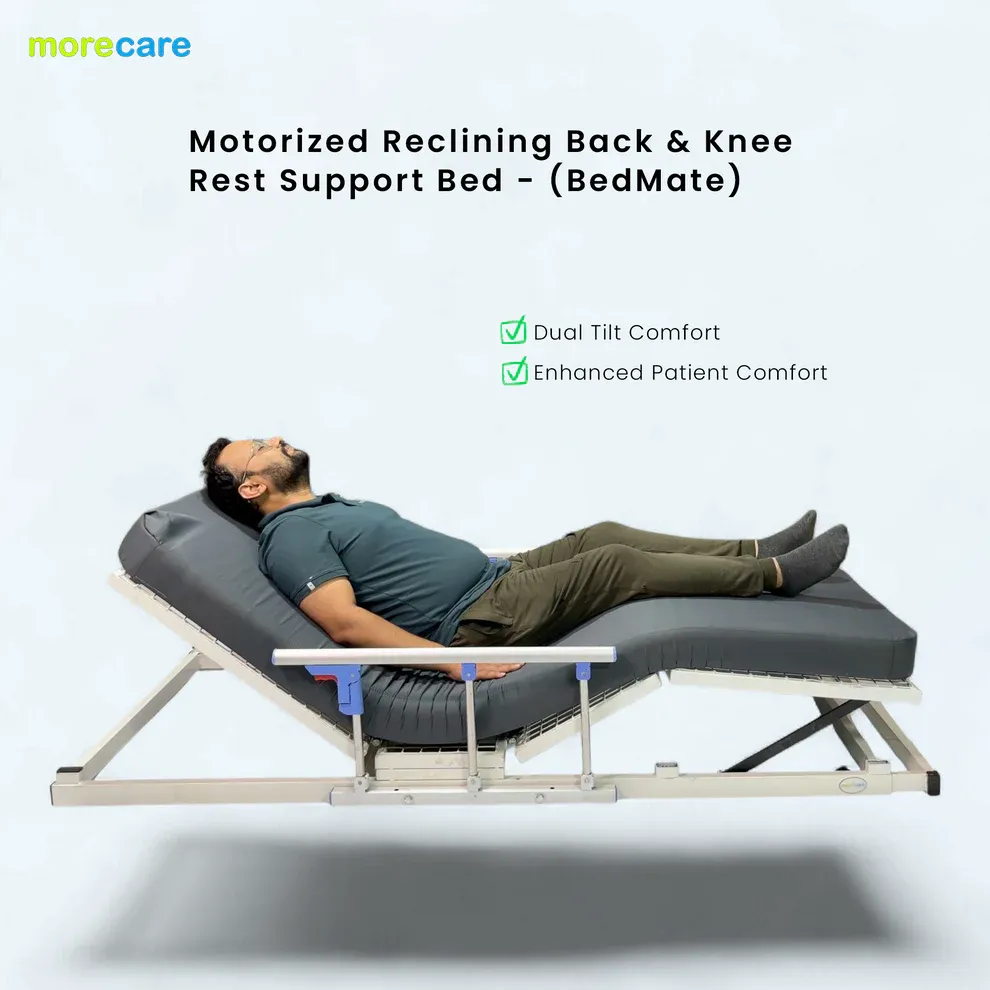
The Morecare BedMate follows the coordinated movement approach.
Electric Backrest Adjustment
The backrest section can elevate the user's upper body from a lying position towards a supported incline.
This may help selected users change their resting position or participate in suitable activities such as reading and conversation.
Electric Knee-Rest Adjustment
The knee section raises to provide a different lower-body resting position.
This may be useful where the patient's clinician has approved the intended posture.
Two Electric Actuators
BedMate includes two 24V linear actuators that operate the moving sections.
Wired Controller
A handheld wired remote allows the operator to adjust the bed's positioning system.
Coordinated Movement
A critical detail is that BedMate's backrest and knee-rest sections move together.
They cannot be independently adjusted in the standard configuration.
Families should therefore confirm that this combined movement is appropriate for the patient's physical condition and intended care activities.
The attachment should be used only after its frame, supporting bed, mattress and rails have been checked for compatibility.
Can BedMate Fit a Normal Wooden or Metal Bed?
Many families want to know whether an electric bed attachment will fit their existing wooden or metal bed.
The answer depends on the construction and dimensions of the particular bed.
BedMate is designed for use with compatible home beds, but compatibility cannot be established by material or bed size alone.
Minimum Usable Width
The standard BedMate requires at least 35 inches of usable width.
This is the actual space available for installation, not simply the external width of the furniture.
A bed with thick wooden side panels or an unusual inner frame may have less usable space than expected.
Adjustable Frame Length
BedMate's standard frame length adjusts from approximately 72 to 82 inches.
The usable supporting surface must accommodate the configured attachment safely.
Existing Bed Strength
The underlying bed must safely support the combined load of:
The patient.
The installed BedMate attachment.
The mattress.
Other applicable loads during approved use.
BedMate's published maximum user weight is 200 kg, but this does not establish that every existing wooden or metal bed can safely support the same load.
The supporting furniture must be independently assessed.
Supporting Surface
The existing bed must provide a stable, suitable surface for the attachment.
A damaged bed, weak slats, unstable frame or inadequate supporting arrangement may make installation unsafe.
Headboard, Footboard and Side Clearance
The attachment must have enough space for its moving components.
Nearby furniture should not obstruct powered movement.
Mattress and Side-Rail Compatibility
The mattress and side rails form part of the overall bed system.
Gaps between the mattress, rails, attachment and supporting frame must be checked for possible entrapment.
Before ordering, families should share clear photographs, usable bed dimensions and details of the existing bed's construction.
Morecare should confirm suitability before the attachment is installed.
What Are the Benefits and Limitations of Converting an Existing Bed?
An electric bed attachment may provide useful positioning functions, but it should not be confused with a complete electric nursing bed.
Understanding what it can and cannot do is essential.
What BedMate Adds
- Powered upper-body elevation
The user can move towards a supported elevated backrest position without relying solely on stacked pillows.
- Coordinated knee elevation
The knee-rest section changes position along with the backrest.
- Wired remote operation
The movement can be controlled electronically by the user or caregiver when appropriate.
- Included mattress
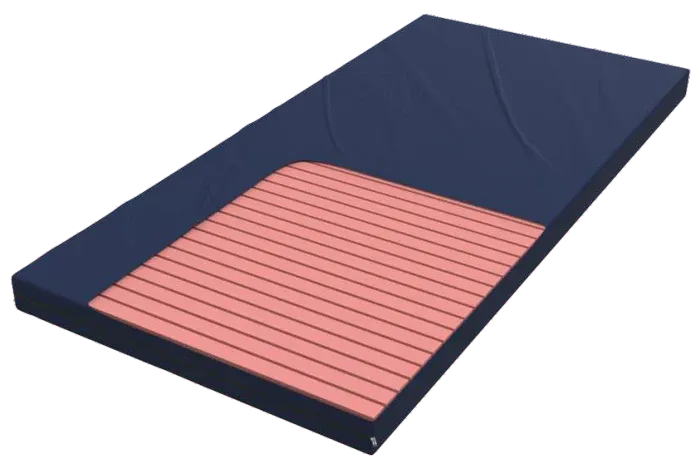
BedMate includes a 4-inch CNC-cut polyurethane foam mattress designed to work with its adjustable support sections.
- Collapsible side rails
Two aluminium side rails are included in the standard configuration.
Their use must be individually assessed because rails can create entrapment and other safety risks.
- Retention of existing furniture
A compatible home bed can remain in place as the supporting structure.
What BedMate Does Not Provide
- Electric bed-height adjustment
The entire bed does not rise or lower.
This matters when caregivers need height adjustment for personal care or transfers.
- Automatic side-to-side turning
BedMate cannot independently turn a patient towards the left or right.
Patients requiring assisted turning still need a suitable repositioning plan.
- Patient lifting or transfer
BedMate is not a patient hoist and cannot lift someone between the bed and wheelchair.
- Independent back and knee controls
The standard system moves these sections together rather than separately.
- Standard battery backup
The published standard configuration has no battery backup.
During a power cut, the mechanism remains in its existing position.
- Manual emergency lowering
No manual emergency-lowering mechanism is provided in the standard published configuration.
A patient who requires urgent repositioning during power failure may need a different solution or an individually planned contingency arrangement.
When Might a Complete Hospital Bed Be Better?
A complete nursing bed may be more appropriate when the patient requires adjustable bed height, specialized transfers, powered turning or other advanced care functions.
The right choice depends on the care plan—not just whether the bed has an electric motor.
How Does Morecare BedMate Help With Homecare Positioning?
The Morecare BedMate Electric Bed Attachment is designed for adults and older users who need powered backrest and knee-rest positioning on a compatible existing home bed.
Its standard configuration includes several useful features.
Electrically Adjustable Backrest
The published backrest elevation reaches up to approximately 85 degrees.
This provides a range of supported upper-body positions, subject to the patient's assessed tolerance.
Electrically Adjustable Knee Rest
The published knee-rest elevation reaches approximately 45 degrees.
The knee-rest and backrest move together during powered adjustment.
Dual Linear Actuators
Two electric linear actuators provide the powered movement.
The system operates using 24V components.
Wired Handset
The included controller allows the user or caregiver to operate the positioning mechanism according to the approved instructions.
Adjustable Frame Length
The standard frame length can be adjusted between 72 and 82 inches.
Custom dimensions may be discussed with Morecare when required.
Included Foam Mattress
The standard package includes a 4-inch CNC-cut PU foam mattress with a removable, washable cover.
However, the mattress should not be assumed to prevent pressure injuries.
Patients at risk of pressure ulcers may require a clinically assessed support surface and repositioning programme.
Collapsible Aluminium Rails
Two push-button-locking side rails are included.
Rail use should follow a patient-specific risk assessment, and mattress-to-rail gaps must be checked.
Published Load Rating
The maximum published user weight is 200 kg.
The existing bed must also be approved to support the combined installed load.
Home Installation
The attachment is supplied with setup instructions and virtual installation guidance.
Actual installation time depends on the existing bed and the configuration.
The system should be inspected and tested before occupied use.
BedMate's core benefit is providing selected electric positioning functions while retaining an appropriate existing bed.
It does not replace every function of a complete hospital bed or the professional care required by a person with substantial mobility limitations.
What Should Families Check Before Buying an Electric Bed Attachment?
Before purchasing an electric bed conversion system, families should review both the existing furniture and the patient's care requirements.
- Measure the Usable Bed Width
Confirm that the actual installation space meets the required dimensions.
For standard BedMate, the minimum usable width is 35 inches.
- Measure the Available Bed Length
Check whether the supporting surface can accommodate the configured 72–82-inch frame.
- Assess the Bed's Structural Condition
A stable and sufficiently strong supporting bed is essential.
Weak slats, damaged joints or uncertain weight-bearing capacity require attention before installation.
- Review the Patient's Positioning Requirements
Confirm that coordinated back-and-knee movement is appropriate.
Some patients may require independent adjustment or specialized clinical positioning.
- Consider Transfer and Caregiver Needs
If the patient requires adjustable bed height or lifting assistance, a bed attachment alone may be insufficient.
- Check Side-Rail and Mattress Safety
The complete bed system must be assessed for entrapment hazards and appropriate rail use.
- Plan for Electrical Failure
BedMate remains in its existing position when power is interrupted.
Families should establish a safe plan for unexpected outages before the attachment is used.
- Confirm Installation and Support
Ask what assembly is required, whether modifications are needed, and which components are covered by warranty.
- Share Bed Photographs
Clear photographs can help Morecare review the supporting frame, usable dimensions, headboard and footboard clearances.
- Obtain Professional Advice When Needed
Patients with complex neurological conditions, pressure-injury risks, significant movement limitations or special positioning requirements may need a detailed clinical assessment.
The best electric bed attachment is not simply the one that fits within the dimensions of the furniture.
It is the one that also supports the patient's prescribed care safely.
Clinical and Safety References
U.S. Food and Drug Administration. Hospital Bed System Dimensional and Assessment Guidance to Reduce Entrapment.
https://www.fda.gov/regulatory-information/search-fda-guidance-documents/hospital-bed-system-dimensional-and-assessment-guidance-reduce-entrapment
U.S. Food and Drug Administration. Safety Concerns About Adult Portable Bed Rails.
https://www.fda.gov/medical-devices/adult-portable-bed-rail-safety/safety-concerns-about-adult-portable-bed-rails
NICE. Pressure Ulcers: Prevention and Management (CG179).
https://www.nice.org.uk/guidance/cg179/chapter/Recommendations
Morecare Mobility & Rehabilitation Solutions. BedMate Electric Adjustable Back & Knee Rest for Existing Beds.
https://morecare.in/bedmate/
Medical Disclaimer: This article provides general information about electric bed attachments and homecare positioning. Bed compatibility, clinical positioning, side-rail use and patient safety should be evaluated by qualified professionals as appropriate. Never assume that an existing bed is suitable solely because its dimensions appear compatible. Follow the manufacturer's approved installation, operation and maintenance instructions.