Why Do Children With Cerebral Palsy Need Different Types of Wheelchairs?
Cerebral palsy affects movement and posture differently in every child.
Some children can sit with relatively limited assistance but cannot walk independently.
Others need continuous external support to maintain their head, trunk and pelvis in a comfortable position.
A child's wheelchair requirements may also change depending on the activity.
For example, a child may need a compact wheelchair when travelling to physiotherapy but require more adjustable seating during home or classroom activities.
Parents should consider two separate questions.
What assistance does the child need while sitting?
This includes head and trunk control, pelvic stability, lower-limb positioning, comfort and the ability to tolerate different seated positions.
How will the wheelchair be used?
This includes school travel, hospital visits, family outings, daily seating, caregiver handling and storage.
The answers influence the type of wheelchair that should be considered.
A lightweight travel wheelchair may be appropriate for selected children who can be positioned adequately without tilt or recline.
A more comprehensive wheelchair may be necessary when the child requires additional adjustments to accommodate their posture or change supported positions.
Neither category is automatically suitable for every child.
A pediatric physiotherapist or occupational therapist should assess the child's individual requirements before equipment selection.
When Is a Lightweight Travel Wheelchair Like EasyGo Useful?
A lightweight travel wheelchair is primarily intended to make caregiver-assisted mobility and equipment transportation more practical.
For families attending frequent school or therapy appointments, a wheelchair's weight and folding arrangement can be important.
The Morecare EasyGo Lightweight CP Travel Wheelchair uses an approximately 8 kg aluminium frame with an umbrella-folding mechanism.
Its design may help caregivers handle and store the empty wheelchair during suitable journeys.
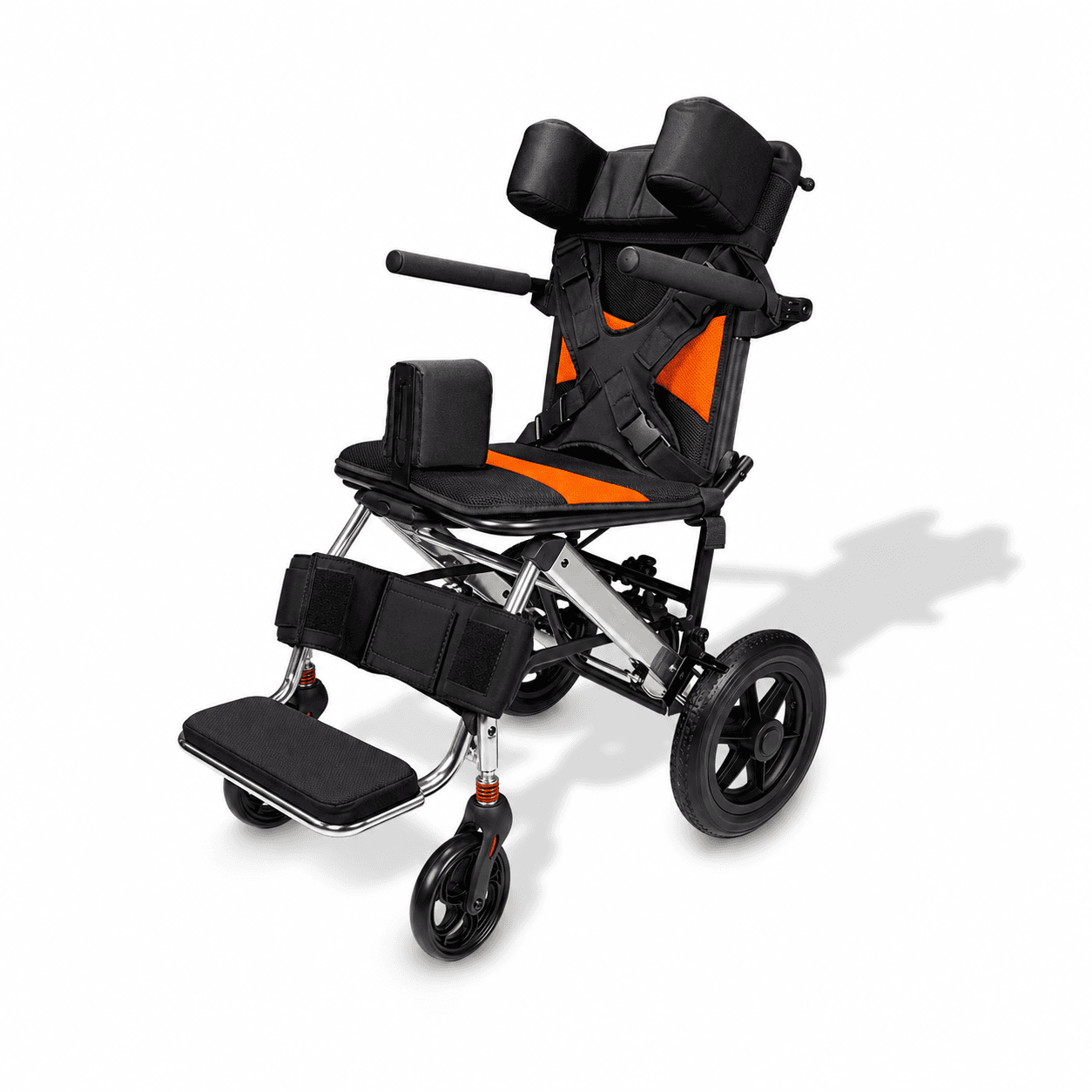
EasyGo also provides additional positioning features beyond those found on many basic transport chairs.
These include:
Adjustable contoured headrest
Provides an additional option for supporting the child's head position.
Four-point butterfly chest harness
Helps maintain the intended upper-body position when appropriately fitted.
Padded leg straps
Provide lower-limb positioning assistance.
Removable abduction support
Can be used when appropriate for the child's assessed hip and thigh position.
Adjustable cushioned footrest
Supports the feet during caregiver-assisted mobility.
Attendant hand brakes and parking locks
Support controlled movement and appropriate stationary positioning.
EasyGo may be considered when the child needs a portable wheelchair for shorter outings and its available seating supports are sufficient.
However, EasyGo does not provide the independent tilt-in-space and backrest recline functions available on Blueflax.
Its portability should not be treated as a reason to overlook substantial head, trunk or pelvic instability.
What Makes Blueflax Different From a Travel Wheelchair?
The Morecare Blueflax Tilt & Recline CP Wheelchair Cum Stroller is designed around more adjustable supported seating.
Its key distinction is the ability to change the wheelchair's seating position using separate tilt-in-space and recline functions.
What is tilt-in-space?
Tilt-in-space changes the angle of the seat and backrest together while broadly maintaining their relationship.
This allows the complete supported seating arrangement to change orientation.
For selected children, tilt may be useful as part of an individualized positioning or rest programme.
However, tilt is not automatically a treatment for poor posture or pressure injuries.
What is recline?
Recline changes the angle between the wheelchair's seat and backrest.
This creates another positioning option that may be appropriate for certain activities or care requirements.
Tilt and recline are different movements and should not be confused.
Their use should be guided by the child's clinical needs, physical tolerance and the manufacturer's instructions.
Additional Blueflax seating features
Blueflax includes configurable head, trunk and pelvic supports, adaptive cushioning, a five-point positioning harness, lateral body supports and adjustable lower-limb components.
These features provide more ways to configure the seating arrangement than EasyGo's standard travel-focused design.
Blueflax has a fixed 18-inch structural seat width, with adaptive cushions used to establish the appropriate effective fit for selected children.
The frame does not physically narrow or widen.
Its published weight is approximately 20 kg, and it uses a three-step folding arrangement.
As a result, Blueflax may be less convenient to transport than EasyGo, but it offers additional seating functions for children who require them.
Blueflax is not automatically appropriate for every child with complex posture or severe head-control difficulties. Individualized seating assessment remains necessary.
EasyGo vs Blueflax — Detailed Product Comparison
Although both are caregiver-propelled pediatric wheelchairs, they are designed for different needs.
- Morecare EasyGo — Lightweight Travel Wheelchair
Primary purpose: Lightweight, caregiver-assisted travel and mobility during shorter outings.
Published price: ₹20,000.
Approximate weight: 8 kg.
Frame material: Aluminium.
Folding mechanism: Umbrella-fold design.
Seat width: 14 inches.
Seat depth: 14 inches.
Head support: Adjustable contoured headrest.
Trunk support: Four-point butterfly chest harness.
Pelvic positioning: Standard cushioned seating with additional positioning options.
Tilt-in-space: Not available.
Recline: Not available.
Lower-limb support: Padded leg straps, removable abduction support and adjustable footrest.
Recommended age: Approximately 4–8 years, with customization considered for selected older children.
Maximum published user weight: 80 kg, subject to appropriate fitting.
Main advantage: Lightweight construction, compact folding and easier transportation of the empty wheelchair.
Best suited for: Selected children who need additional positioning support during school journeys, therapy appointments, hospital visits and shorter family outings.
- Morecare Blueflax — Tilt & Recline CP Wheelchair
Primary purpose: More adjustable supported seating for children requiring additional positioning functions.
Published price: ₹42,000.
Approximate weight: 20 kg.
Frame material: Aluminium alloy.
Folding mechanism: Three-step folding design.
Seat width: Fixed 18-inch structural frame, with adaptive cushions used to configure the effective fit.
Seat depth: Depends on the configured seating arrangement; measurements must be confirmed.
Head support: Configurable head support.
Trunk support: Five-point harness and lateral body supports.
Pelvic positioning: Adaptive cushions and pelvic positioning components.
Tilt-in-space: Available.
Recline: Available.
Lower-limb support: Adjustable footrests, straps and calf supports.
Recommended age: Approximately 4–15 years, subject to individual fitting.
Maximum published user weight: 80 kg; confirm the approved complete-system capacity.
Main advantage: Greater positioning flexibility through tilt, recline and configurable seating supports.
Best suited for: Selected children who require more extensive postural support, adjustable seating positions or tilt and recline as part of their individualized seating programme.
- What Does This Comparison Mean for Families?
Choose EasyGo for consideration when portability is the main priority.
If the child can be appropriately positioned in EasyGo and the family needs a wheelchair that is easier to fold, transport and store, its lighter frame may be an advantage.
Choose Blueflax for consideration when positioning flexibility is the main priority.
If the child requires tilt-in-space, recline or additional trunk and pelvic positioning, Blueflax may be more appropriate.
However, Blueflax should not be selected simply because its structural seat is larger.
Likewise, EasyGo should not be selected merely because the child's weight is below its maximum capacity.
The child's measurements, postural needs and intended activities must guide the decision.
Neither wheelchair should be used as an occupied vehicle passenger seat without specific approval for that purpose and an appropriate transport restraint system.
Which Wheelchair Is More Suitable for Your Child's Needs?
Consider four common situations.
Situation A: The child needs a wheelchair mainly for hospital visits and family outings
The family already has an appropriate seating arrangement at home but finds it difficult to transport a heavy wheelchair.
The child can maintain a suitable seated position with the available head, trunk and lower-limb supports.
EasyGo may be worth considering because of its lightweight frame and umbrella-folding design.
Situation B: The child needs frequent changes in supported seating position
The child has difficulty tolerating a single seated position and the therapist recommends tilt-in-space or backrest recline.
Blueflax may be more appropriate because it provides these adjustments.
However, the therapist must determine how the functions should be used and whether the configured seating provides adequate support.
Situation C: The child has poor head and trunk control
The child regularly leans forward or sideways and requires substantial positioning assistance.
Neither product should be selected without assessing head, trunk and pelvic support.
EasyGo's standard headrest and butterfly harness may be insufficient.
Blueflax offers more configurable supports, but severe instability or complex asymmetry may still require specialist seating.
Situation D: The family needs a wheelchair for both travel and prolonged daily seating
The child spends substantial periods in a wheelchair for school or home activities.
Choosing one lightweight wheelchair for every activity may not be appropriate.
A more adjustable seating system such as Blueflax may deserve consideration, subject to assessment.
Some families may benefit from separate travel and everyday seating arrangements if clinically and practically justified.
The correct choice is not always one product versus the other.
It may involve identifying different mobility requirements for different environments.
What Should Parents Confirm Before Ordering EasyGo or Blueflax?
Before purchasing either wheelchair, families should provide a detailed picture of the child's physical abilities and intended use.
- Head control
Can the child maintain their head position independently, or do they require substantial external support?
- Trunk stability
Does the child lean forward, sideways or require continuous assistance to remain comfortably seated?
- Pelvic positioning
Can the pelvis be positioned comfortably, or does the child have significant asymmetry, sliding or restricted hip movement?
- Seating measurements
Share seated hip width, thigh length, lower-leg length and trunk height.
For Blueflax, confirm how the child's measurements will be accommodated within its fixed structural seat width.
- Lower-limb requirements
Consider foot positioning, leg crossing, joint mobility and any therapist-prescribed supports.
- Need for tilt and recline
Ask whether the child's rehabilitation professional recommends positional adjustments and why.
- Daily use and transportation
Clarify whether the wheelchair will be used primarily for short journeys, school, home activities or prolonged seating.
Families should also confirm car boot dimensions, folding arrangements, caregiver handling capability and after-sales support.
Age and maximum user-weight ratings are useful starting points, but they cannot replace individual fitting.
When more complex positioning is required, in-person evaluation may be necessary even if photographs and video consultations are available.
The goal is to choose equipment that supports the child's comfort, mobility and participation in the activities that matter to the family.
Clinical References
World Health Organization. Wheelchair Provision Guidelines, 2023.
https://www.who.int/publications/i/item/9789240074521
NICE. Cerebral Palsy in Under 25s: Assessment and Management (NG62).
https://www.nice.org.uk/guidance/ng62/chapter/Recommendations
Morecare Mobility & Rehabilitation Solutions. EasyGo Lightweight CP Travel Wheelchair.
https://morecare.in/easygo/
Morecare Mobility & Rehabilitation Solutions. Blueflax Tilt & Recline CP Wheelchair Cum Stroller.
https://morecare.in/blueflax/
Medical Disclaimer: This article provides general information about pediatric wheelchair selection and positioning. Individual equipment suitability should be established through assessment by a qualified rehabilitation professional. Tilt, recline, positioning harnesses and other accessories must be used according to the manufacturer's approved instructions. Neither wheelchair should be used as an occupied motor-vehicle seat without specific approval for that purpose.