Why Do Some Children With Cerebral Palsy Need Customized Wheelchairs?
Cerebral palsy can affect muscle tone, movement, coordination and postural control.
These difficulties differ significantly between children.
One child may sit with minimal support but require a wheelchair for mobility.
Another may have difficulty maintaining head and trunk alignment even when seated.
Some children also have joint limitations or musculoskeletal changes that affect their sitting position.
Standard pediatric wheelchairs are generally manufactured with predetermined frame dimensions and adjustment ranges.
They can work well when these features match the child's needs.
However, customization may deserve consideration in several situations.
Poor Head Control
A child may be unable to maintain their head in a comfortable position without external support.
A standard headrest may not adequately accommodate the required direction or extent of support.
Trunk Instability
Some children repeatedly lean forward or towards one side.
They may need a more individualized arrangement of trunk supports.
Pelvic Positioning Difficulties
A child may slide forward, sit asymmetrically or have difficulty maintaining the pelvis in the intended position.
The problem may involve seat dimensions, pelvic support, muscle tone or joint restrictions.
Unusual Body Measurements
Age does not reliably predict wheelchair fit.
Children of the same age may have different hip widths, thigh lengths, lower-leg lengths and trunk heights.
Restricted Joint Movement
Hip or knee contractures may make conventional seating angles uncomfortable or unsuitable.
Changing Needs During Growth
As children grow, their dimensions and support requirements can change.
A previously suitable wheelchair may need adjustment or replacement.
These problems should be assessed together rather than treated as isolated accessory requirements.
A headrest cannot necessarily compensate for inadequate pelvic or trunk positioning.
Likewise, tightening a harness does not correct every seating difficulty.
The objective is to develop a seating arrangement that accommodates the child's assessed posture and supports appropriate mobility and participation.
Which Medical and Functional Conditions May Require Special Pediatric Seating?
Although this guide focuses on cerebral palsy, other childhood conditions may also create unusual wheelchair requirements.
The need for customization depends on functional limitations and positioning requirements, not diagnosis alone.
Spastic Cerebral Palsy
Some children have increased muscle tone that affects sitting, hip positioning or lower-limb alignment.
Equipment may need to accommodate the child's movement and available joint range.
A wheelchair should not force restricted joints into uncomfortable positions.
Dyskinetic Cerebral Palsy
Involuntary movements and changing muscle tone may make it difficult to maintain a stable posture.
The seating arrangement may need to accommodate movement while providing appropriate support.
Severe Head and Trunk Control Difficulties
Some children require additional external positioning to maintain a comfortable and functional seated posture.
The suitability of standard headrests, harnesses or lateral supports should be assessed carefully.
Cerebral Palsy With Scoliosis or Pelvic Asymmetry
Children with significant spinal or pelvic asymmetry may need more specialized seating components.
The configuration should distinguish between flexible postural deviations and fixed musculoskeletal limitations.
Forcing a fixed deformity towards a neutral position may be inappropriate.
Spina Bifida
Some children with spina bifida experience reduced lower-limb function, altered sensation or complex seating requirements.
Pressure management, skin monitoring and suitable support surfaces may be particularly important.
Neuromuscular Disorders
Conditions involving muscle weakness may affect head control, trunk stability and the ability to reposition independently.
The wheelchair may need to support the child's changing abilities.
Other Developmental or Neurological Conditions
Children with rare conditions may have body dimensions or functional limitations that are not accommodated by standard equipment.
In these situations, the most useful starting point is a clear description of what the child cannot do comfortably or safely with their current wheelchair.
A medical diagnosis helps provide context, but the individual seating assessment determines which modifications may be suitable.
What Parts of a CP Wheelchair Can Be Customized?
Different wheelchair problems require different solutions.
Sometimes, adjusting an existing component is sufficient.
In other situations, the frame, seating geometry or complete wheelchair configuration may need reassessment.
Morecare evaluates customization requests involving the following areas.
- Seat Width and Depth
A seat that is too wide may allow excessive sideways movement.
A seat that is too deep may create pressure behind the knees or prevent the child from sitting in the intended position.
Possible solutions may involve an appropriate seating configuration, supportive cushions or a different frame size.
A change to the structural frame requires engineering review rather than simply cutting or extending components.
- Head Support
Some children need a different headrest height, shape or support arrangement.
A contoured headrest may be suitable for one child but insufficient for another.
More complex requirements may need specialist head-support components.
- Trunk and Lateral Support
Additional lateral positioning may help selected children maintain a more stable supported sitting position.
The placement and pressure of these supports require careful fitting.
- Pelvic Positioning
The pelvis forms the foundation of the seated posture.
An individualized assessment may identify the need for seating cushions, appropriate pelvic positioning components or changes to the seating configuration.
- Chest Harness Configuration
Some children need different harness dimensions or attachment positions.
A chest harness is a positioning aid and must never be used to compensate for an unsuitable seat or create breathing restrictions.
It is not a motor-vehicle crash restraint.
- Footrests and Lower-Limb Support
Footrest height, lower-leg support and approved leg-positioning accessories may need to accommodate individual measurements.
- Abduction and Thigh Positioning
Selected children may benefit from an appropriately fitted thigh-positioning component when recommended.
Such supports do not cure spasticity or prevent hip displacement.
- Tilt-in-Space and Recline
Some children require the ability to change supported seating positions.
These are fundamental wheelchair functions, not simple accessories.
Adding tilt or recline to a product that was not originally designed for them requires substantial engineering review and may not be feasible.
A wheelchair already designed with these functions may be the better option.
- Caregiver Accessibility
Some families may need different handling arrangements or accessible caregiver controls.
Any modification must preserve safe wheelchair operation.
- Growth and Future Adjustments
Where technically feasible, the configuration may be reviewed for selected future adjustments.
However, a customized wheelchair cannot be assumed to accommodate unlimited growth.
Not every modification listed here is available on every Morecare model.
Each request must be evaluated for clinical suitability, structural safety, manufacturing feasibility and compatibility with the chosen wheelchair.
How Does Morecare Evaluate a Custom Wheelchair Requirement?
A made-to-order pediatric wheelchair should not begin with manufacturing.
It should begin with a clear understanding of the child's difficulties.
Morecare's customization service provides a structured route for evaluating unusual equipment requirements.
Step 1: Explain the Current Problem
Parents or therapists describe what is not working.
Examples include:
The child repeatedly falls towards one side.
The wheelchair seat is too deep.
The headrest does not provide suitable positioning.
The child's legs cannot be comfortably accommodated.
The current wheelchair is difficult to use at home or school.
The family needs a configuration that is not available in standard product options.
Step 2: Share Measurements and Supporting Information
Useful information may include:
Child's age, height and weight.
Seated hip width.
Thigh length.
Lower-leg length.
Back and trunk measurements.
Head and trunk control.
Existing wheelchair photographs.
Videos of the seating difficulty, where appropriate.
Therapist's recommendations.
More detailed clinical assessment may be required for complex postural difficulties.
Step 3: Review Feasibility
Morecare evaluates whether the requirement can be addressed through an existing wheelchair configuration, an approved modification or a more specialized design.
Some requests may be unsuitable because of safety, clinical or engineering limitations.
Step 4: Propose a Configuration
Where feasible, the team can discuss the proposed scope, important dimensions, required components and expected limitations.
The solution may involve a modified standard wheelchair or a more extensive made-to-order arrangement.
Step 5: Confirm Cost and Timeline
The quotation should identify the agreed customization scope, additional charges where applicable and estimated manufacturing time.
Projects requiring new engineering or special components may take longer than straightforward adjustments.
Step 6: Manufacture and Verify
Approved configurations proceed through the relevant manufacturing and inspection process.
Structural changes, load-bearing components and powered functions require appropriate product-specific verification.
Step 7: Fit, Train and Follow Up
The child should be assessed in the finished wheelchair to confirm whether the configuration meets the intended requirements.
Families need instructions for correct positioning, adjustment, maintenance and safe operation.
Some children may require further fitting or reassessment as they grow.
This approach aligns with the principles of individualized wheelchair provision: select, fit, train and follow up.
Why Consider Morecare for a Customized Pediatric Wheelchair?
Families searching for customized CP wheelchairs often encounter two problems.
Some suppliers offer only standard sizes and accessories.
Others can fabricate components but may have limited familiarity with the interaction between wheelchair geometry, posture, caregiver handling and rehabilitation requirements.
Morecare combines a pediatric rehabilitation product range with manufacturing and customization services.
Experience in Rehabilitation Equipment
Morecare has worked in the mobility and rehabilitation equipment sector since 2014.
Its manufacturing operations in Jaipur began in 2023.
Existing Pediatric Wheelchair Range
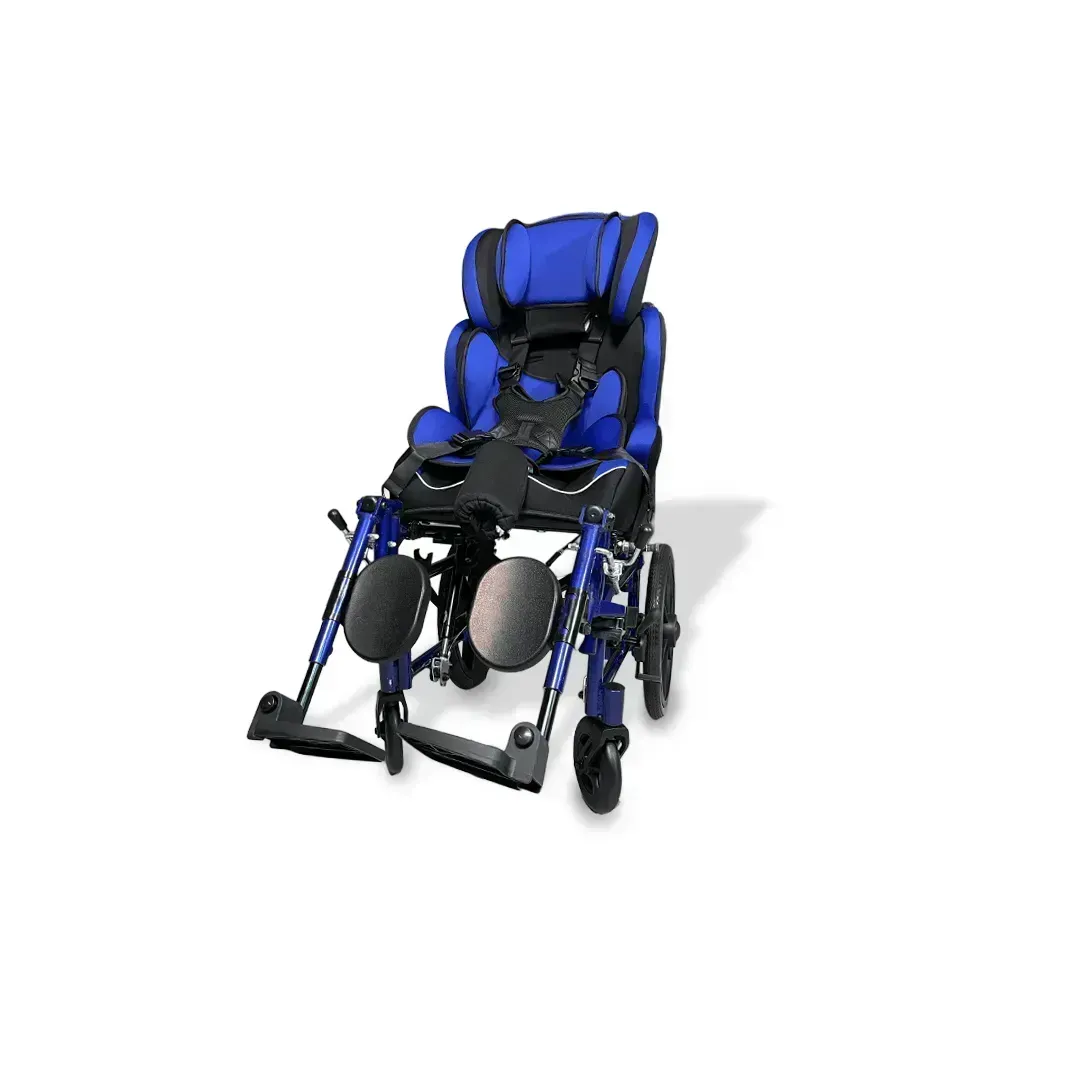
Morecare offers different wheelchair configurations, including the EasyGo travel wheelchair and Blueflax tilt-and-recline CP wheelchair.
These provide starting points for discussing distinct mobility and positioning requirements.
EasyGo focuses on portable, caregiver-assisted mobility for selected children.
Blueflax offers tilt-in-space, recline and more configurable seating supports.
Neither is automatically suitable for every child with complex needs.
Rehabilitation-Focused Customization
Morecare's published customization service includes evaluating equipment modifications, made-to-order products and individual engineering requirements.
For pediatric seating, this means parents can explain the child's specific problem rather than being limited to choosing a catalogue item.
Engineering and Manufacturing Evaluation
The company can review requests that may require fabrication, adjustments or new components.
The exact capabilities, design approach and testing requirements depend on the project.
Collaboration With Rehabilitation Professionals
Morecare's customization service includes working with physiotherapists, occupational therapists and other rehabilitation stakeholders.
For complex pediatric postural needs, input from the child's treating professionals is especially important.
One-Off Requirements
Some children need a configuration that is not suitable for mass production.
Morecare's service accepts individual custom-project enquiries, subject to feasibility review.
Direct Discussion of the Problem
Parents do not need to prepare professional CAD drawings before making an enquiry.
They can begin with a simple explanation, photographs, measurements and relevant product references.
Morecare can then determine what further information is necessary.
The real benefit is access to a manufacturer willing to examine an unusual rehabilitation requirement, while remaining clear about what can and cannot be safely provided.
How Much Does a Custom CP Wheelchair Cost, and What Should Parents Share?
The cost of a customized pediatric wheelchair depends on the selected base product and the work required.
A minor support adjustment may involve different costs and development time from manufacturing a substantially modified seating system.
What Influences the Price?
Base wheelchair model
The starting configuration influences the frame, mechanisms and available adjustments.
Custom seating components
Specialized cushions, headrests, lateral supports or harnesses may require additional materials and fitting.
Structural modifications
Changes to load-bearing components may involve engineering work and additional testing.
Powered or moving mechanisms
Modifications involving tilt, recline, electrical systems or complex linkages can increase technical requirements.
Prototype or fitting work
Some projects may need additional development or fitting before the configuration can be approved.
What About Delivery Timelines?
There is no fixed timeline that applies to every made-to-order pediatric wheelchair.
An existing product with a straightforward approved modification may be completed sooner than a new design.
Morecare should confirm the estimated schedule after reviewing the individual requirement.
Is a Custom Wheelchair Always Necessary?
No.
Some seating problems can be resolved by selecting a better-fitting standard wheelchair or adjusting the available supports.
A custom design should be considered when the assessed needs cannot be adequately met using appropriate existing options.
What Information Should Parents Send?
To begin a useful consultation, share:
Child's age, height and weight.
Medical condition and relevant functional difficulties.
Head and trunk control: whether the child can maintain sitting posture.
Current wheelchair: model, photographs and the specific problems experienced.
Seating measurements: hip width, seat depth requirements, trunk height and lower-leg length.
Joint or positioning restrictions: where identified by a healthcare professional.
Daily use: home, school, therapy, travel or prolonged seating.
Therapist recommendations: seating assessment or prescribed supports, if available.
Location and practical constraints: doorway access, vehicle requirements and caregiver assistance.
Budget and urgency: where relevant.
Families should share personal medical information and identifiable images only with appropriate consent and through the company's authorized enquiry channel.
The purpose of the initial discussion is to determine whether a suitable solution is feasible.
Clinical and Technical References
World Health Organization. Wheelchair Provision Guidelines, 2023.
https://www.who.int/publications/i/item/9789240074521
NICE. Cerebral Palsy in Under 25s: Assessment and Management (NG62).
https://www.nice.org.uk/guidance/ng62/chapter/Recommendations
Morecare Mobility & Rehabilitation Solutions. Customization Services.
https://morecare.in/customization-services
Morecare Mobility & Rehabilitation Solutions. Blueflax Tilt & Recline CP Wheelchair.
https://morecare.in/blueflax/
Morecare Mobility & Rehabilitation Solutions. EasyGo Pediatric Travel Wheelchair.
https://morecare.in/easygo/
Medical and Engineering Disclaimer: This article provides general information about pediatric wheelchair customization. Equipment suitability, seating dimensions, postural supports and modifications should be determined through individualized assessment by appropriately qualified rehabilitation professionals. Changes to structural frames, powered mechanisms or other safety-critical wheelchair components require suitable engineering verification. Customization does not guarantee improved clinical outcomes or prevent musculoskeletal complications.