Can a Child With Cerebral Palsy Use a Travel Wheelchair Every Day?
A lightweight travel wheelchair can be part of a child's daily mobility routine.
For example, some families use a portable wheelchair for the journey between home and school.
Others use it during regular physiotherapy appointments, hospital visits or community outings.
In these situations, the wheelchair may be used frequently without necessarily being occupied for prolonged, uninterrupted periods.
However, parents should distinguish between two situations.
Frequent Short-Duration Travel
The wheelchair is used for journeys and activities during which the child can be appropriately supported.
The child may also use another seating system at school or home.
Prolonged Daily Seating
The wheelchair is used for extended periods during classroom activities, meals, rest or other daily routines.
This may require more extensive adjustments, pressure-management strategies and opportunities for changing position.
A wheelchair's suitability for one situation does not establish suitability for the other.
The child's ability to maintain posture, communicate discomfort and reposition independently affects the decision.
Some children may use a travel wheelchair frequently without difficulty when properly fitted.
Others may need a more comprehensive adaptive wheelchair even for relatively short activities.
There is no single daily seating duration that is appropriate for every child with cerebral palsy.
A pediatric physiotherapist or occupational therapist should help determine the appropriate use pattern.
Why Does Prolonged Sitting Require More Attention?
Sitting places pressure on areas of the body that contact the wheelchair.
These may include the pelvis, thighs, back and feet.
When a child has limited movement or cannot independently change position, pressure may remain concentrated in certain areas.
Poor seating fit can also contribute to discomfort or undesirable postural changes.
Parents should understand several important considerations.
Pressure Distribution
An appropriate seating surface should help distribute support according to the child's needs.
A simple foam cushion may be adequate for some users but insufficient for others.
The suitability of a pressure-relieving cushion depends on the complete seating arrangement.
Ability to Reposition
Some children can shift their body position independently.
Others require assistance to change posture or relieve pressure.
Muscle Tone and Movement
Spasticity, dystonia or involuntary movements can affect how the child sits and where pressure develops.
Pelvic and Trunk Alignment
An unstable pelvic position may cause the child to slide, lean or experience uneven pressure.
Comfort and Pain
Children with cerebral palsy may experience discomfort for several reasons, including musculoskeletal conditions, muscle fatigue or unsuitable positioning.
Parents should not assume that a child is comfortable simply because the child is quiet.
Signs such as persistent redness, repeated sliding, distress, unusual stiffness or changes in sitting tolerance should prompt reassessment.
A specialized seating assessment may be necessary when the child is at risk of pressure-related skin problems.
What Seating Features Matter During Everyday Wheelchair Use?
A wheelchair intended for frequent use should provide an appropriate overall seating arrangement.
The frame, cushion, headrest, trunk supports, pelvic positioning and footrests all influence how the child sits.
Seat Width and Depth
The seat should fit the child's body measurements.
Excessive seat width may allow unwanted sideways movement.
An unsuitable seat depth may create pressure behind the knees or fail to support the thighs appropriately.
Head Support
Some children benefit from an adjustable headrest.
However, significant head-control limitations may require more specialized supports.
Trunk Stability
A correctly fitted positioning harness may help selected children maintain an appropriate upper-body position.
Children with substantial lateral instability may need additional trunk supports.
Pelvic Positioning
The pelvis forms the foundation of sitting posture.
Its position should be assessed together with the seat cushion and other supports.
Lower-Limb Support
Footrests, leg straps and other positioning components should accommodate the child's joint mobility and comfort.
Pressure Management
Some children require specialized cushions or changes in supported position as part of their seating programme.
These components should be selected based on the child's individual risk and requirements.
A wheelchair with more accessories is not automatically more suitable.
The components must work together as an appropriately fitted seating system.
When Is a Travel Wheelchair Not Enough for All-Day Seating?
A lightweight folding wheelchair may offer useful portability but still lack the adjustments required for some children.
Several situations should prompt consideration of more comprehensive seating.
- The Child Cannot Reposition Independently
Children who remain in one position without assistance may need a structured repositioning and pressure-management plan.
- The Child Requires Frequent Positional Changes
Some children benefit from appropriately prescribed tilt-in-space or recline functions.
These adjustments should be selected and used according to professional assessment.
- Significant Head or Trunk Instability
A standard headrest and chest harness may not provide sufficient support for complex postural difficulties.
- Persistent Sliding or Pelvic Asymmetry
Repeated movement out of position may indicate inadequate seating fit or a need for specialized pelvic support.
- Pressure-Related Skin Problems
Persistent redness, pressure injury or recurrent skin irritation requires prompt professional attention.
- Pain or Reduced Sitting Tolerance
Discomfort may be associated with joint limitations, muscle tone, pressure or other medical concerns.
- The Child Needs Specialized Classroom Seating
A travel chair may be useful for reaching school but may not provide the support required throughout classroom activities.
In these situations, a wheelchair such as the Morecare Blueflax may be considered when its tilt, recline and configurable supports match the child's requirements.
However, Blueflax is not automatically a complete pressure-management solution.
A child may require a specialist cushion, customized seating or another clinically prescribed system.
The appropriate choice should follow individualized assessment.
Where Does Morecare EasyGo Fit Into a Daily Mobility Routine?
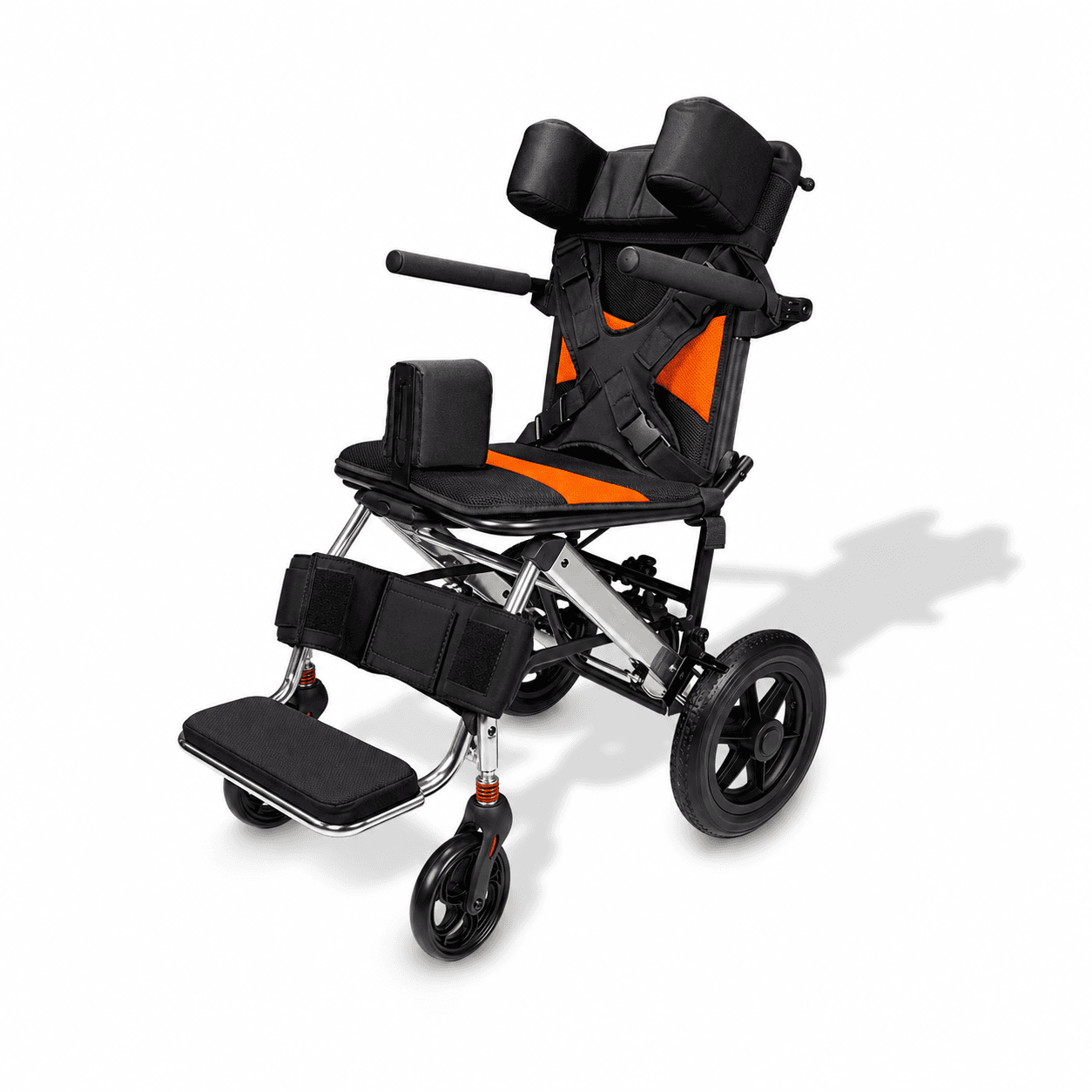
The Morecare EasyGo Lightweight CP Travel Wheelchair is designed for selected children who need portable, caregiver-assisted mobility with additional positioning features.
Its main advantages relate to transportation and practicality during shorter outings.
Lightweight Aluminium Frame
EasyGo weighs approximately 8 kg, making the empty wheelchair more manageable for some caregivers than heavier alternatives.
Umbrella-Folding Mechanism
The folding design allows the unoccupied wheelchair to be stored and transported more conveniently when suitable space is available.
Adjustable Contoured Headrest
Provides additional head-positioning options for selected children.
Four-Point Butterfly Chest Harness
Offers upper-body positioning assistance when properly fitted.
Padded Leg Positioning Straps
Help maintain an appropriately assessed lower-limb position.
Removable Abduction Support
Provides an additional positioning option when suitable for the child's hip mobility and seating requirements.
Adjustable Cushioned Footrest
Supports the child's feet during caregiver-assisted mobility.
Optional Seating Customization
Depending on the configuration, Morecare can discuss harness sizing, backrest-height adjustments, pressure-relieving cushion options and selected additional supports.
However, adding a pressure-relieving cushion does not automatically make EasyGo suitable for continuous all-day seating.
The complete seating arrangement still requires assessment.
EasyGo has a standard 14-inch seat width and 14-inch seat depth.
Its recommended age range is approximately 4–8 years, with customization considered for selected older children.
The published maximum user weight is 80 kg, but appropriate fit depends on the child's measurements and positioning needs.
EasyGo may be considered as:
A wheelchair for suitable school journeys.
A portable option for regular physiotherapy appointments.
A mobility solution for hospital visits.
An additional travel wheelchair for family outings.
A secondary wheelchair when the child already has appropriate specialized seating elsewhere.
It does not provide the same tilt-in-space or recline functions as Blueflax.
Therefore, its intended travel use should not be interpreted as an assurance of prolonged seating suitability.
How Can Parents Decide Whether One Wheelchair Is Enough?
Parents often prefer purchasing one wheelchair that can be used in every situation.
That is understandable, particularly when rehabilitation equipment represents a significant investment.
However, choosing a single wheelchair should depend on whether it can meet the child's different daily requirements.
A pediatric therapist can help families review the following questions.
What Is the Main Purpose?
Will the wheelchair be used mostly for transportation, or will it serve as the child's primary seating system?
How Long Will the Child Remain Seated?
Consider the child's actual routine and opportunities for rest, transfers and repositioning.
There is no universal safe time limit for all children.
Can the Child Change Position?
Determine whether the child can independently adjust posture or requires caregiver assistance.
Does the Child Need Tilt or Recline?
Ask whether positional adjustments are clinically necessary.
Does the Child Have Any Pressure-Related Concerns?
Consider skin condition, pressure history, discomfort and the suitability of the cushion.
Is the Wheelchair Correctly Sized?
Seat width, depth, backrest height, footrest position and head support should match the child's measurements.
Can the Family Manage Transportation?
Review wheelchair weight, folding, car boot space and caregiver handling ability.
For some families, a properly configured single wheelchair may meet several daily needs.
For others, separate travel and specialized seating arrangements may be more appropriate.
The correct solution depends on the child's needs, not simply the convenience of owning fewer products.
Wheelchair fit and use should be reassessed as the child grows or their functional abilities change.
Clinical References
World Health Organization. Wheelchair Provision Guidelines, 2023.
https://www.who.int/publications/i/item/9789240074521
NICE. Cerebral Palsy in Under 25s: Assessment and Management (NG62).
https://www.nice.org.uk/guidance/ng62/chapter/Recommendations
Wound Healing Society. Guidelines for the Treatment of Pressure Ulcers — 2023 Update.
https://pmc.ncbi.nlm.nih.gov/articles/PMC11403384/
Morecare Mobility & Rehabilitation Solutions. EasyGo Lightweight CP Travel Wheelchair.
https://morecare.in/easygo/
Morecare Mobility & Rehabilitation Solutions. Blueflax Tilt-in-Space CP Wheelchair.
https://morecare.in/blueflax/
Medical Disclaimer: This article provides general information about wheelchair seating and mobility. Appropriate seating duration, positioning, pressure management and equipment selection require individual assessment by qualified rehabilitation professionals. Persistent skin redness, pain or other concerning symptoms require professional evaluation. Follow the manufacturer's approved instructions for all wheelchair components.