What Challenges Do Families Face When Caring for a Bedridden Parent?
Homecare can change significantly when an elderly parent becomes unable to move or reposition independently.
Some individuals spend most of the day in bed because of weakness, neurological conditions, recovery after illness or other mobility limitations.
Others can participate in certain movements but still require substantial assistance.
Families may need to help with several activities.
Changing Resting Positions
A parent may become uncomfortable after remaining in one position.
Caregivers may need to adjust the upper body or help the person return towards a flatter position.
Moving Between Lying and Supported Elevation
Some people cannot raise their upper body without assistance.
Caregivers may use pillows or physically help them into an elevated position.
Routine Personal Care
Activities such as grooming, changing clothing and other bed-based care may require an appropriate supported position.
Monitoring Comfort
Pain, fatigue, muscle stiffness and reduced movement can influence how comfortable a person feels in bed.
Managing Repeated Caregiver Tasks
When several adjustments are required throughout the day, manually supporting or repositioning the person may become physically demanding.
However, not all these activities require the same equipment.
An electric backrest may assist with selected changes in lying position.
A patient who requires complete assistance with transfers may need a separate lifting system.
Someone who cannot turn independently may still require caregiver-assisted repositioning or specialized equipment.
Understanding the exact difficulty is the first step towards choosing suitable homecare support.
How Can Electric Backrest Elevation Help During Daily Care?
A conventional flat bed does not provide powered upper-body positioning.
Caregivers often use pillows to help a person rest with their head and trunk elevated.
This may be adequate for some individuals, but repeated pillow adjustments can be inconvenient and may not provide a stable or consistent position.
An electric backrest allows the supported upper-body angle to be adjusted through a powered mechanism.
Resting in a Supported Elevated Position
Some people prefer a raised upper-body position during parts of the day.
An adjustable backrest can make this positioning more repeatable.
However, the appropriate angle depends on the person's comfort, medical condition and care plan.
Reading and Conversation
A supported elevated position may allow selected users to engage more comfortably in activities such as reading, watching television or talking with family.
Bed-Based Personal Care
Caregivers may find certain approved activities more practical when the person's upper body is appropriately supported.
The correct position should be determined according to the particular task and the patient's needs.
Reducing Repeated Pillow Rearrangement
Powered positioning may reduce the need to repeatedly build and adjust stacks of pillows for upper-body elevation.
However, pillows and other supports may still be required as part of an individualized positioning plan.
Understanding the Limitations
Raising the backrest can also cause a person to slide down the bed, particularly when they have limited trunk or pelvic control.
This movement can increase discomfort and create shear forces against the skin.
Caregivers should therefore monitor the person's position and follow the prescribed method for adjusting the bed.
An elevated backrest is not automatically appropriate for every patient or every activity.
For example, swallowing difficulties, aspiration risk, respiratory conditions and post-surgical restrictions require individual clinical guidance.
Why Might Adjustable Knee Support Be Useful?
Upper-body positioning is only one part of a bed's adjustable surface.
Some systems also include a movable section beneath the knees.
This allows the lower-body resting position to change when the adjustment is appropriate for the person.
Supporting Different Resting Positions
An adjustable knee section can change the arrangement of the thighs and lower legs relative to the mattress.
Some people may find a particular supported position more comfortable.
However, the position must accommodate the individual's hip and knee mobility.
Coordinating Back and Knee Positioning
Certain adjustable beds raise the back and knee sections together.
This provides a defined combined movement rather than separate adjustment of each section.
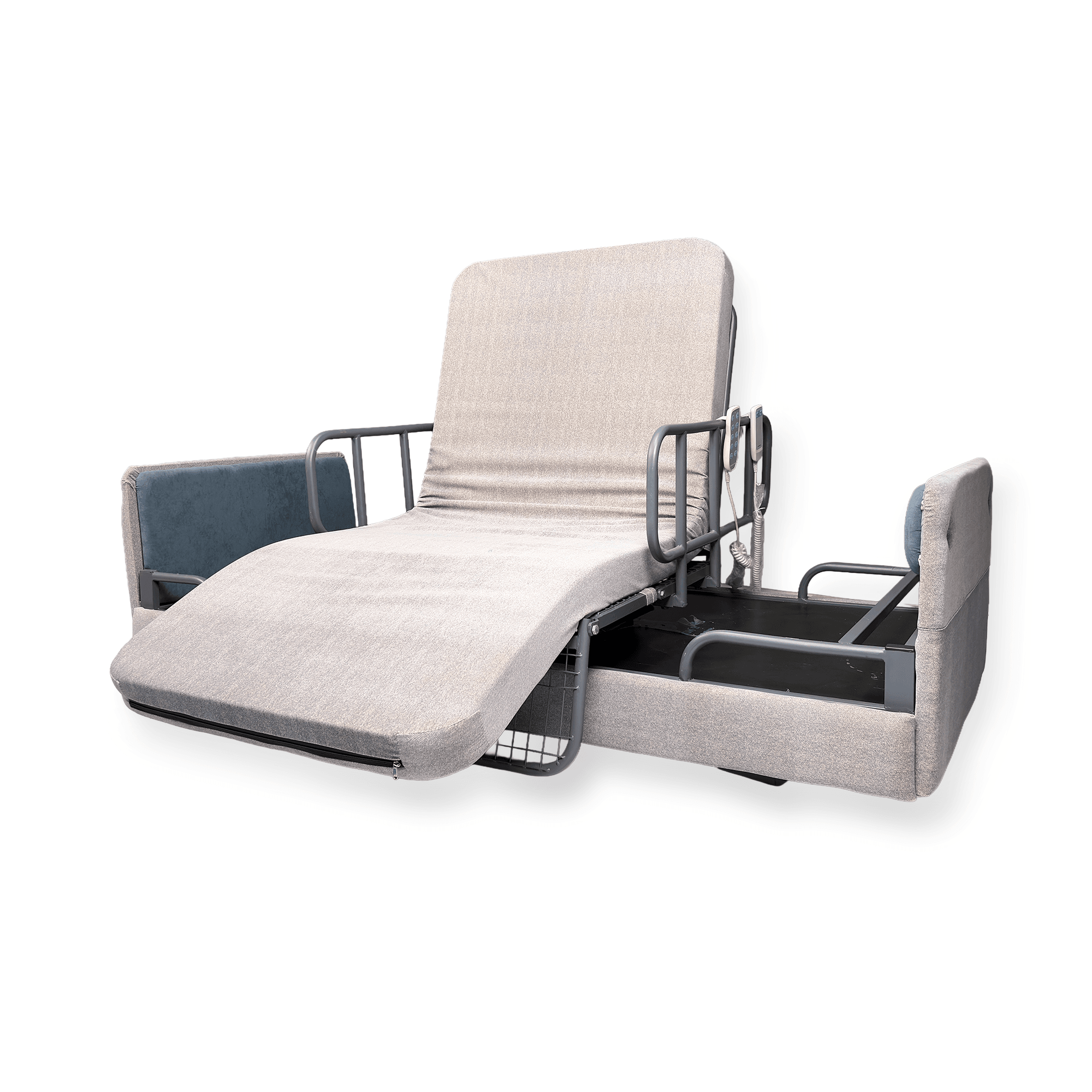
The Morecare BedMate uses this coordinated arrangement.
Its two electric actuators operate the backrest and knee-rest sections simultaneously.
The standard configuration does not provide independent backrest and knee-rest controls.
What Families Should Check
Before using knee elevation, consider whether the patient has:
Hip or knee pain.
Restricted joint movement.
Fixed contractures.
Recent surgery with specific positioning restrictions.
Significant swelling or other medically relevant conditions.
Difficulty tolerating the combined back-and-knee movement.
A caregiver should never force the legs into a particular angle using the bed mechanism.
Knee elevation should also not be advertised as a treatment for poor circulation, swelling, pressure injuries or other medical conditions without condition-specific clinical evidence.
The objective is to provide an appropriate supported position as part of the person's overall care plan.
What Can an Adjustable Bed Not Do for a Bedridden Patient?
This is one of the most important questions families should understand before purchasing equipment.
An adjustable backrest and knee-rest mechanism may help with selected movements, but a fully dependent person often requires additional care.
- It Does Not Automatically Turn the Patient Sideways
BedMate cannot independently turn someone towards their left or right side.
Patients who cannot reposition themselves may need assisted turning, suitable repositioning equipment and an individualized care plan.
- It Does Not Prevent Pressure Injuries
Pressure injuries can develop when pressure and shear affect the skin and underlying tissues.
A person with severely limited mobility may require:
Individual pressure-risk assessment.
A clinically appropriate mattress or support surface.
Assisted repositioning at prescribed intervals.
Regular skin monitoring.
Appropriate heel-pressure management.
Review of pain, comfort, nutrition and moisture-related skin concerns.
BedMate's included foam mattress should not be assumed to provide the same pressure-redistribution performance as a clinically prescribed specialist mattress.
Electric back-and-knee movement is not a substitute for a pressure-care programme.
- It Does Not Lift the Patient Out of Bed
BedMate is not a patient-transfer hoist.
If the person requires substantial assistance moving between bed and wheelchair, a dedicated transfer solution may be necessary.
- It Does Not Raise or Lower the Whole Bed
The overall bed height is determined by the existing supporting furniture.
If caregivers need adjustable bed height for safe access or transfers, a complete height-adjustable nursing bed may be more appropriate.
- Bed Rails Are Not Universal Fall-Prevention Devices
Side rails can create risks, including entrapment between the rail, mattress and bed frame.
They should only be used after appropriate assessment and correct installation.
- It Does Not Replace Caregiver Training
Families must still understand safe positioning, transfer assistance, skin monitoring, electrical controls and what to do if the equipment stops working.
The most suitable equipment depends on the tasks that caregivers actually need to perform.
How Does Morecare BedMate Support Homecare Positioning?
The Morecare BedMate Electric Bed Attachment is designed for selected adults and elderly users who require powered backrest and knee-rest positioning while retaining a compatible existing home bed.
Its standard configuration includes the following features.
Electric Backrest Elevation
The published backrest range extends to approximately 85 degrees.
This allows the upper body to be placed in different supported positions, subject to the person's tolerance and care plan.
Electric Knee-Rest Adjustment
The knee-rest section elevates up to approximately 45 degrees.
Coordinated Dual-Actuator Movement
Two 24V electric actuators operate the back and knee sections together.
They are not independently adjustable in the standard configuration.
Wired Handheld Controller
The powered movement is controlled using a wired handset.
The patient or caregiver can operate the system when appropriate and in accordance with the instructions.
Existing-Bed Compatibility
BedMate is intended for compatible home beds with:
At least 35 inches of usable width.
Sufficient space for its adjustable 72–82-inch frame.
A stable, structurally suitable supporting surface.
Adequate clearance around the moving sections and side rails.
Included Foam Mattress
A 4-inch contour-cut polyurethane foam mattress is supplied.
Its suitability for patients with increased pressure-injury risk should be assessed separately.
Collapsible Aluminium Side Rails
The standard package includes two side rails.
These require correct installation and patient-specific safety assessment.
Published User Capacity
BedMate has a published user-weight capacity of up to 200 kg.
The existing bed must also safely support the combined load of the patient, attachment and other applicable components.
Power-Failure Behaviour
If electrical power is lost, BedMate remains in its current position.
The standard system does not include battery backup or manual emergency lowering.
Therefore, families should not rely on it when immediate powered position changes may be essential unless an appropriate contingency arrangement is established.
Main Intended Benefit
BedMate allows selected families to introduce electric back-and-knee positioning without replacing the entire bed.
It does not provide powered side turning, overall bed-height adjustment or patient lifting.
How Should Families Choose a Bed for an Elderly Parent With Limited Mobility?
Before purchasing an adjustable bed attachment or complete nursing bed, families should evaluate their parent's actual care requirements.
- Identify the Main Positioning Problem
Does the person primarily need assistance moving between flat and elevated resting positions?
Or do they require turning, transfers, whole-bed height adjustment or additional functions?
- Review the Patient's Mobility
Can the person independently change position?
Can they participate in transfers?
Do caregivers need to provide substantial physical assistance?
- Understand Medical Positioning Requirements
Some conditions or recent procedures may involve specific positioning restrictions.
The treating clinician should confirm whether coordinated back-and-knee movement is appropriate.
- Consider Pressure-Injury Risk
People who remain in bed for prolonged periods may need specialist support surfaces, assisted repositioning and regular skin assessment.
- Check the Existing Bed
BedMate requires a compatible supporting bed.
The usable dimensions, structural condition and overall load-bearing capacity must be reviewed.
- Evaluate Caregiver Access
Consider whether the existing bed height allows the intended care activities and approved transfer methods to be performed safely.
- Plan for Power Failure
Determine whether the patient can safely remain in the current position until power returns.
If urgent repositioning may be required, select a system and care arrangement that addresses this need.
- Consider Future Care Needs
A person who currently requires only backrest adjustment may later need more comprehensive homecare assistance.
Families should discuss expected care requirements with the treating healthcare team.
- Arrange Installation and Training
The equipment should be installed correctly, tested and demonstrated before occupied use.
- Review Whether a Complete Nursing Bed Is Necessary
A complete hospital or homecare bed may be more appropriate when adjustable height, advanced positioning or specialized nursing functions are essential.
The goal is to select equipment that supports the patient's actual needs while avoiding unnecessary features and inappropriate compromises.
Clinical and Safety References
NICE. Pressure Ulcers: Prevention and Management (CG179).
https://www.nice.org.uk/guidance/cg179/chapter/Recommendations
U.S. Food and Drug Administration. Safety Concerns About Adult Portable Bed Rails.
https://www.fda.gov/medical-devices/adult-portable-bed-rail-safety/safety-concerns-about-adult-portable-bed-rails
U.S. Food and Drug Administration. Hospital Bed System Dimensional and Assessment Guidance to Reduce Entrapment.
https://www.fda.gov/regulatory-information/search-fda-guidance-documents/hospital-bed-system-dimensional-and-assessment-guidance-reduce-entrapment
Morecare Mobility & Rehabilitation Solutions. BedMate Electric Adjustable Back & Knee Rest for Existing Beds.
https://morecare.in/bedmate/
Medical Disclaimer: This article provides general information about homecare positioning and adjustable bed equipment. Individual positioning, pressure management, transfers and nursing care should follow recommendations from qualified healthcare professionals. Always follow the manufacturer's approved installation and operation instructions.