How Does a Standard Walker Support Walking?
A conventional walking frame is commonly prescribed for adults who need additional balance or weight-bearing assistance.
Depending on its design, it may have four fixed legs, front wheels or a wheeled frame.
The user generally supports themselves by holding the handles and transferring some load through their arms.
For individuals with sufficient trunk control, upper-limb strength and standing ability, this may provide appropriate assistance.
However, a conventional walker does not usually provide direct support around the chest or pelvis.
If a person cannot maintain upright posture or control their trunk while standing, relying only on the handgrips may be inadequate.
The appropriate solution depends on whether the main difficulty is balance, muscle weakness, postural control or another medical factor.
Five Signs a Standard Walker May Not Provide Enough Support
Families and therapists may observe several difficulties during assisted walking.
- Excessive forward leaning
The person bends forward over the walker and struggles to maintain an upright position.
This may indicate weakness, fatigue, poor postural control or an improperly adjusted walking aid.
- Sideways trunk instability
The person repeatedly leans to one side while standing or stepping.
They may need substantial assistance to maintain their trunk position.
- Difficulty supporting body weight
The person's legs cannot consistently support the required load during walking.
This requires careful assessment because a supportive walker may not provide enough unloading.
- Dependence on continuous physical assistance
A caregiver or therapist must constantly support the person's upper body to prevent loss of balance.
This may suggest that the current walking aid does not match the patient's needs.
- Difficulty coordinating supported steps
The person can move their legs to some extent but struggles to combine stepping, weight shifting and postural stability.
A rehabilitation professional may recommend additional support or a different gait-training approach.
These signs do not automatically mean that a more complex walker is required. Incorrect walker height, fatigue, medication effects and other factors should also be assessed.
Why Is Trunk Control Important During Walking?
Trunk control refers to the ability to maintain and adjust the position of the upper body during movement.
Walking requires coordination between the trunk, pelvis and lower limbs.
When a person takes a step, body weight shifts between the legs. The trunk must respond to these movements to help maintain balance.
After a stroke or other neurological injury, impaired muscle activation, sensation and coordination can make these adjustments difficult.
A person may therefore have some movement in both legs yet remain unable to walk safely using a conventional frame.
Rehabilitation may involve trunk-strengthening exercises, supported standing, balance training and repeated stepping practice.
For selected individuals, equipment with additional trunk and pelvic positioning supports may help facilitate these activities.
However, external support should be selected carefully so that it assists rather than unnecessarily restricts movement.
How Is the Morecare Crab Walker Different?
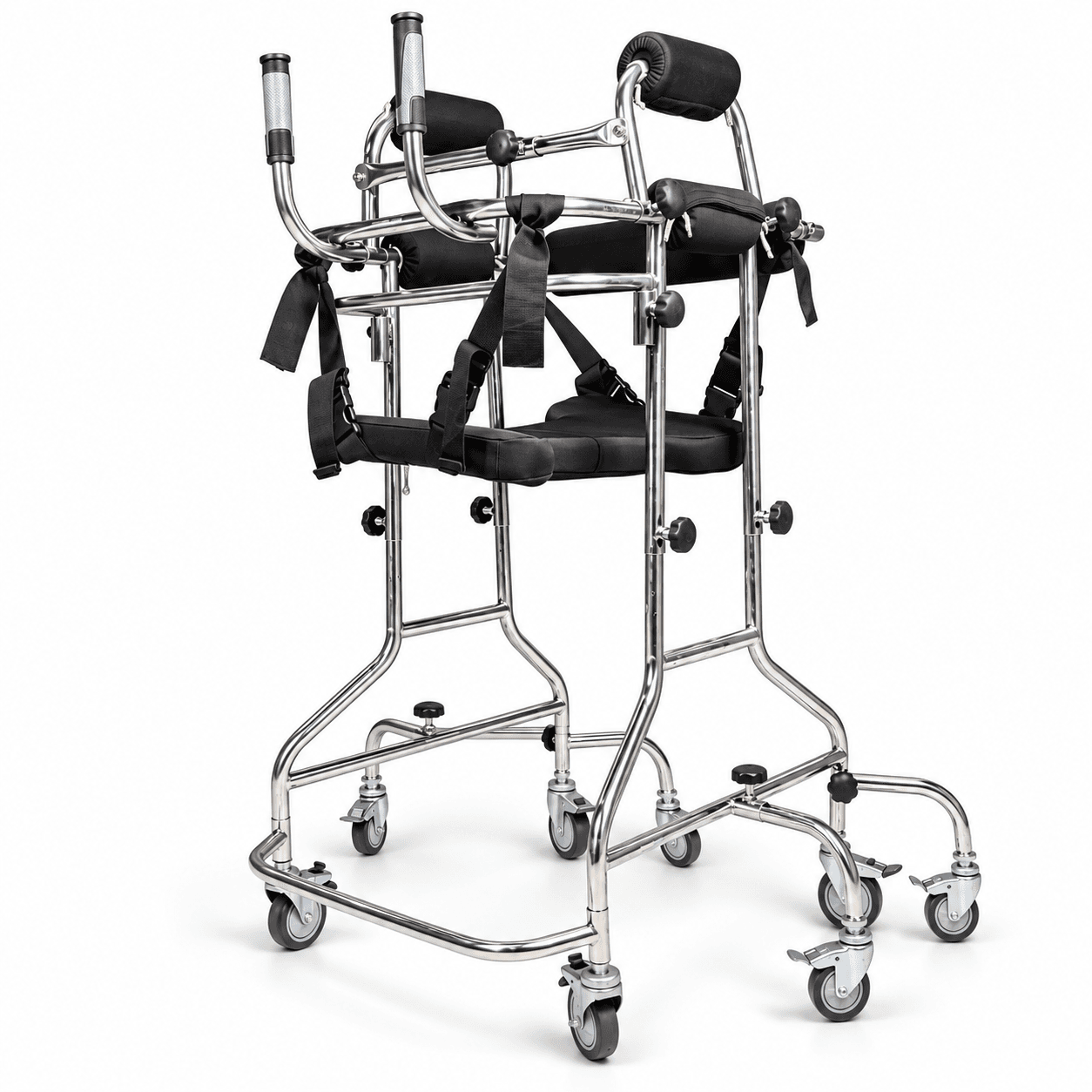
The Morecare Crab Walker is designed for adults who require additional body positioning and support during supervised standing and gait training.
Unlike a conventional walking frame, it includes an integrated support arrangement around the upper body and pelvis.
Its main features include:
Adjustable chest support
Padded chest support provides an additional contact point for upper-body positioning.
Padded arm supports
These allow the user's forearms to rest on supportive surfaces rather than relying exclusively on conventional handgrips.
Pelvic sling
The pelvic sling provides partial body-weight assistance and additional pelvic positioning support.
It is not intended for complete suspension or patient lifting.
Eight-wheel base
Eight individually lockable castors support equipment positioning and controlled movement according to the manufacturer's instructions.
The wheel arrangement does not eliminate the risk of tipping or falling.
Adjustable structure
The frame and support positioning can be adjusted for selected adult users according to their measurements and rehabilitation requirements.
The Crab Walker is intended to support participation in appropriate rehabilitation activities, not to move the legs automatically or replace active muscle function.
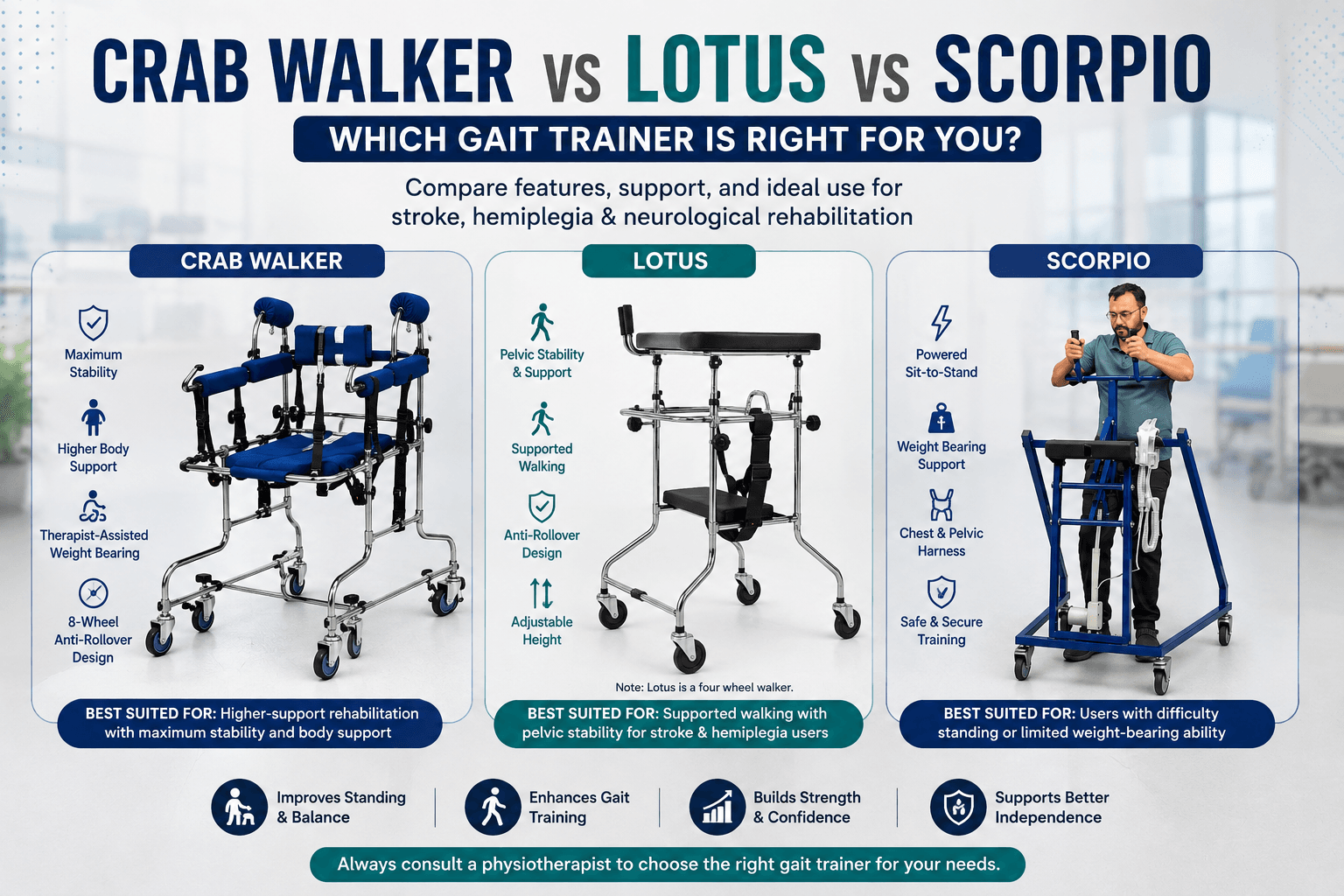
Standard Walker vs Crab Walker – Which Is More Appropriate?
The most suitable device depends on how much assistance the person needs.
Requirement
Standard Walker
Morecare Crab Walker
Hand support
Yes
Yes
Forearm support
Model-dependent
Included
Chest support
Generally not included
Included
Pelvic support
Generally not included
Partial support sling
Trunk positioning
Primarily user-controlled
Additional external support
Walking assistance
For users with sufficient stability
For selected users needing more postural support
Full-body lifting
No
No
Professional assessment
Recommended
Essential
A standard walker may be preferable for someone who already has adequate trunk control and needs only modest assistance.
The Crab Walker may be considered when additional chest, forearm and pelvic positioning support is clinically appropriate.
However, if the person cannot bear sufficient weight through their legs, needs substantial body-weight unloading or cannot safely maintain supported standing, another rehabilitation system may be required.
More equipment is not always better. The aim is to match the level of support to the person's actual functional abilities.
How Should Families Choose the Right Walking Equipment?
Before purchasing a supportive walker, gather information about the person's current mobility.
Start with their ability to sit upright, stand with assistance, support weight through the legs and initiate stepping.
Next, consider how much help they currently need from a caregiver or therapist.
If the patient has difficulty maintaining trunk alignment, additional chest or pelvic support may be worth discussing.
For home rehabilitation, also evaluate available walking space, floor conditions, doorway clearance and the caregiver's ability to assist safely.
The Morecare Crab Walker is designed for adults approximately 5 to 6.2 feet tall, subject to individual fitting.
The maximum permitted user weight should be confirmed with Morecare against the specific product configuration before purchase.
A physiotherapist should assess whether the person is suited to a conventional walker, a supportive gait trainer, an overhead body-weight-support system or another mobility solution.
The correct equipment should support safe, purposeful rehabilitation without creating unrealistic expectations of independent walking.