Is the Patient Suitable for Powered Standing at Home?
The first consideration is whether the patient can safely participate in the intended standing activity.
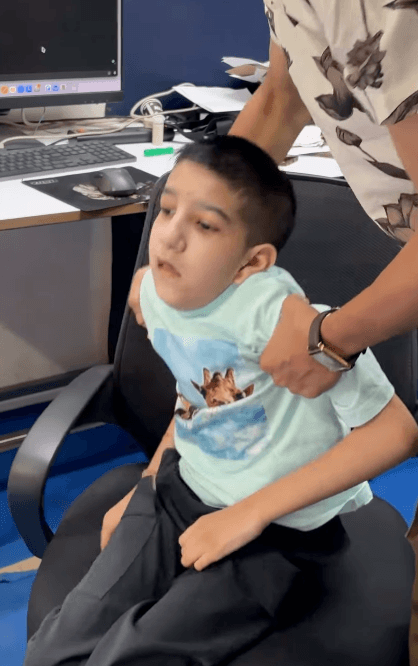
A person may have difficulty rising from a chair because of lower-limb weakness, impaired balance or poor trunk control.
However, not every patient who cannot stand independently is suitable for the same rehabilitation equipment.
A physiotherapist should assess the patient's ability to tolerate upright positioning, support weight through the legs and participate in prescribed movement.
Important considerations include:
Head and trunk control.
Lower-limb movement and joint stability.
Hip, knee and ankle mobility.
Blood-pressure responses during standing.
Pain, fatigue and standing tolerance.
Ability to understand or respond to instructions, with appropriate assistance.
Current transfer and caregiver requirements.
Some patients may need substantial body-weight unloading or specialized positioning beyond what an ordinary standing trainer provides.
A powered mechanism does not automatically mean the equipment can suspend the entire body.
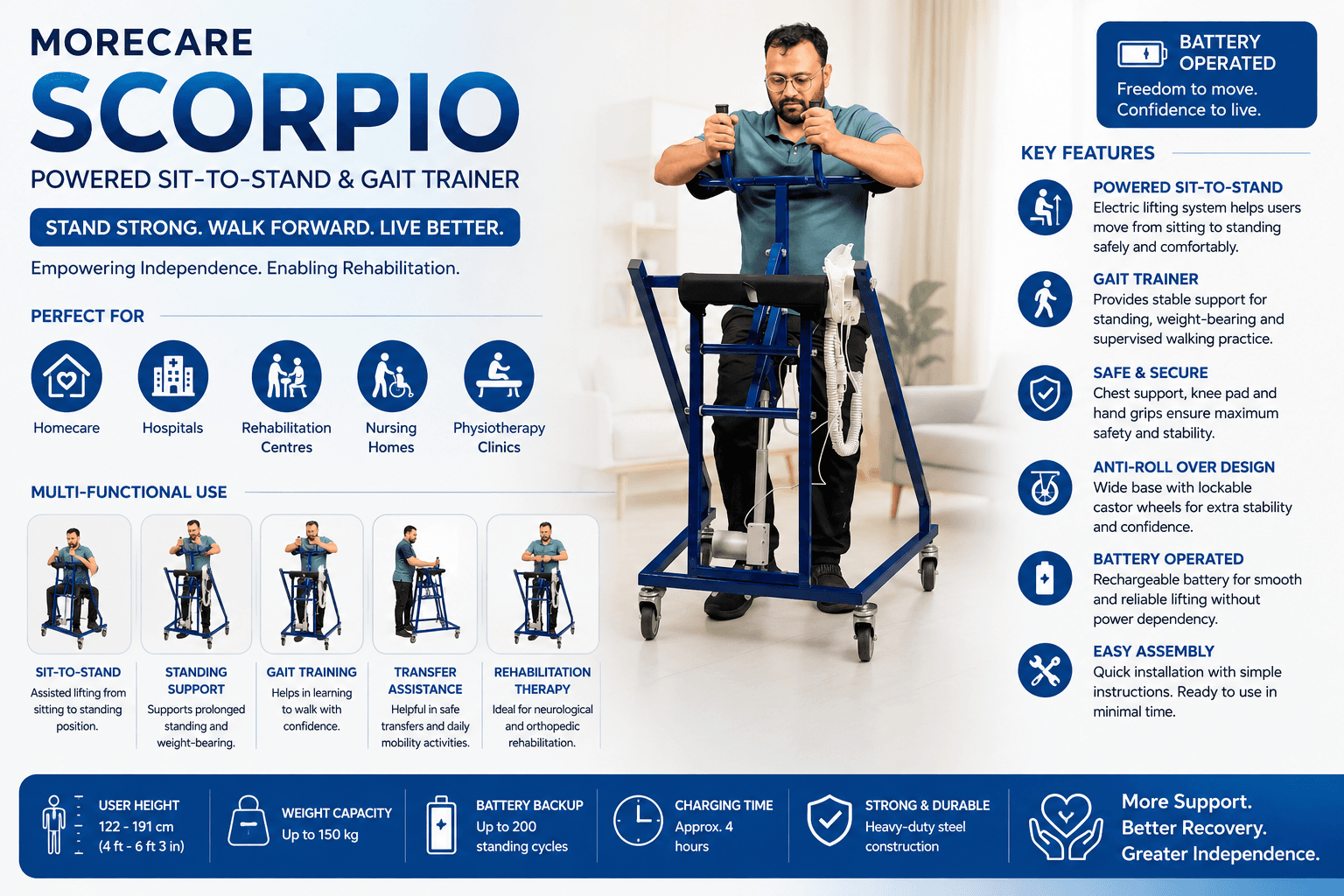
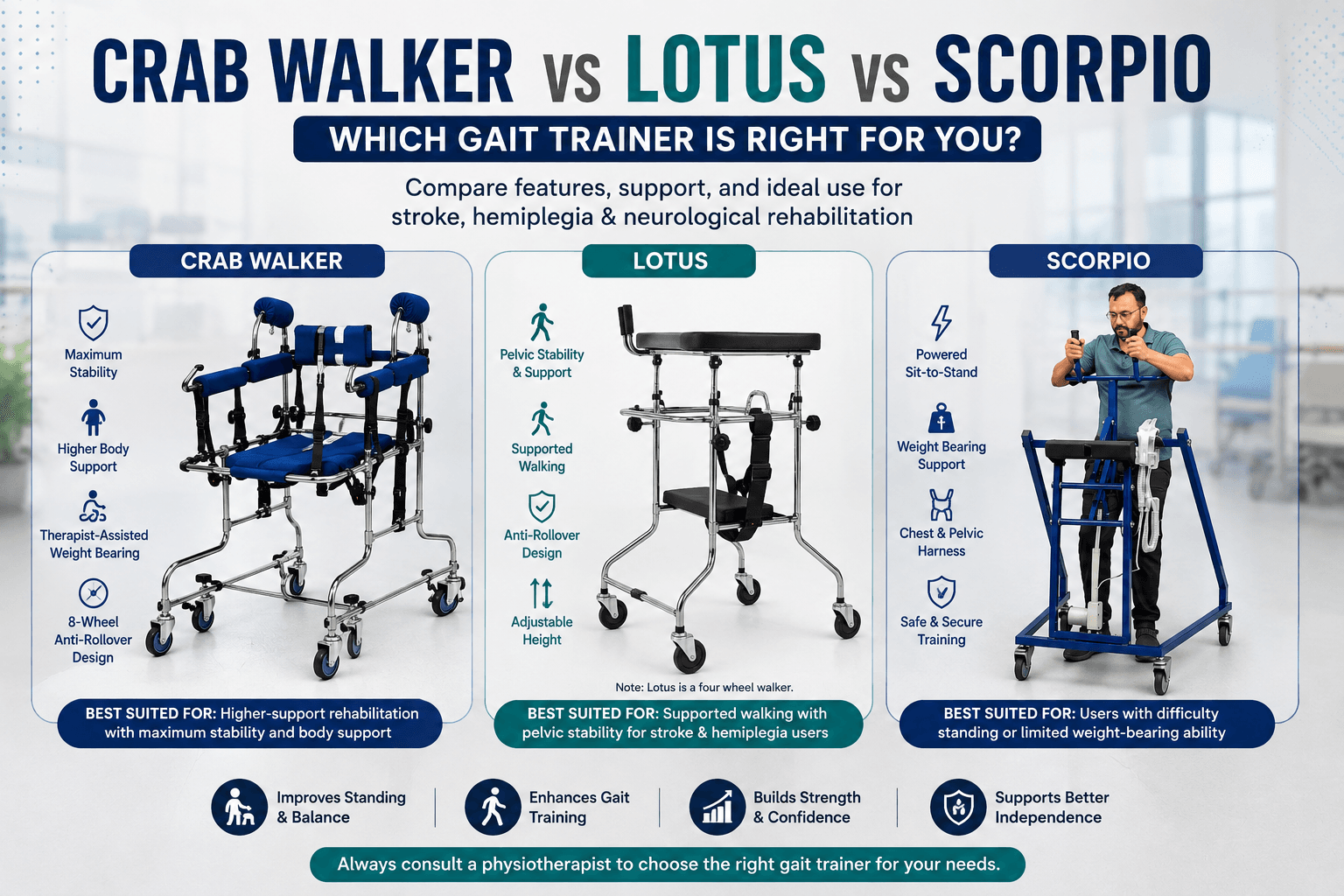
For selected patients, Scorpio may provide mechanical assistance during sit-to-stand rehabilitation, but a qualified professional must determine whether its support arrangement is appropriate.
Will the Equipment Fit Through Doorways and Move Safely at Home?
Space is one of the most commonly overlooked considerations when purchasing home rehabilitation equipment.
A standing trainer may fit inside a room but still be difficult to move through narrow doorways or turn near furniture.
The Morecare Scorpio has published overall dimensions of approximately 42 inches long, 32 inches wide and 48 inches high.
Its listed turning radius is approximately 40 inches.
Before purchasing, measure:
Doorway clearance
Measure the usable opening with the door fully open, including any obstruction from handles or the door itself.
Walking pathway
Identify the narrowest area through which the equipment must pass.
Turning space
Allow sufficient room for the equipment, patient and supervising caregiver to change direction.
Floor condition
Check that the intended practice area is firm, level, dry and free from loose rugs, cables and obstacles.
Storage space
Consider where the equipment will remain between sessions, including access for charging and inspection.
The published frame width alone does not establish the minimum safe doorway width.
Additional clearance may be required for accessories, manoeuvring and caregiver assistance.
Families should share actual room and doorway measurements with Morecare before ordering.
Can the Patient Safely Start From Their Chair or Wheelchair?
A powered sit-to-stand system must be compatible with the patient's starting position.
This may involve an ordinary chair, wheelchair or another approved seating surface.
The height, width, armrests and access around the chair can affect how the standing equipment is positioned.
Scorpio's published specifications include approximately six inches of seat-height adjustment, but the complete starting height range is not confirmed.
Before selecting the equipment, families should clarify:
The patient's current seated position.
The height of the chair or wheelchair seat.
Whether armrests or footrests obstruct device positioning.
How the patient will be correctly fitted into the chest and pelvic harnesses.
Whether knee and arm supports can be adjusted appropriately.
How the patient will be returned safely to sitting.
The transfer procedure should be demonstrated by a trained professional.
Caregivers should never assume that powered standing equipment can be positioned around every wheelchair or hospital bed.
Scorpio is not a general-purpose patient hoist and should not be used for unapproved bed-to-wheelchair lifting or full-body transfers.
If the patient requires complete lifting assistance, a dedicated transfer system may be necessary.
What Training Does a Home Caregiver Need?
Electric controls may make the standing movement easier to operate, but the overall procedure still requires training.
Caregivers must understand how to prepare the equipment and support the patient before activating the standing mechanism.
For Scorpio, this includes:
Positioning the frame
Confirming that the equipment is placed correctly on an appropriate floor surface.
Adjusting body supports
Checking the chest harness, pelvic harness, arm supports and knee supports according to the approved fitting procedure.
Operating the controller
Understanding the electric standing controls and how movement is initiated and stopped.
Using wheel brakes
Following the validated procedure for stationary standing, fitting and gait-training activities.
Monitoring the patient
Watching for fatigue, pain, dizziness, breathing changes, skin pressure or loss of position.
Returning to sitting
Understanding the approved procedure for safely completing the session.
A physiotherapist should also establish which activities the patient can perform, the required assistance and suitable stopping criteria.
The number of caregivers needed must be determined through individual assessment.
Home rehabilitation should not begin simply because the equipment has been assembled or the battery is charged.
How Important Are Battery Operation and Emergency Planning?
Battery-powered rehabilitation equipment can be convenient, but electrical systems require additional preparation.
Scorpio uses a rechargeable lithium-ion battery and a wired handheld controller.
The product page lists up to 200 standing cycles per full charge and approximately four hours for recharging.
It also lists a 24V, 2A charger.
Actual battery performance may vary with user load, battery condition, operating conditions and usage.
Families should follow several basic precautions.
Check the battery before sessions
Avoid beginning a standing activity when the battery may not have sufficient charge to complete the prescribed procedure.
Use the approved charger
Follow the manufacturer's charging instructions and avoid incompatible chargers or damaged cables.
Inspect the equipment
Check visible cables, connectors, harnesses, support adjustments and moving components before use.
Confirm emergency controls
Caregivers should know how to stop powered movement and what procedure to follow if the system malfunctions.
Plan for power failure
Before a patient is raised, an approved method must be available to return them safely to a supported position if the motor, battery or controller stops working.
Scorpio's published product information does not yet establish a manual emergency-lowering mechanism or complete power-failure recovery procedure.
These details must be confirmed by Morecare before home use.
Families should not attempt to improvise emergency lowering, dismantle loaded components or manually move an actuator.
How Should Families Plan a Safe Home Rehabilitation Programme?
A standing trainer is only one component of a rehabilitation programme.
Its effectiveness depends on appropriate patient selection, fitting, supervision and meaningful activity.
For selected users, the Morecare Scorpio can assist the transition from sitting into supported standing.
Following assessment, a therapist may incorporate activities such as supported standing tolerance, controlled weight shifting and assisted stepping.
The walking function is not powered.
The patient must have the necessary abilities to participate, with the level of supervision and assistance determined by the rehabilitation professional.
Before beginning a home programme, families should establish:
Rehabilitation goals
Is the priority standing tolerance, active participation in sit-to-stand, weight shifting or assisted walking?
Session structure
What activities, duration and rest periods are appropriate for the patient?
Caregiver responsibilities
Who will prepare the equipment, supervise the patient and respond if difficulties occur?
Environmental preparation
Is the practice area clear, stable and suitable for the prescribed movements?
Equipment maintenance
Who will inspect the supports, wheels, electrical components and battery?
Periodic reassessment
When should the therapist review the patient's progress and whether the current equipment remains appropriate?
The most useful home rehabilitation programme is not necessarily the one with the longest standing duration or greatest number of steps.
It is the one that matches the patient's abilities, clinical needs and meaningful functional goals.
Clinical and Safety References
NHS. How to Move, Lift and Handle Someone Else.
https://www.nhs.uk/social-care-and-support/practical-tips-if-you-care-for-someone/how-to-move-lift-and-handle-someone-else/
U.S. Food and Drug Administration. Patient Lifts at Home: Safety Guide.
https://www.fda.gov/media/88149/download
Occupational Safety and Health Administration. Guidelines for Nursing Homes: Ergonomics for the Prevention of Musculoskeletal Disorders.
https://www.osha.gov/ergonomics/guidelines/nursing-home/final-nh-guidlines
Morecare Mobility & Rehabilitation Solutions. Scorpio Electric Sit-to-Stand & Gait Training System.
https://morecare.in/scorpio/
Medical Disclaimer: This article provides general rehabilitation education. Equipment suitability, transfer procedures and home standing programmes must be determined by qualified rehabilitation professionals. Always follow the approved manufacturer instructions and confirm emergency recovery procedures before using powered equipment.