What Is Partial Body-Weight Support During Gait Training?
Partial body-weight support means reducing some of the load passing through a person's legs during standing or walking practice.
For example, an adult recovering from a neurological injury may be able to initiate stepping but struggle with balance, upright posture or maintaining sufficient support through the lower limbs.
A supportive gait trainer can help create an environment for practising these activities.
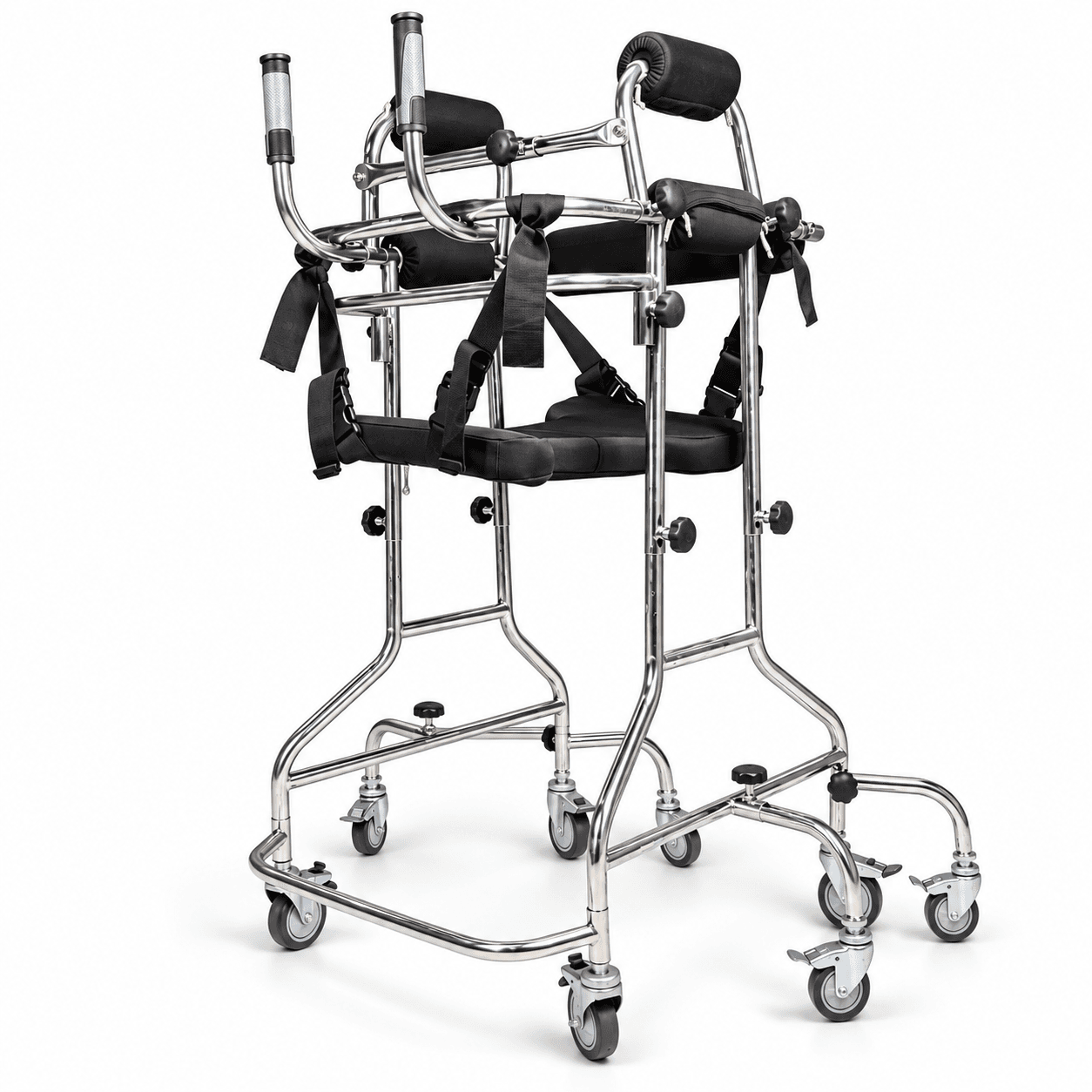
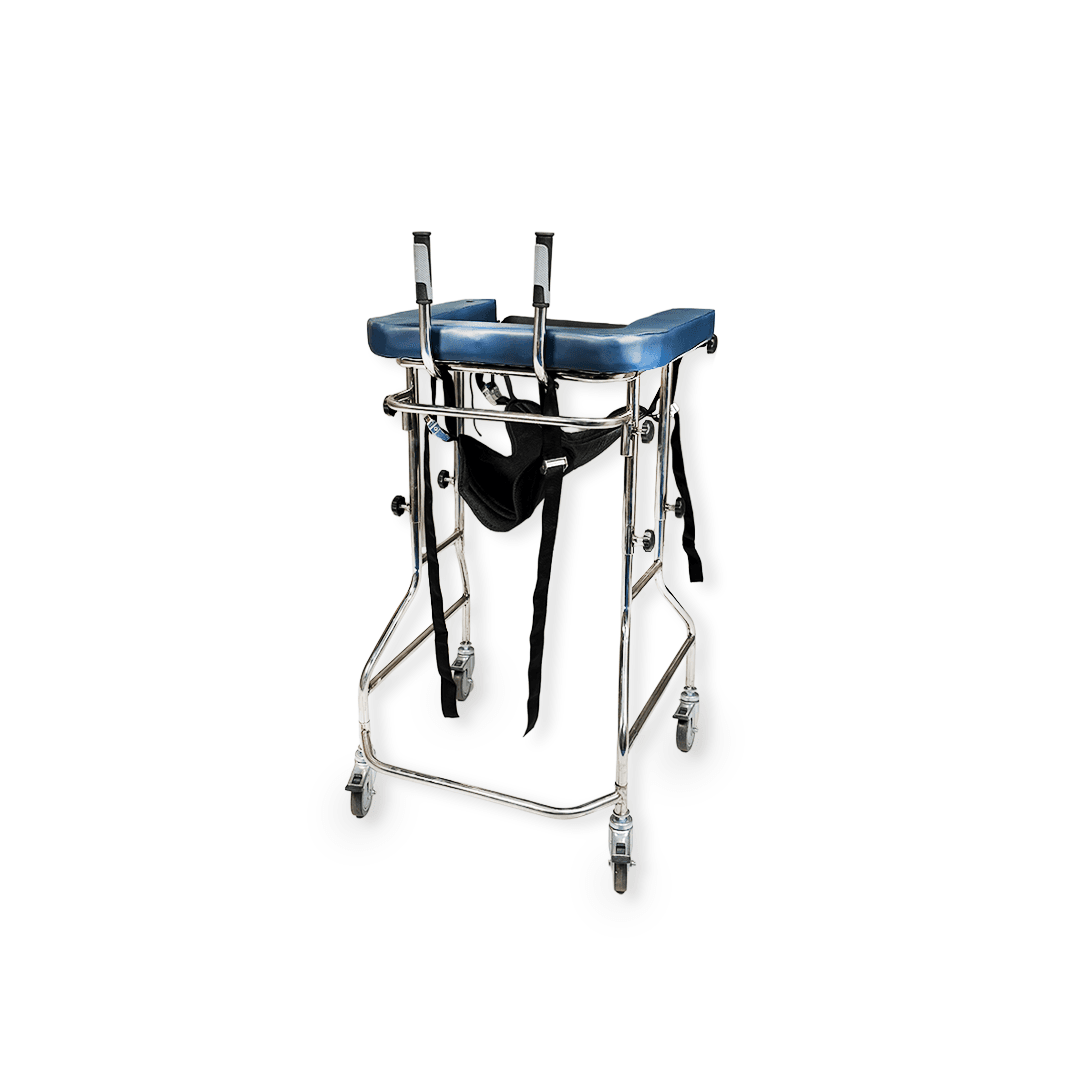
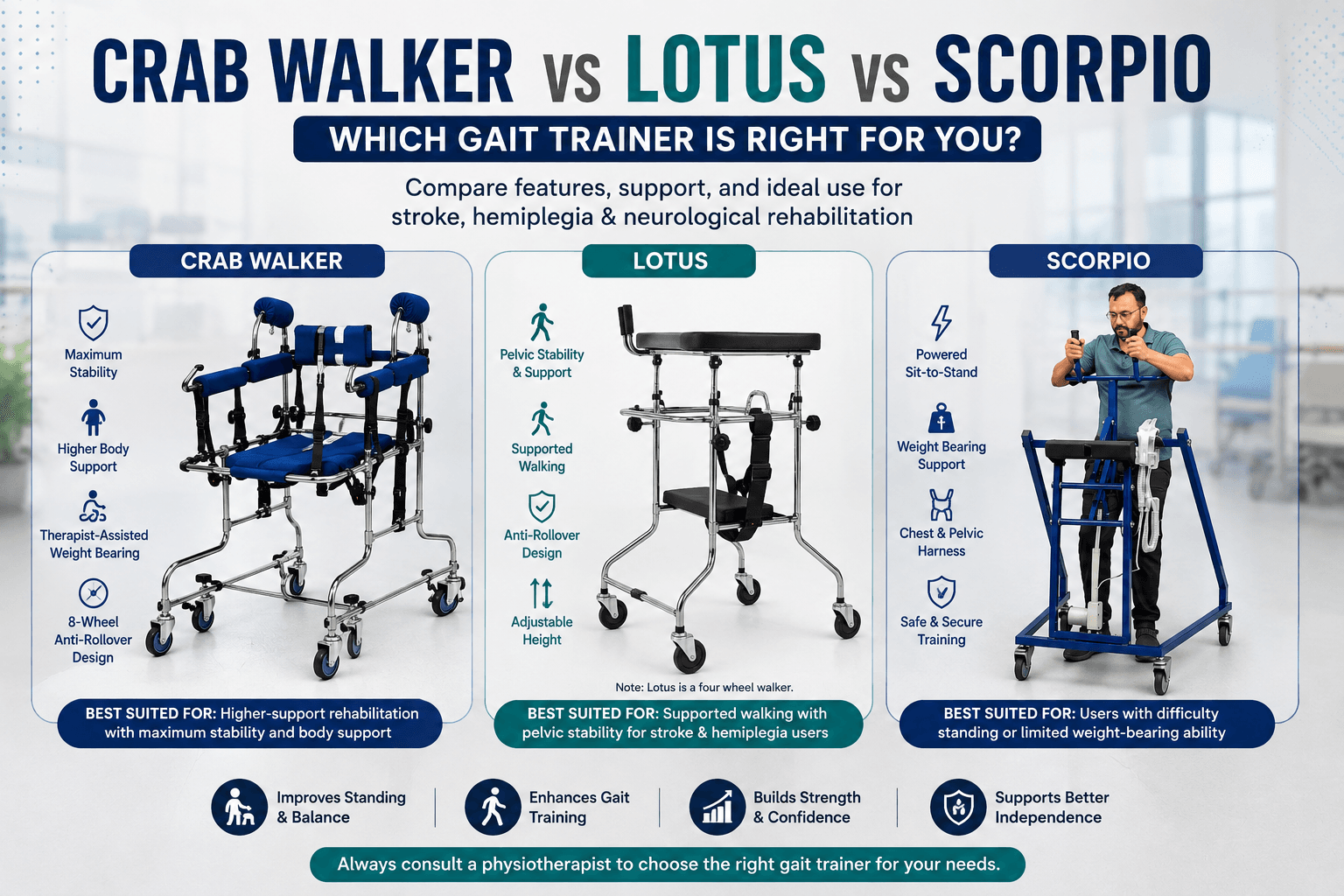
The Morecare Crab Walker combines a wide eight-wheel base, adjustable padded chest and arm supports, and a pelvic sling.
The sling is intended to provide partial body-weight assistance, while the user continues to support the remaining load through their legs.
The exact amount of support must be determined through individual assessment. The Crab Walker does not provide a calibrated percentage of unloading.
How Does a Full-Suspension or Overhead Support System Work?
An overhead body-weight-support system uses a harness connected to a support structure above the patient.
Depending on its design, it may use an electric lifting mechanism, a mechanical support system or specialized rehabilitation equipment to provide controlled unloading.
These systems can be helpful when a person needs more assistance than a conventional supportive walker can provide.
Some systems allow therapists to adjust how much body weight is transferred through the harness during standing and stepping activities.
However, body-weight support and complete patient suspension are not identical.
A system that can unload a percentage of body weight is not necessarily approved to suspend the patient's entire weight.
Its safe operating limits, harness compatibility and lifting capabilities must be confirmed from the manufacturer's specifications.
Which Patients May Benefit From a Pelvic-Sling Gait Trainer?
A pelvic-sling gait trainer may be considered when the patient can actively participate in standing or stepping but requires additional physical support.
Examples include selected adults undergoing rehabilitation after:
Stroke or hemiplegia
Incomplete spinal cord injury
Neurological conditions affecting balance and posture
Orthopaedic conditions, when weight-bearing is permitted
Prolonged immobility with reduced standing confidence
The Morecare Crab Walker provides adjustable chest and arm positioning to help support upright posture while the pelvic sling offers partial assistance.
It may be useful for therapist-guided standing, weight-shifting and stepping practice.
However, the presence of a medical diagnosis does not automatically make someone suitable.
A therapist must assess weight-bearing capacity, trunk control, lower-limb movement, standing tolerance and required supervision.
When Might Overhead Body-Weight Support Be More Appropriate?
Some patients cannot safely bear enough weight through their legs to use a pelvic-sling walker.
Others may have substantial postural instability, fatigue or movement limitations requiring more controlled assistance.
In these situations, a rehabilitation professional may recommend an overhead body-weight-support system.
A motorized system such as the Morecare i-Gait may be considered when adjustable unloading and specialized gait-training support are needed, subject to its approved operating limits.
Patients who need complete lifting from a bed or wheelchair require a separately assessed transfer solution.
An ordinary supported walker must never be used as a patient hoist.
The choice should depend on the patient's ability and rehabilitation goals rather than assuming that one system is universally better.
Crab Walker vs Overhead Support – Important Differences
The main difference is how support is delivered and how much assistance the patient needs.
Feature
Crab Walker
Overhead Body-Weight-Support System
Support arrangement
Chest, arm and pelvic supports
Harness connected to overhead mechanism
Weight assistance
Partial, not quantified
May provide adjustable unloading, depending on model
User participation
Requires sufficient remaining weight-bearing and stepping ability
May accommodate users needing greater unloading
Primary activity
Supported standing and stepping
Controlled body-weight-supported gait rehabilitation
Full suspension
Not permitted
Only when specifically approved for the system
Assessment
Individual fitting essential
Individual fitting and harness assessment essential
The Morecare Crab Walker is designed for adults approximately 5–6.2 feet tall and has a maximum user-weight rating of 150 kg.
Its eight individually lockable wheels and adjustable body supports allow selected adults to practise stepping on firm, level surfaces.
An overhead support system may be more appropriate when adjustable unloading is essential to the rehabilitation programme.
Neither system guarantees independent walking or recovery.
Five Questions to Ask Before Choosing a Gait Trainer
Before purchasing rehabilitation equipment, discuss the following with the treating physiotherapist.
- How much weight can the patient safely bear?
Determine whether the person can support a meaningful portion of their body weight through their legs.
- Can the patient initiate stepping?
Some patients can actively move their legs but need additional postural support. Others require more intensive assistance.
- How stable are the head, trunk and pelvis?
Poor postural control may require a different support configuration or specialized equipment.
- Does the patient need assistance only for walking, or also for transfers?
A gait trainer should not be substituted for a lifting device when full-body transfer assistance is required.
- Where will rehabilitation take place?
Consider caregiver training, floor conditions, doorway clearance and supervision.
The Crab Walker requires a minimum clear doorway opening of 34 inches, with additional space for turning and assisted walking.
An appropriate equipment recommendation should account for both the patient's functional abilities and the rehabilitation environment.