Why Does Wheelchair Weight Matter for Families?
A child's mobility needs often extend beyond the home.
Parents may need to transport a wheelchair several times a week for school, rehabilitation appointments, hospital visits or family gatherings.
A heavy wheelchair can create practical challenges when it must be lifted into a car or carried into storage.
This is especially relevant when the caregiver also needs to supervise and assist the child.
A lightweight wheelchair may reduce the load involved in handling the empty equipment.
However, wheelchair weight alone does not determine how manageable it is.
Parents should also consider the shape of the folded frame, available lifting points, caregiver strength and the height of the vehicle's boot.
For example, a relatively lightweight but awkwardly shaped chair may still be difficult to lift safely.
A wheelchair that folds into a manageable shape may be more convenient for some families than one that is simply lighter.
The best choice balances equipment weight, handling requirements and appropriate support for the child.
Caregivers should never attempt to lift a wheelchair with the child seated inside unless a specifically approved procedure and equipment arrangement permits it.
What Should Parents Check in a Folding Mechanism?
Different wheelchairs use different folding arrangements.
Some fold sideways, while others collapse through an umbrella-style mechanism.
The folding design affects how the wheelchair is stored and carried.
Before choosing a model, parents should review several practical details.
Ease of folding
Can the caregiver operate the folding mechanism correctly without excessive effort?
Secure locking
Does the wheelchair lock properly when opened and remain stable during intended use?
Folded dimensions
What are the actual length, width and height after folding?
Accessory handling
Do headrests, footrests or other components need to be removed before folding?
Storage convenience
Can the empty folded chair be stored safely in the intended location?
Risk of trapped fingers
Are caregivers trained to keep hands, clothing and children clear of moving joints and locking mechanisms?
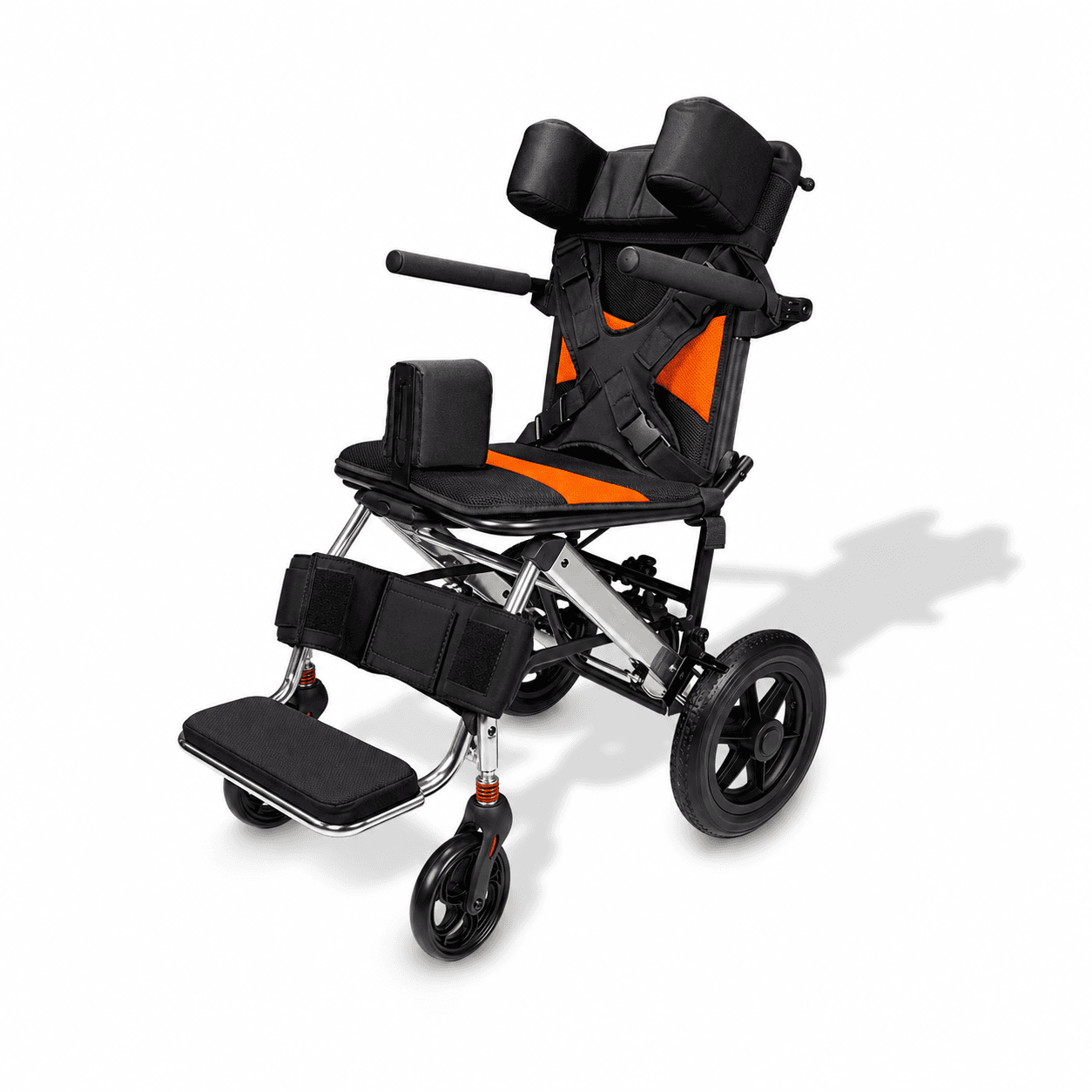
The Morecare EasyGo uses an umbrella-folding mechanism with a rear lock-release arrangement.
This design is intended to make transporting and storing the unoccupied wheelchair more manageable.
However, families should confirm the exact folded dimensions and approved folding procedure before purchase.
A folding frame should never be adjusted or collapsed while the child is seated.
How Can Parents Check Whether a Wheelchair Fits in Their Car?
Car compatibility is one of the most important considerations for a travel wheelchair.
A product may be described as portable but still be difficult to fit inside a particular vehicle.
Parents should measure the available boot space rather than relying only on the vehicle's overall size.
Measure the boot opening
Check the narrowest usable width and height through which the folded wheelchair must pass.
Measure the available storage area
Record the clear length, width and height inside the boot.
Check the loading height
Consider how high the caregiver must lift the empty wheelchair to place it inside the car.
Allow room for other belongings
The wheelchair should fit without damaging its supports or preventing the boot from closing securely.
Confirm the folded configuration
Ask whether the headrest, footrest or other accessories affect the folded size.
Before ordering EasyGo, families should compare their vehicle measurements with the actual folded wheelchair dimensions confirmed by Morecare.
A real folding demonstration can also help explain how the chair is handled.
Importantly, a pediatric travel wheelchair is not automatically approved for transporting an occupied child inside a moving vehicle.
The child should use an appropriate certified vehicle seating and restraint arrangement, while the wheelchair itself should be safely stored.
Does a Lightweight Wheelchair Still Need Postural Support?
Lightweight construction is useful only when the wheelchair also meets the child's seating requirements.
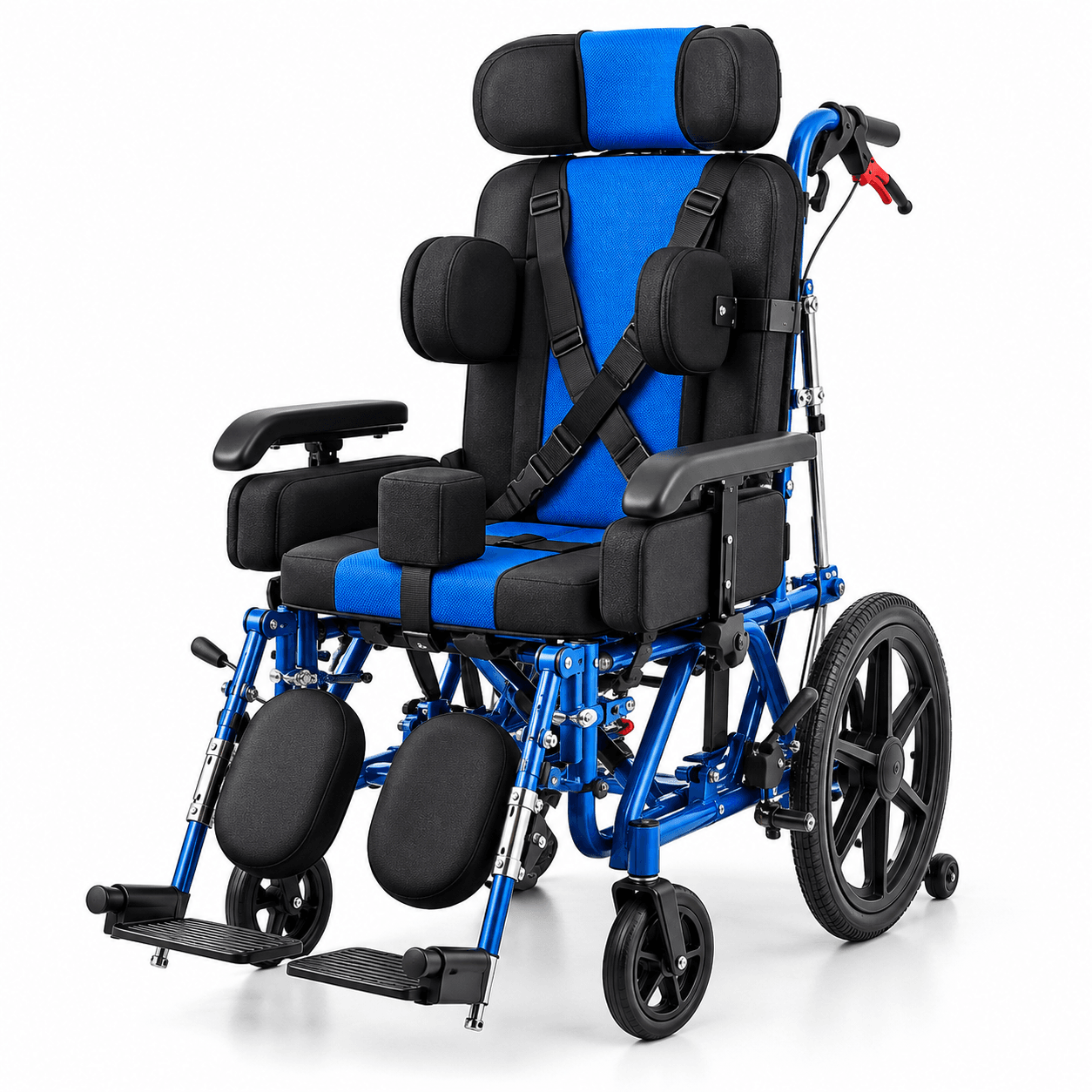
Children with cerebral palsy may experience reduced head control, poor trunk stability, muscle stiffness or difficulty positioning their legs.
A basic folding transport chair may not provide enough assistance for these needs.
Important seating considerations include:
Head support
Some children require an adjustable headrest to help maintain a comfortable head position.
Trunk positioning
A correctly fitted chest harness may provide additional upper-body support.
Pelvic stability
The seat and positioning arrangement should accommodate the child's pelvis appropriately.
Leg and foot support
Footrests and individually selected positioning components may help maintain suitable lower-limb placement.
Seat dimensions
Seat width, depth and backrest height should match the child's actual body measurements.
Seating tolerance
The child should remain comfortable, with no excessive pressure, pain or breathing restriction.
A lightweight travel wheelchair should not be selected simply because the child's weight is below the manufacturer's maximum capacity.
For children requiring tilt-in-space, recline, extensive lateral supports or complex pressure management, a specialized adaptive wheelchair may be more appropriate.
Portability must be balanced against the child's physical needs.
How Does Morecare EasyGo Combine Lightweight Design With Support?
The Morecare EasyGo Lightweight CP Travel Wheelchair is designed for selected children who need caregiver-assisted travel with additional positioning support.
Its principal feature is an approximately 8 kg aluminium frame combined with an umbrella-folding design.
The system also includes several pediatric seating components.
Lightweight aluminium construction
The frame is intended to make handling and transportation of the empty wheelchair more manageable.
Umbrella folding
The rear lock-release mechanism allows the chair to fold for transportation and storage.
Adjustable contoured headrest
Provides additional head positioning options according to the child's assessed requirements.
Four-point butterfly chest harness
Provides upper-body positioning assistance when correctly fitted.
Padded leg straps
Help maintain the intended lower-limb position when appropriate.
Removable leg-abduction support
Offers an additional positioning option for selected children.
Adjustable cushioned footrest
Provides foot support and helps keep the feet clear of the wheels.
Attendant hand brakes and rear parking locks
Provide caregiver control during movement and stationary positioning according to the approved operating instructions.
EasyGo has a standard usable seat width and depth of 14 inches.
It is generally recommended for children aged 4–8 years, with customized fitting considered for selected older children up to approximately 12 years.
Its published maximum user weight is 80 kg, but the child's actual measurements and seating needs must determine whether the chair is suitable.
The wheelchair is primarily intended for shorter supervised outings rather than prolonged daily adaptive seating.
Families who require tilt, recline or more comprehensive postural adjustments may need a different configuration.
Six Things to Confirm Before Purchasing a Foldable CP Wheelchair
Before placing an order, parents should check both transportation requirements and the child's seating needs.
- Confirm the actual wheelchair weight
Ask whether the stated weight includes all standard accessories required for use.
- Check the folded dimensions
Compare the manufacturer's measurements with the car boot, storage area and any other relevant access points.
- Review the child's seating measurements
Provide seated hip width, thigh length, lower-leg length, trunk height and other measurements requested during fitting.
- Assess head and trunk support
A pediatric physiotherapist or occupational therapist should determine whether the wheelchair provides adequate positioning.
- Understand the folding and braking procedures
Caregivers should receive instructions on safe folding, unfolding, wheel locking and maintenance.
- Consider how frequently and how long the chair will be used
A lightweight travel wheelchair may be suitable for shorter outings, but prolonged seating or complex positioning needs may require a specialized adaptive wheelchair.
Families should also confirm warranty coverage, replacement-part availability and after-sales technical support.
The most suitable travel wheelchair is not necessarily the smallest or the lightest.
It is the one that offers a practical balance between portability, appropriate support and reliable everyday handling.
Clinical References
World Health Organization. Wheelchair Provision Guidelines, 2023.
https://www.who.int/publications/i/item/9789240074521/
NICE. Cerebral Palsy in Under 25s: Assessment and Management (NG62).
https://www.nice.org.uk/guidance/ng62/chapter/Recommendations
Morecare Mobility & Rehabilitation Solutions. EasyGo Lightweight CP Travel Wheelchair.
https://morecare.in/easygo/
Medical Disclaimer: This article provides general information on pediatric mobility and wheelchair selection. Individual equipment suitability, seating fit and positioning should be assessed by qualified rehabilitation professionals. Follow the approved manufacturer instructions for transport, folding, braking and wheelchair use.