Can Walking Practice Begin Before Independent Standing?
Walking involves much more than simply moving the legs.
A person must support body weight, maintain an appropriate posture, shift weight between the lower limbs and coordinate stepping movements.
After neurological injury, some of these abilities may remain while others are impaired.
For example, a stroke survivor may have sufficient movement to initiate steps but struggle to stand up from a wheelchair because of weakness and poor balance.
Another patient may be able to remain upright when supported but cannot maintain standing independently.
For selected individuals, rehabilitation may include assisted walking activities before independent standing or walking is achieved.
A physiotherapist may use appropriate equipment to help establish a supported upright position and then assess whether stepping practice is safe.
However, this does not mean every person who cannot stand can immediately begin walking.
Some individuals require preliminary work on medical stability, positioning, lower-limb loading, postural control or strength.
Others may need substantial body-weight unloading or specialized rehabilitation equipment.
The correct starting point depends on the person's actual functional abilities.
What Is the Difference Between Supported Standing and Assisted Walking?
Supported standing and assisted walking are related but distinct rehabilitation activities.
Supported standing
The person maintains an upright position while receiving assistance from equipment, a therapist or both.
The focus may include posture, standing tolerance and appropriate lower-limb loading.
Weight shifting
The person moves some body weight from one side towards the other under controlled supervision.
This may be used when preparing for stepping activities.
Assisted stepping
The person attempts to move one leg forward while maintaining adequate support and balance.
The movement may require verbal cues, manual assistance or specialized rehabilitation equipment.
Supported walking
The person performs a sequence of steps with the assistance needed to maintain stability and movement.
Not every person who can tolerate supported standing is ready for stepping.
Similarly, a patient who can initiate a step may still require substantial assistance to move safely.
A rehabilitation professional should assess strength, postural control, joint stability, weight-bearing capacity and movement coordination before progressing between activities.
Why Do Some Patients Need Assistance Just to Reach Standing?
The transition from sitting to standing requires coordinated movement of the trunk and lower limbs.
A person must shift their body weight forward and generate enough force through the legs to rise.
Following a neurological injury, this movement may be difficult even when some stepping ability remains.
Common barriers include:
Lower-limb weakness
Reduced strength around the hips and knees can make lifting the body from sitting difficult.
Poor balance
The person may be unable to control their centre of mass during the transition.
Trunk instability
Limited postural control may make it difficult to maintain a suitable upper-body position.
Asymmetrical movement
After stroke, one side of the body may contribute less during standing.
Fatigue or reduced endurance
The patient may have difficulty repeating the transition during rehabilitation sessions.
Difficulty coordinating movement
Neurological conditions may affect the timing and sequence of movement.
In these situations, therapists may use manual assistance, specialized transfer techniques or appropriate standing equipment.
For selected users, an electric sit-to-stand mechanism may provide mechanical assistance during the transition.
However, powered assistance should not be confused with active strengthening or a complete patient-lifting system.
The amount of active participation still matters when designing the rehabilitation programme.
How Can Morecare Scorpio Support Standing and Gait Practice?
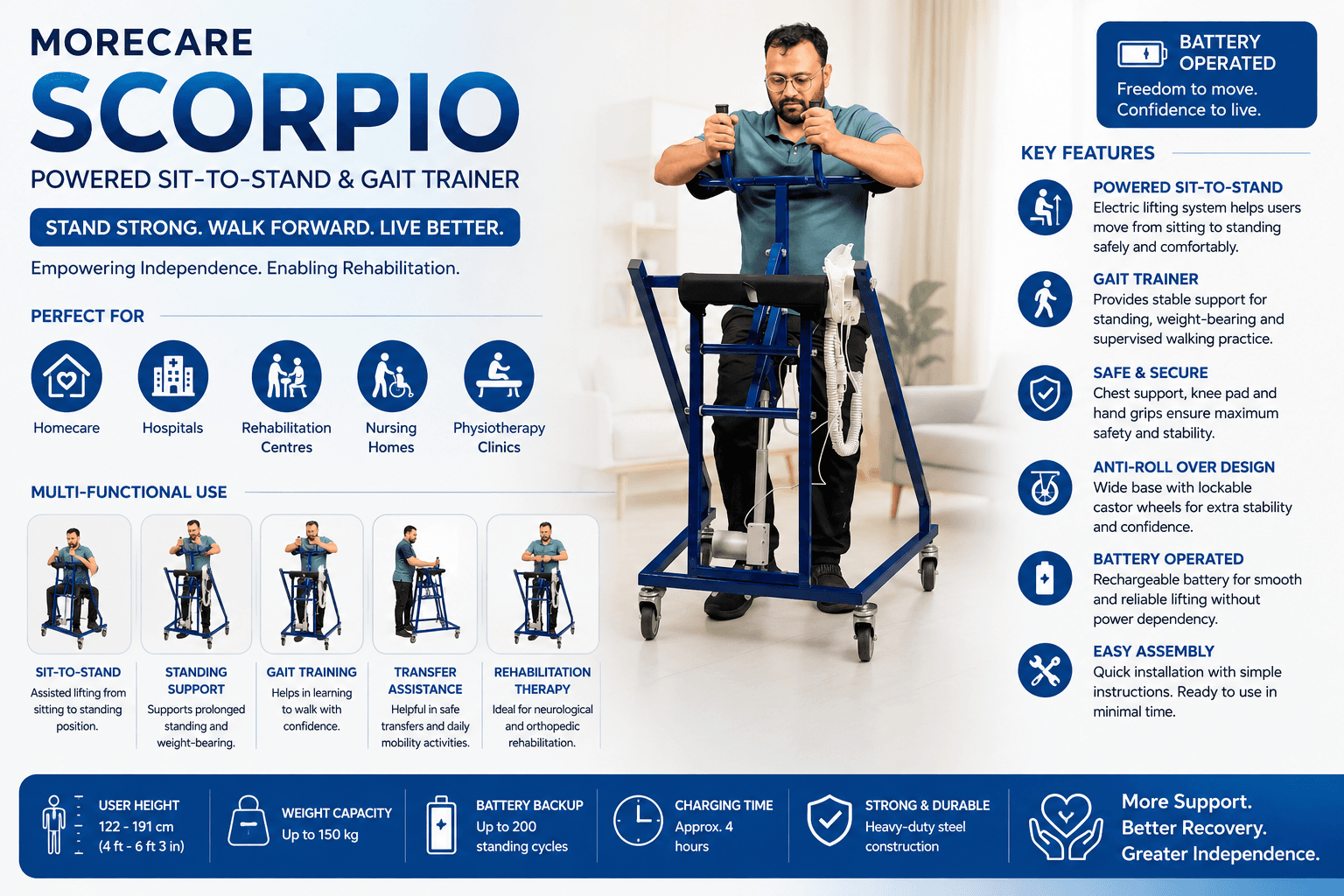
The Morecare Scorpio Electric Sit-to-Stand & Gait Training System is designed for selected teenagers and adults who require powered assistance during the transition from sitting to standing.
The system combines an electric standing mechanism with adjustable body supports and a wheeled gait-training frame.
Its main features include:
Battery-powered standing assistance
An electric linear actuator assists the sit-to-stand transition through a rechargeable battery-powered mechanism.
Wired handheld controller
Allows the operator to control the powered standing movement.
Adjustable arm supports
Provide upper-limb positioning options according to the user's measurements and support requirements.
Adjustable knee supports
Offer additional positioning support around the lower limbs.
Chest and pelvic harnesses
Help establish the intended supported posture when correctly fitted.
Wheeled rehabilitation frame
Allows selected users to participate in therapist-guided stepping activities on appropriate level surfaces.
Scorpio's defining feature is its ability to assist the transition from sitting into standing before suitable rehabilitation activities begin.
Once standing, a physiotherapist may assess whether the person can participate in weight shifting, supported balance or assisted stepping.
However, Scorpio does not automatically move the legs.
Its current specifications also do not establish calibrated body-weight unloading or complete patient suspension during walking.
Patients who require those capabilities may need a different rehabilitation system.
Scorpio is intended for selected users approximately 4 feet to 6 feet 3 inches tall, subject to individual fitting.
The approved maximum user-weight capacity and emergency recovery procedure must be confirmed by Morecare before clinical use.
How Much Body-Weight Support Does a Patient Need?
One of the most important considerations is how much of their own weight a patient can safely support through their legs.
Different rehabilitation systems provide different levels of assistance.
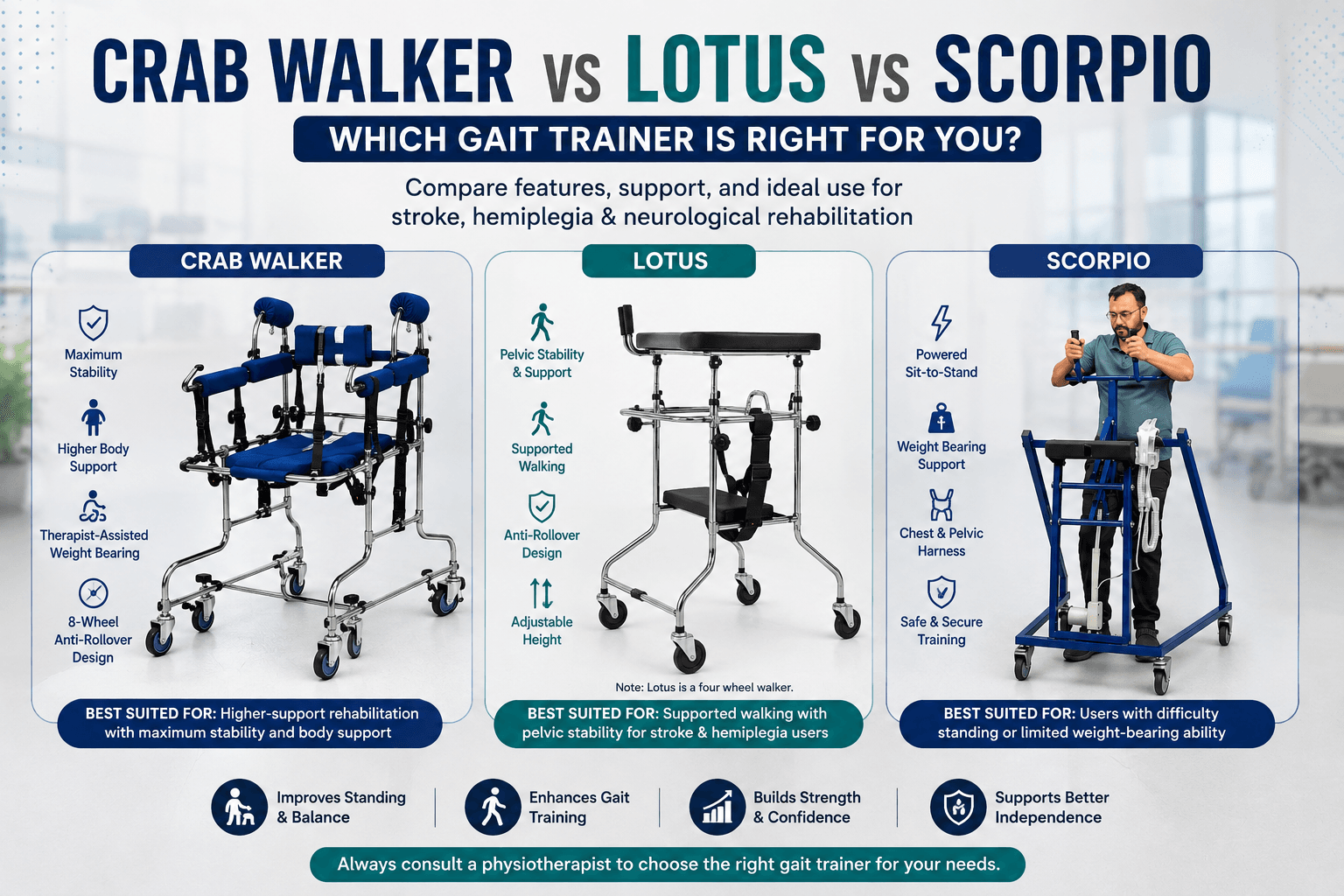
Conventional walking aids
A standard walker or similar mobility aid may provide suitable support for someone who can bear sufficient weight and maintain adequate trunk stability.
Supportive gait trainers
Some devices include additional chest, arm or pelvic supports to assist positioning during standing and stepping.
These systems may still require the patient to support a significant portion of body weight.
Powered sit-to-stand trainers
These devices assist the movement from sitting into standing. Their standing mechanism does not automatically establish how much weight they unload during walking.
Overhead body-weight-support systems
A harness attached to an appropriate overhead mechanism may allow a controlled portion of the patient's body weight to be unloaded during prescribed gait rehabilitation.
Full suspension is a separate capability that must be specifically validated for the equipment.
For a patient who cannot bear sufficient weight through the lower limbs, an ordinary supportive gait trainer may be inadequate.
The physiotherapist should select equipment according to the person's movement, weight-bearing and safety requirements.
Neither a pelvic harness nor an electric actuator should be assumed to provide complete body-weight suspension unless the manufacturer has explicitly validated that function.
How Can Families Know Whether a Patient Is Ready for Supported Walking?
Before choosing rehabilitation equipment, families should discuss the patient's abilities with the treating physiotherapist.
The assessment should consider several important questions.
Can the patient tolerate upright positioning?
Dizziness, blood-pressure changes, pain or other medical concerns may affect standing tolerance.
Can the patient bear weight through the legs?
Determine how much lower-limb loading is safe and what assistance is required.
Can the patient maintain head and trunk position?
Some patients require specialized supports beyond those provided by a standard gait trainer.
Can the patient initiate stepping?
The ability to move the legs voluntarily or participate in therapist-assisted stepping helps determine the appropriate training method.
Can the patient safely enter and exit the equipment?
The transfer method should be established before use, including what happens if the powered system stops.
Is the rehabilitation environment suitable?
Adequate space, stable flooring, trained caregivers and appropriate supervision are essential.
What is the immediate rehabilitation goal?
For some patients, the priority may be supported standing or weight shifting rather than walking distance.
The rehabilitation programme should be adjusted as the person's abilities change.
No equipment can guarantee that a patient will regain independent standing or walking.
The objective is to provide appropriate assistance for safe, meaningful participation in individualized rehabilitation activities.