What Is an Electric Sit-to-Stand Rehabilitation Trainer?
An electric sit-to-stand rehabilitation trainer assists the movement from a seated position towards standing.
This movement normally requires coordinated activity of the trunk, hips, knees and ankles.
Patients recovering from neurological injuries may have difficulty performing the movement because of weakness, poor balance or impaired coordination.
A powered standing mechanism can provide mechanical assistance during the transition.
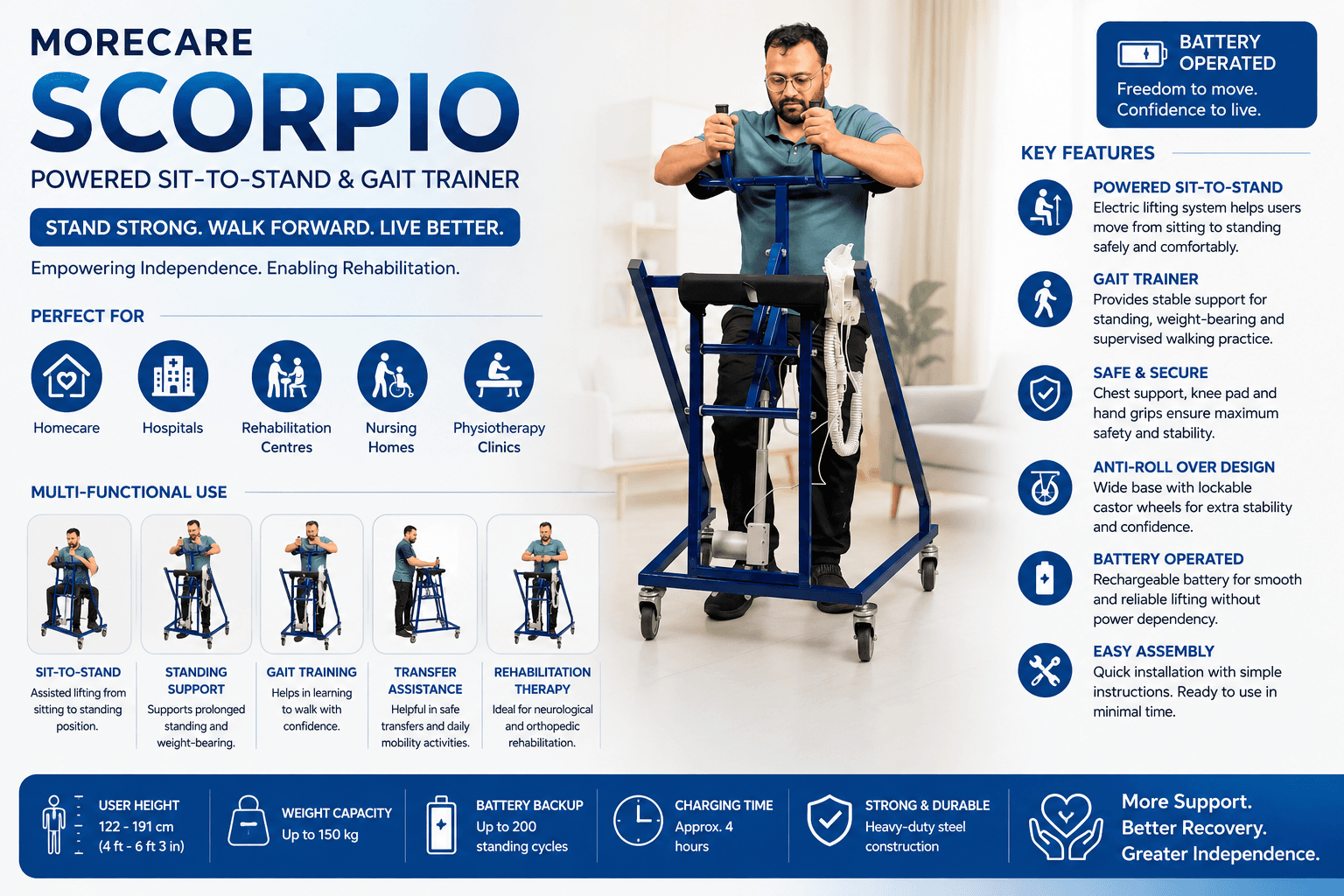
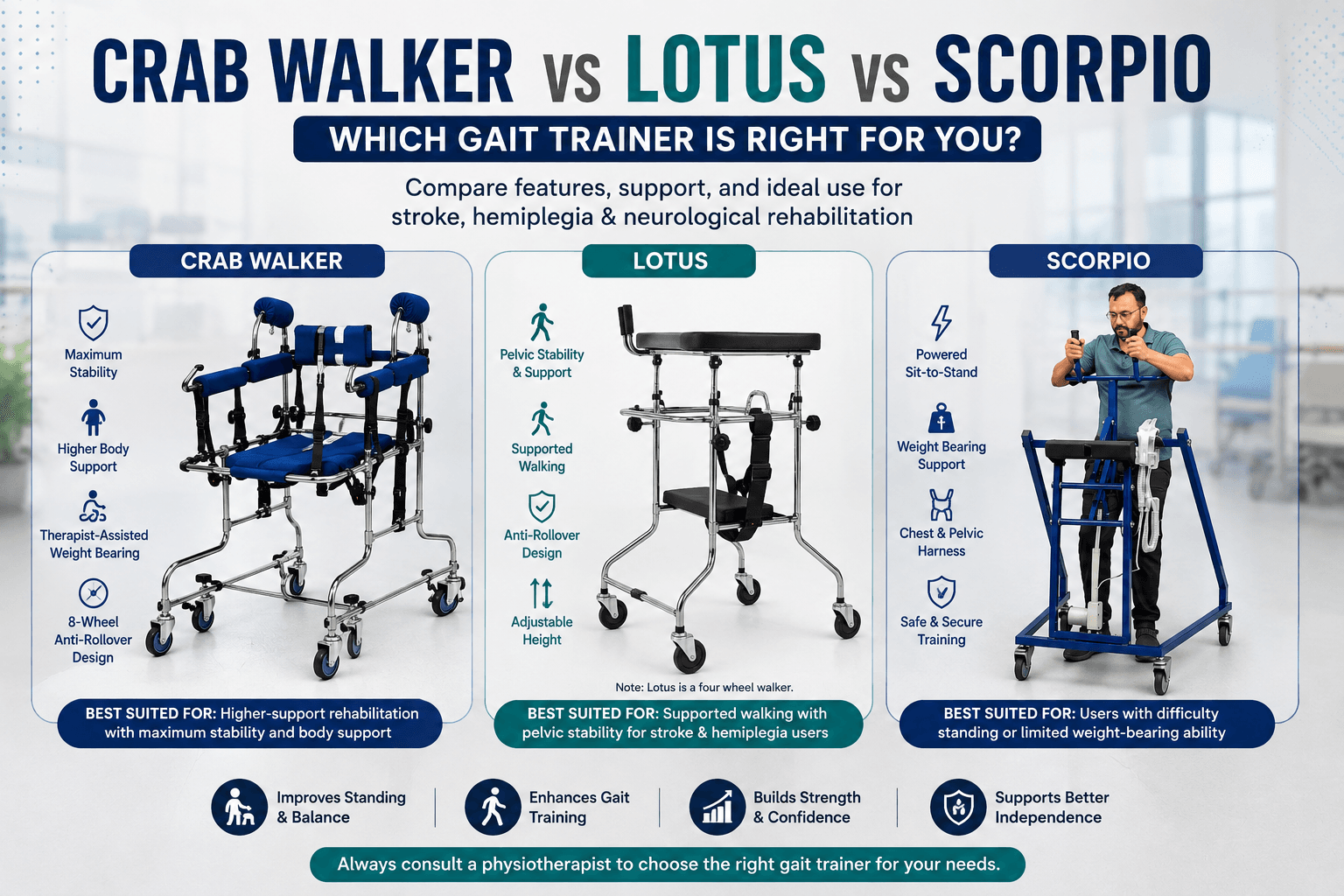
The Morecare Scorpio is an example of this category.
It combines a battery-powered linear actuator with adjustable arm and knee supports, a chest harness and a pelvic harness.
Its main purpose is to help selected patients reach a supported standing position for therapist-guided rehabilitation activities.
Once correctly positioned, suitable patients may participate in supported standing, weight shifting or assisted stepping.
However, an electric standing mechanism does not automatically establish that the device can lift the patient's complete body weight.
Scorpio is not designed as a general-purpose full-body transfer hoist.
Patients should be assessed for safe positioning, lower-limb loading, trunk control and standing tolerance before using it.
What Is a Full-Body Patient Hoist?
A full-body patient hoist is designed to lift and transfer individuals who require substantial assistance with mobility.
These systems generally use a lifting arm, electric or hydraulic mechanism, and a compatible sling that supports the person during movement.
Unlike rehabilitation standing trainers, their primary purpose is safe patient handling and transfers.
Common applications include:
Moving a patient from bed to wheelchair.
Transferring between a wheelchair and suitable seating.
Assisting with selected commode transfers.
Repositioning a patient between compatible surfaces.
Lifting a patient from floor level when the equipment is approved for that use.
The Morecare Snapdragon is an electric patient hoist with a published Safe Working Load of 300 kg.
It includes an adjustable base, powered lifting mechanism and compatible sling arrangements for patient transfers.
It can also support selected rehabilitation activities when using the appropriate approved sling and clinical procedure.
However, a patient hoist should not automatically be treated as a gait trainer.
Transfer lifting and walking rehabilitation require different positioning, handling and safety considerations.
The correct sling, attachment arrangement and operating procedure must be selected for the intended activity.
Why Is Weight-Bearing Ability Important When Choosing Equipment?
One of the most important questions is how much weight the patient can safely support through their legs.
Consider two different situations.
Situation A: The patient can participate in supported standing
The person has some lower-limb weight-bearing ability but struggles to rise from a chair.
They may have difficulty coordinating movement, controlling their trunk or maintaining balance.
A powered standing rehabilitation system may be appropriate after professional assessment.
For selected users, Scorpio can assist the transition into supported standing before prescribed rehabilitation activities.
Situation B: The patient requires complete lifting assistance
The person cannot safely participate in the intended standing transfer and requires the equipment to support their body during movement.
In this situation, a full-body sling-supported patient hoist may be more appropriate.
A system such as Snapdragon can be assessed for lifting and transferring the person between suitable surfaces.
However, weight-bearing is not the only factor.
Head control, trunk stability, cognition, fatigue, pain, joint restrictions and medical conditions can all influence equipment selection.
A rehabilitation professional should determine the appropriate transfer and standing method.
Families should never assume that a chest harness or pelvic belt can support the patient's complete weight unless the equipment has been specifically approved for that purpose.
Scorpio vs Snapdragon — What Are the Main Differences?
Both Scorpio and Snapdragon use electric mechanisms, but their intended functions are different.
Feature
Morecare Scorpio
Morecare Snapdragon
Primary purpose
Powered standing rehabilitation
Patient lifting and transfers
Electric function
Sit-to-stand assistance
Sling-supported lifting
Main support system
Chest, pelvic, arm and knee supports
Compatible lifting slings
Full-body lifting
Not established or approved
Yes, within approved limits
Bed-to-wheelchair transfers
Not a general-purpose transfer hoist
Designed for suitable transfers
Supported standing
Yes, for selected users
Possible with approved sling and procedure
Gait training
Therapist-guided stepping
Possible with approved walking sling
Maximum capacity
Production rating requires confirmation
Published 300 kg SWL
Main selection factor
Ability to participate in supported standing
Need for sling-supported lifting and transfers
The Scorpio is generally the more relevant option when the rehabilitation programme requires powered assistance to reach standing and the person can safely participate in the prescribed activity.
Snapdragon is more relevant when the primary requirement is lifting and transferring a dependent patient.
In some cases, a patient may require separate equipment for daily transfers and rehabilitation activities.
Choosing equipment solely because it is electric or has a higher capacity can lead to an unsuitable purchase.
Can One Device Be Used for Both Transfers and Rehabilitation?
Some patient-handling equipment is designed for more than one function.
For example, selected sling-supported systems may accommodate transfers and certain supported standing or walking activities.
However, these functions are not interchangeable.
A full-body transfer sling may position the patient differently from a walking harness.
The attachment points, body support, allowable loading and equipment movement requirements may also differ.
The Morecare Snapdragon offers compatible sling options for transfers and walking-related rehabilitation.
Each activity must use the correct manufacturer-approved sling and operating procedure.
The Morecare Scorpio follows a different principle.
Its powered mechanism assists the sit-to-stand transition, while its adjustable supports may be used during supervised standing and stepping practice.
It is not designed to replace a full-body patient hoist for routine bed-to-wheelchair or commode transfers.
Families should avoid using any rehabilitation trainer as lifting equipment simply because its motor can raise the user.
Similarly, a patient hoist should not be used for walking training unless that activity is explicitly supported by the approved configuration and appropriate clinical supervision.
How Should Families Choose Between a Standing Trainer and Patient Hoist?
Before purchasing either type of equipment, discuss the patient's abilities and daily requirements with a physiotherapist or occupational therapist.
- Can the patient participate in standing?
Determine whether the person has sufficient lower-limb loading ability and postural control for the intended standing activity.
- Is the main goal rehabilitation or daily transfers?
A powered standing trainer may be considered for prescribed standing practice, whereas a full-body hoist may be needed for dependent transfers.
- What level of physical assistance is required?
Consider whether the person needs positioning support, partial assistance or complete sling-supported lifting.
- Does the patient need both functions?
Some patients may require a transfer solution alongside separate gait-training equipment.
- Is the environment suitable?
Check bed clearance, wheelchair access, doorway width, floor conditions and the space required for equipment operation.
- What safety procedures are available?
Confirm the approved user-weight capacity, sling compatibility, caregiver training, brakes, emergency stop and power-failure recovery procedure.
The correct equipment should be chosen according to the patient's assessed needs, not simply the product's lifting mechanism or advertised features.
Professional assessment and training are particularly important when the patient has complex neurological, musculoskeletal or medical limitations.
Clinical References
NHS. How to Move, Lift and Handle Someone Else.
https://www.nhs.uk/social-care-and-support/practical-tips-if-you-care-for-someone/how-to-move-lift-and-handle-someone-else/
Leicestershire Partnership NHS Trust. Using Hoists to Move Patients Policy.
https://www.leicspart.nhs.uk/wp-content/uploads/2021/09/Using-Hoists-to-Move-Patients-Polilcy-exp-Sept-27.pdf
Morecare Mobility & Rehabilitation Solutions. Scorpio Electric Sit-to-Stand & Gait Training System.
https://morecare.in/scorpio/
Morecare Mobility & Rehabilitation Solutions. Snapdragon Electric Patient Lift & Transfer Hoist.
https://morecare.in/snapdragon/
Medical Disclaimer: This article provides general information about rehabilitation and patient-handling equipment. Individual transfers, standing programmes and lifting procedures require professional assessment, appropriate equipment and trained supervision. Follow the approved manufacturer instructions for the specific model and configuration.