Why Do Stroke Patients Struggle to Stand Up?
Standing from a seated position requires coordinated movement of the trunk, hips, knees and ankles.
During a normal sit-to-stand movement, the body shifts forward before the legs generate enough force to raise the person into standing.
A stroke can disrupt this process.
Some patients experience hemiparesis, meaning weakness affecting one side of the body. Others experience hemiplegia, involving more severe loss of voluntary movement.
Stroke may also affect sensation, coordination, balance and the ability to judge body position.
As a result, a stroke survivor may struggle to:
Move their trunk forward before standing.
Generate sufficient force through the affected leg.
Maintain balance while rising.
Coordinate movement between both lower limbs.
Complete standing without caregiver assistance.
Control the movement when returning to sitting.
Fear of falling may further reduce confidence.
These problems vary considerably between patients.
A physiotherapist should assess lower-limb strength, movement control, balance and transfer ability before recommending standing exercises or rehabilitation equipment.
How Does Hemiplegia Affect Weight-Bearing and Balance?
Following a stroke, a person may place more weight through the stronger leg while avoiding the affected side.
This can occur because of weakness, impaired sensation, reduced confidence or difficulty coordinating movement.
Uneven loading may become particularly noticeable during sit-to-stand practice.
For example, a patient may push strongly through the unaffected leg while the affected leg contributes less to the standing movement.
Some patients also lean towards one side or have difficulty maintaining their trunk in an appropriate position.
Rehabilitation professionals may evaluate:
Lower-limb loading
How much weight the patient can safely support through each leg.
Trunk control
Whether the person can maintain and adjust upper-body position during movement.
Knee stability
Whether the affected knee can support the required load without unsafe collapse or excessive movement.
Standing balance
Whether the patient can remain upright with an appropriate level of assistance.
Movement coordination
How effectively the patient initiates and completes the standing transition.
The goal is not necessarily to force perfectly equal weight-bearing in every patient.
Instead, therapists establish safe, individualized movement strategies based on the patient's abilities and rehabilitation objectives.
Why Is Sit-to-Stand Training Important After Stroke?
Sit-to-stand is a functional movement performed throughout everyday life.
A person may need to rise from a bed, wheelchair, toilet or ordinary chair many times during daily activities.
Difficulty performing this movement can limit independence even when some walking ability remains.
Stroke rehabilitation therefore commonly includes task-specific practice.
Depending on the patient's abilities, therapy may involve:
Practising forward weight transfer.
Repeated assisted standing movements.
Controlled transitions from standing to sitting.
Lower-limb strengthening.
Supported balance activities.
Training related to transfers and daily routines.
The frequency, duration and difficulty of these activities should be individualized.
The 2025 European Stroke Organisation guideline suggests that additional sit-to-stand practice may improve balance after stroke.
Canadian Stroke Best Practices also recommends considering sit-to-stand practice to improve the ability to perform this movement.
However, improvement depends on the person's condition, participation and rehabilitation programme.
Simply completing a powered standing movement does not necessarily provide the same training effect as actively performing the task.
Therapists should determine how the patient can participate meaningfully in each activity.
When Might Powered Sit-to-Stand Assistance Be Appropriate?
Some stroke survivors have enough movement to participate in supported standing but cannot safely complete the transition from sitting without considerable assistance.
Others may require so much help that caregivers struggle to manage the movement manually.
In selected cases, powered standing assistance may be considered as part of an individualized rehabilitation programme.
A powered sit-to-stand mechanism uses an actuator to assist the transition from sitting towards standing.
This may reduce the lifting effort that would otherwise have to be supplied manually by caregivers.
It may also help a therapist position an appropriately assessed patient for further supported activities.
However, several distinctions are important.
Powered assistance is not the same as active rehabilitation.
If the mechanism performs most of the movement, the amount of active lower-limb training may be different from an independently performed sit-to-stand exercise.
A standing aid is not always a patient hoist.
Patients requiring complete body lifting or general-purpose transfers may need a dedicated hoist rather than a rehabilitation trainer.
Standing does not automatically establish walking ability.
A person may tolerate supported standing without having sufficient motor control for stepping.
The treating rehabilitation professional should determine whether powered assistance supports the patient's actual therapy goals.
How Can Morecare Scorpio Be Used in Stroke Rehabilitation?
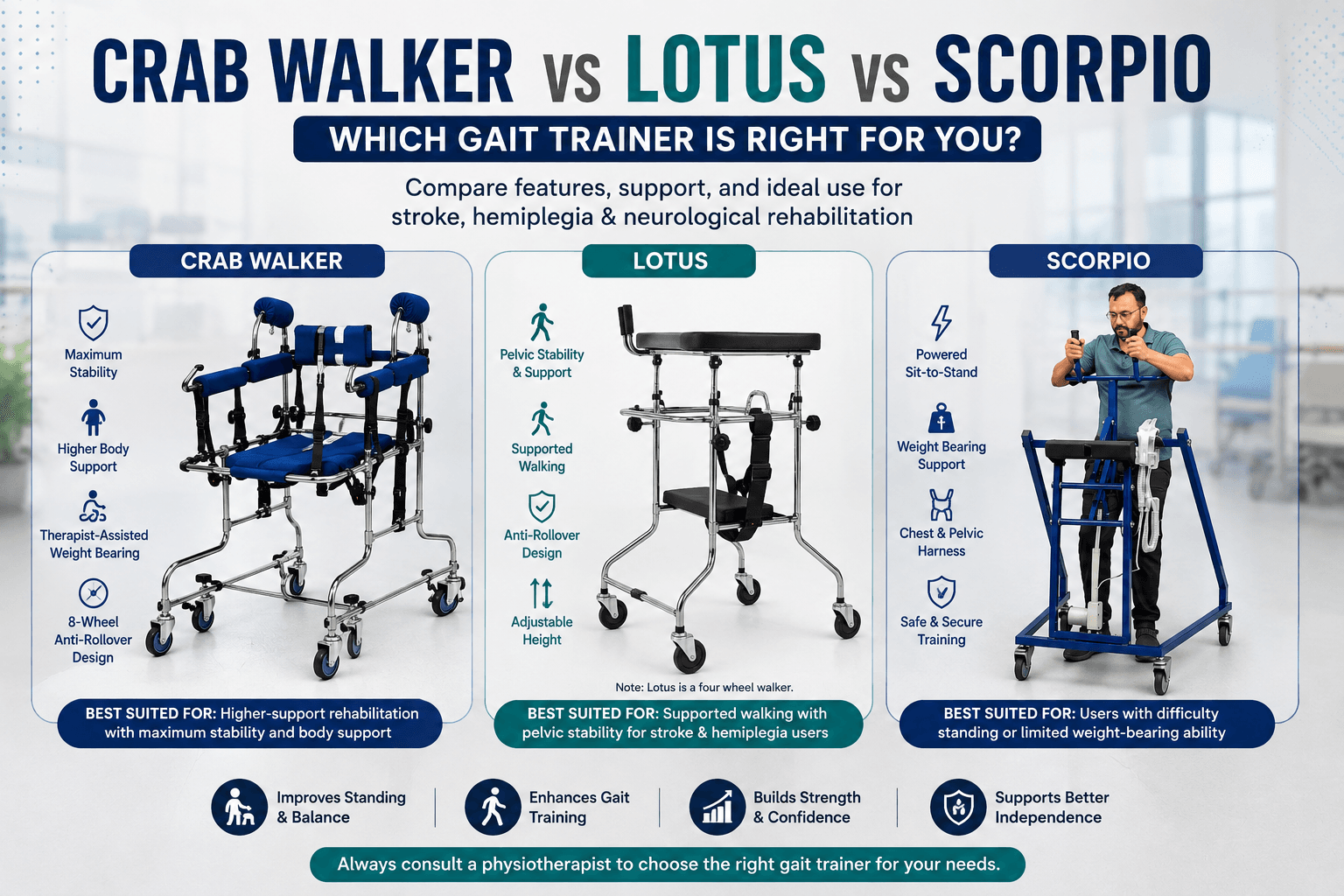
The Morecare Scorpio Electric Sit-to-Stand & Gait Training System combines a battery-powered standing mechanism with adjustable positioning supports.
Its primary purpose is to assist selected users during the transition from sitting into supported standing.
The system includes:
Electric linear actuator
Provides powered assistance during the sit-to-stand transition.
Rechargeable lithium-ion battery
Supplies power to the standing mechanism.
Wired handheld controller
Allows the operator to control the electric standing movement.
Adjustable arm supports
Provide upper-limb positioning options according to the patient's measurements and needs.
Adjustable knee supports
Provide additional lower-limb positioning support.
Chest and pelvic harnesses
Help establish the intended supported position when correctly fitted.
Wheeled gait-training frame
Allows selected patients to participate in supervised standing and therapist-guided stepping activities.
For a stroke survivor with one-sided weakness, Scorpio may be considered when powered assistance is needed to reach an appropriate standing position.
Once standing, a therapist may assess whether the patient can participate in weight-shifting, balance or stepping activities.
Scorpio does not drive the legs automatically or provide a documented percentage of body-weight unloading.
It is not approved as a full-body suspension system or a general-purpose patient hoist.
Its suitability must be established before use, particularly for patients with poor trunk control, substantial knee instability or limited lower-limb loading capacity.
How Should Families Choose Standing Equipment After Stroke?
Different stroke survivors require different levels of physical assistance.
A person who can stand independently but needs support while walking may benefit from a conventional walking aid.
Someone who requires additional trunk or pelvic positioning during stepping may need a supportive gait trainer.
A patient whose main difficulty is rising from a chair may be assessed for a powered sit-to-stand system.
Others may require a full-body transfer hoist or a more comprehensive rehabilitation arrangement.
Before selecting Scorpio, families should discuss the following with the treating physiotherapist.
Current sit-to-stand ability
Can the patient initiate standing, or is substantial assistance required?
Affected-side movement
How much voluntary movement and loading ability remains in the weaker leg?
Knee and trunk control
Can the body be supported in the intended standing position without unsafe joint movement?
Medical stability
Does the patient experience dizziness, blood-pressure problems, pain or other conditions that may affect upright training?
Stepping ability
Can the person participate in assisted stepping, or is standing the immediate rehabilitation goal?
Caregiver and environmental requirements
Is there adequate space, an approved transfer procedure and trained supervision?
Scorpio is intended for selected teenagers and adults approximately 4 feet to 6 feet 3 inches tall, subject to individual fitting.
Its final user-weight limit must be confirmed against the current approved manufacturing specification before use.
For suitable patients, the purpose is to provide access to appropriately supported rehabilitation activities—not to promise recovery of independent standing or walking.