Why Is Standing Up From a Chair Difficult for Some Patients?
Standing from sitting is a complex movement involving several muscle groups and coordinated postural adjustments.
During the movement, a person must bring their body weight forward, generate force through their legs and maintain balance while moving into an upright position.
The hips, knees and ankles all contribute to the transition.
The trunk also plays an important role in maintaining stability.
When these movements are impaired, standing can become physically demanding or impossible without assistance.
Common contributing factors include:
Weakness in the hip and thigh muscles.
Reduced ability to bear weight through the legs.
Poor trunk control and balance.
Limited movement at the hips, knees or ankles.
Reduced coordination following neurological injury.
Pain, fatigue or fear of falling.
Some patients may be able to move their legs while sitting but cannot generate sufficient force to stand.
Others may initiate standing but lose balance before reaching an upright position.
The cause should be evaluated by a physiotherapist or rehabilitation professional before choosing equipment.
Which Medical Conditions Can Affect Sit-to-Stand Ability?
Difficulty standing is common across several neurological and musculoskeletal conditions.
Stroke and hemiplegia
A stroke may cause weakness on one side of the body, impaired balance or reduced coordination.
These difficulties can affect the person's ability to transfer weight and rise from a seated position.
Spinal cord injury
Depending on the location and severity of the injury, individuals may experience reduced lower-limb strength, sensation and standing control.
Cerebral palsy
Some teenagers and adults with cerebral palsy experience movement abnormalities, spasticity and postural limitations that make standing transitions difficult.
Parkinson's disease
Bradykinesia, rigidity and impaired postural control may interfere with initiating and completing sit-to-stand movements.
Multiple sclerosis
Muscle weakness, fatigue and impaired balance can affect standing and mobility.
Prolonged illness or reduced activity
Extended periods of immobility may contribute to reduced strength and physical endurance.
However, diagnosis alone does not determine whether a powered standing trainer is suitable.
The patient's remaining motor function, joint mobility, standing tolerance and ability to participate safely must be assessed individually.
Why Can Manual Lifting Become Difficult for Caregivers?
When a patient cannot stand independently, family members may attempt to provide physical assistance.
Common situations include helping someone rise from a wheelchair, bed or ordinary chair.
Some caregivers pull the patient's hands, support them under the arms or attempt to lift much of their body weight.
These methods may be unsafe when performed without appropriate training.
They can create risks such as:
Caregiver back and shoulder strain.
Loss of balance during standing.
Uncontrolled movement of the patient's body.
Pressure or injury around the arms and shoulders.
Falls during the transition.
The appropriate transfer technique depends on the patient's abilities and medical condition.
A physiotherapist or trained rehabilitation professional should establish whether the person needs verbal guidance, manual assistance, a standing aid or a full-body patient hoist.
Powered standing equipment can reduce the need for caregivers to supply all the lifting force manually.
However, it does not eliminate the need for correct positioning, trained assistance or an approved transfer procedure.
How Does an Electric Sit-to-Stand Trainer Work?
An electric sit-to-stand rehabilitation system uses a powered mechanism to assist movement from sitting towards standing.
Depending on its design, the system may include an electric linear actuator, positioning supports, a rechargeable battery and an operating controller.
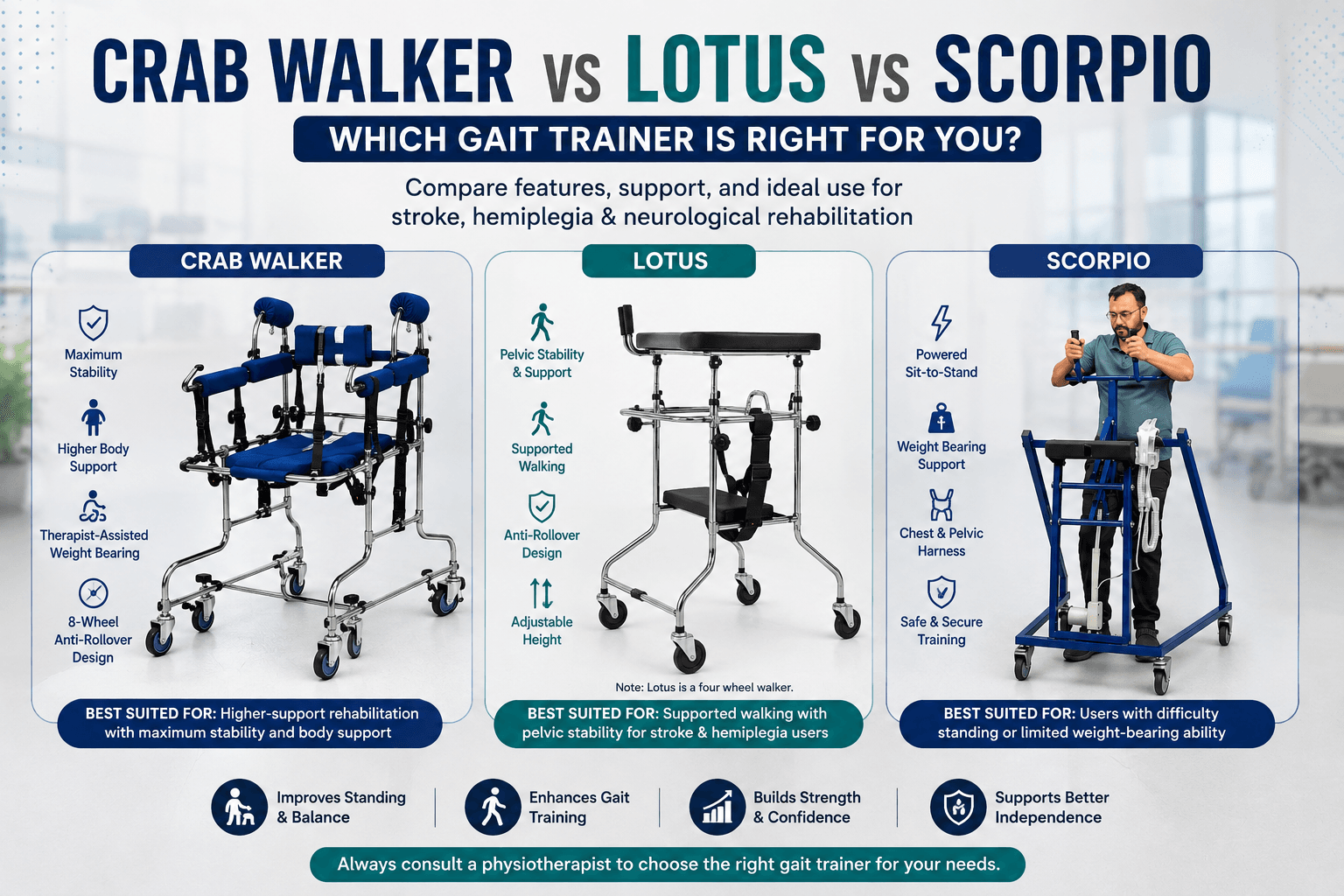
The Morecare Scorpio uses an electric linear actuator powered by a rechargeable lithium-ion battery.
Its wired handheld controller operates the standing mechanism.
The system also includes:
Chest harness
Provides upper-body positioning support during prescribed rehabilitation activities.
Pelvic harness
Helps maintain the required pelvic positioning during supported standing.
Adjustable arm supports
Allow the upper limbs to be positioned according to the patient's measurements and abilities.
Adjustable knee supports
Provide additional lower-limb positioning support during the standing transition.
Wheeled rehabilitation frame
Allows the equipment to be positioned and used for selected supervised gait-training activities.
A trained caregiver or therapist must follow the approved operating instructions, including fitting, braking and emergency procedures.
The powered mechanism helps perform the standing transition, but it does not establish that the patient can independently bear weight or walk.
Scorpio is not intended to replace a general-purpose full-body patient transfer hoist.
Can Powered Standing Assistance Be Combined With Walking Rehabilitation?
For some patients, reaching a suitable standing position is the first challenge.
After standing, they may be able to participate in additional rehabilitation activities depending on their physical abilities.
The Morecare Scorpio combines powered sit-to-stand assistance with a supported gait-training frame.
This allows a therapist to evaluate whether the patient can participate in activities such as:
Supported standing
Maintaining an upright position with the required external assistance.
Weight-bearing practice
Participating in appropriately prescribed lower-limb loading activities.
Weight shifting
Practising controlled changes in body position under supervision.
Assisted stepping
Initiating or practising steps when sufficient motor function and support are available.
Functional movement training
Working towards individualized mobility objectives established by the rehabilitation team.
However, Scorpio's walking function is not motor-driven.
The device does not automatically move the patient's legs or provide documented full-body suspension.
Some individuals may benefit only from standing activities, while others may progress to supervised stepping.
The rehabilitation programme should be based on actual functional abilities rather than assuming that powered standing will lead to independent walking.
How Do You Know Whether Scorpio Is Suitable for Your Patient?
Before purchasing an electric sit-to-stand trainer, a physiotherapist should assess the patient's standing and movement requirements.
Important questions include:
Can the patient participate in a supported standing transition?
Determine whether the patient's posture, joint mobility and medical condition permit the proposed standing movement.
Does the patient have sufficient head and trunk control?
Some patients may require additional support beyond the standard configuration.
Can the patient safely tolerate lower-limb loading?
Conditions affecting bones, joints, circulation or neurological function may require specific precautions.
Does the patient need rehabilitation standing or complete body lifting?
Patients requiring general-purpose transfers may need a dedicated patient hoist instead.
Can the patient participate in stepping?
Walking practice should only begin when a rehabilitation professional has assessed the patient's motor function and required support.
Is the home or clinic suitable?
Check doorway clearance, floor conditions, available turning space and caregiver training.
The Morecare Scorpio is designed for teenagers and adults approximately 4 feet to 6 feet 3 inches tall, subject to individual fitting.
The current product page publishes a maximum user weight of 150 kg, but this must be reconfirmed by Morecare against the approved production specification before use.
Scorpio may be considered for selected patients who require powered standing assistance and could participate in supported rehabilitation activities.
It should not be used for unsupervised standing, unsupported transfers or walking beyond the patient's assessed abilities.