Why Do Some Children Need a Customized Standing Frame?
Standing requires coordinated support from the lower limbs, pelvis, trunk and head.
Children with cerebral palsy or other neurological conditions may have difficulty maintaining this position because of muscle weakness, altered muscle tone, impaired coordination or restricted joint movement.
Some children can participate in supported standing with relatively simple positioning assistance.
Others require more extensive support.
Standard standing frames are manufactured around defined body dimensions, adjustment ranges and support configurations.
These may not meet every child's requirements.
Poor Head Control
Some children cannot independently maintain an appropriate head position during supported standing.
A standard headrest may not provide enough support or may be positioned incorrectly for the child's body proportions.
Trunk Instability
A child may lean forward, backward or sideways when placed in a standing position.
The frame may need appropriately located chest and trunk supports.
Pelvic Asymmetry
Some children have difficulty maintaining a comfortable pelvic position.
This may involve muscle tone, hip limitations or a structural postural asymmetry.
Hip and Knee Contractures
Fixed joint restrictions can prevent a child from comfortably reaching the standing position assumed by a conventional frame.
The equipment should accommodate assessed movement limitations rather than force the joints towards a position they cannot achieve.
Unusual Body Dimensions
Age alone does not establish standing-frame fit.
A child may have non-standard trunk height, leg length, pelvic width or other proportions that affect support placement.
Different Standing Tolerance
Some children may tolerate a supported upright position.
Others need a more gradual transition from lying towards upright standing, or may not currently be suitable for standing.
Difficulty Participating in Activities
An activity tray or suitable upper-body support may be required for selected play, communication or therapy tasks during a prescribed standing session.
These requirements should be assessed together.
A custom standing frame is not simply a standard frame with extra straps.
It is a support system that must accommodate the child's body, therapeutic goals and safety requirements.
Which Medical Conditions May Require Special Standing Support?
A medical diagnosis may explain why a child needs support during standing.
However, the appropriate standing arrangement depends on the child's individual assessment.
Cerebral Palsy
Children with cerebral palsy may have spasticity, dystonia, weakness, impaired balance or reduced postural control.
Some children require support around the knees and pelvis.
Others also need trunk and head positioning.
For children with substantial motor impairment, standing should be included only when clinically appropriate and with specific goals.
Cerebral Palsy With Hip Displacement Risk
Children with cerebral palsy, particularly those with more substantial motor limitations, may be at increased risk of hip displacement.
Hip position, pain and available movement should be reviewed before selecting a standing configuration.
A standing frame or abduction support should not be promoted as a guaranteed method of preventing hip displacement.
Children should continue appropriate medical hip surveillance.
Cerebral Palsy With Fixed Contractures
A child with restricted hip, knee or ankle movement may not tolerate a conventional upright alignment.
The therapist must distinguish between flexible positioning difficulties and fixed joint limitations.
The frame should not force a painful or mechanically restricted joint into position.
Spina Bifida
Some children with spina bifida have reduced lower-limb strength or sensation.
Standing support may require attention to leg positioning, skin inspection, pressure distribution and the child's orthopedic status.
Spinal Muscular Atrophy
Children with spinal muscular atrophy may have significant weakness and complex postural requirements.
Standing suitability depends on the child's medical condition, joint mobility, bone health and treating team's recommendations.
Muscular Dystrophy
Children with muscular dystrophy may develop progressive weakness or contractures.
Any standing programme should be based on current functional and medical assessment.
Developmental Delay and Hypotonia
Some children with reduced muscle tone require external support to maintain standing posture.
However, the need for a standing frame depends on their functional abilities and rehabilitation goals.
Other Complex Neurological Conditions
Children with rare neurological disorders or substantial movement limitations may have unusual positioning needs that are not addressed by standard equipment.
In every case, the purpose of standing should be defined by the treating rehabilitation team.
The goal may involve supported participation in activities, positioning practice or another individualized rehabilitation objective.
A standing frame does not cure the underlying condition or guarantee independent standing or walking.
What Parts of a Pediatric Standing Frame Can Be Customized?
Different standing difficulties require different adjustments.
Sometimes a standard frame already provides the necessary range.
In other situations, alternative support components or a made-to-order configuration may be required.
Morecare evaluates standing-frame customization requests involving several areas.
- Frame Height
The frame must accommodate the child's overall height and the positions of important body supports.
A child with unusual body proportions may need a different support arrangement from another child of the same height.
- Head Support
Some children need an adjustable headrest or additional positioning support.
The component should be selected according to the child's head control, trunk position and comfort.
- Chest and Trunk Support
Support height, width and placement may need adjustment.
The system must not create excessive pressure or interfere with breathing.
- Pelvic Support
Pelvic straps, hip guides or other approved supports may help establish an appropriate standing position.
The arrangement should accommodate the child's assessed hip mobility and postural asymmetry.
- Knee Supports
Knee support height, width and positioning can be important.
Supports must not force the knees into painful extension or place inappropriate pressure over vulnerable areas.
- Footplates and Foot Positioning
Footplates, heel supports and suitable straps may be needed to accommodate the child's feet.
Ankle positioning should respect the available joint range and any prescribed orthotic requirements.
- Activity Tray
Some children use an activity tray during supervised standing for play, communication or therapy tasks.
Tray height and distance should allow suitable upper-body positioning.
- Standing Orientation
Some children are assessed for an upright standing frame, while others may require a supine or other specialized arrangement.
Changing a product's basic standing orientation is not necessarily a simple customization.
It may require choosing a different engineering platform.
- Frame Dimensions and Stability
A request for an unusually narrow, tall or low standing frame requires structural review.
Changing the frame footprint can affect stability and tip resistance.
- Additional Positioning Accessories
Certain children may need more specialized support configurations.
However, each component must be compatible with the frame and approved intended use.
Important: These are areas Morecare can evaluate, not a promise that every modification is available on every model.
Structural, load-bearing and powered changes require engineering assessment and appropriate verification.
Which Morecare Standing Frame Can Serve as a Starting Point?
Morecare manufactures different pediatric standing-frame configurations.
Selecting the correct base model is often more practical than attempting to convert an unsuitable product into a different type of standing device.
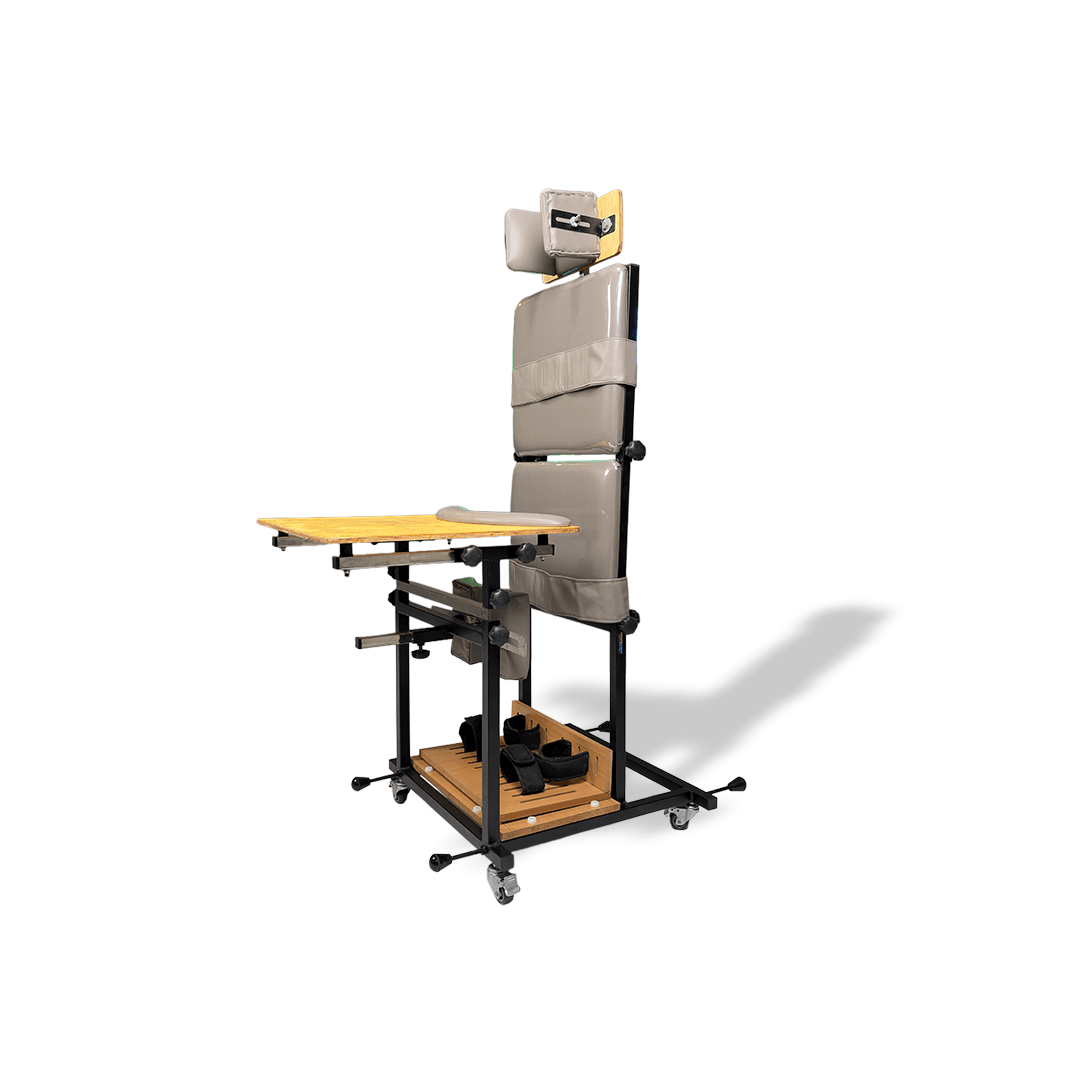
- Morecare Veronica — Upright Activity Standing Frame
Veronica is designed for selected children who require supported upright standing with an activity tray.
Its published features include:
Recommended age approximately 4–15 years.
Maximum published user weight of 80 kg.
Fixed upright standing configuration.
Adjustable head, chest, pelvic and knee supports.
Foot-positioning components.
Adjustable activity tray.
Height-adjustable supporting frame.
Lockable wheels.
Published customization options include frame height, chest-support height, knee-support position, tray height and distance, foot-positioning accessories and additional supports.
When might Veronica be considered?
For selected children who can safely participate in a prescribed upright standing programme and need a configurable frame for support and activities.
- Morecare i-Stand Nova — Compact Pediatric Upright Standing Frame
i-Stand Nova is a compact, fixed-upright standing system.
Its published features include:
Recommended age approximately 4–16 years.
Suitable user-height range approximately 2–5 feet, subject to measurements.
Maximum published user weight of 80 kg.
Adjustable head, trunk, pelvic and knee supports.
Body-positioning straps.
Activity tray.
Compact frame arrangement.
The child faces the padded front support board.
i-Stand Nova does not provide electric tilt or gradual supine-to-standing movement.
When might i-Stand Nova be considered?
For selected children who need a compact supported-upright arrangement and whose positioning requirements can be accommodated by its fixed standing configuration.
- Morecare Peony — Electric Supine Standing Frame
Peony provides a different standing arrangement.
It supports the child from a supine position and uses an electric actuator to change the frame angle.
Published features include:
Electric adjustment from approximately 0° to 90°.
Suitable user-height range approximately 60–137 cm.
Maximum published user weight of 60 kg.
Adjustable head, trunk, pelvic, knee, calf and foot supports.
Adjustable activity tray.
Wired powered positioning mechanism.
Lockable castors.
Peony's powered movement allows gradual adjustment of the supported standing angle.
However, it does not automatically establish that standing is medically appropriate or that a child can tolerate the entire range.
When might Peony be considered?
For selected children whose therapist recommends a supine standing arrangement with controlled angle adjustment and substantial external positioning support.
What If None of These Models Fits?
A child may require different dimensions, support geometry or a configuration not available within a standard adjustment range.
Morecare can review the request through its customization service.
Sometimes an existing model can be configured appropriately.
In other situations, a different standard product or more extensive engineering evaluation may be necessary.
No model should be selected solely on age, diagnosis or maximum weight rating.
How Does Morecare Develop a Made-to-Order Standing Frame?
A customized standing frame should begin with the child's rehabilitation requirements.
The manufacturing approach must then be evaluated against those needs.
Morecare's customization service provides a structured process for individual projects.
Step 1: Understand the Problem
Parents or therapists explain why the current standing frame is unsuitable.
Examples include:
The child's head falls outside the available support.
The trunk leans sideways.
The knee supports cannot be positioned correctly.
The pelvis cannot be accommodated comfortably.
The child has restricted hip or knee movement.
The frame does not fit the child's dimensions.
The available standing arrangement does not match the prescribed programme.
Step 2: Collect Measurements
Useful measurements may include:
Overall height.
Weight.
Trunk length.
Pelvic width.
Upper-leg length.
Lower-leg length.
Foot dimensions.
Relevant joint ranges of motion.
Measurements should be collected according to professional guidance, particularly when the child has fixed deformities or significant postural asymmetry.
Step 3: Review Clinical Requirements
The treating physiotherapist or rehabilitation specialist should clarify:
Whether supported standing is indicated.
Intended standing orientation.
Relevant hip, knee and ankle limitations.
Required head, trunk and pelvic support.
Pain, fracture history or bone-health concerns.
Appropriate supervision and transfer arrangements.
Standing goals and tolerance.
Step 4: Evaluate the Base Frame
Morecare reviews whether Veronica, i-Stand Nova, Peony or another configuration can address the requirement.
A standard adjustable component may be sufficient.
Alternatively, a modified support or frame dimension may deserve evaluation.
Step 5: Define the Proposed Modification
Where feasible, the project scope should identify:
Confirmed dimensions.
Support positions.
Required accessories.
Standing orientation and angle functions.
Approved user-weight limit.
Transfer and operating arrangements.
Structural and safety requirements.
Step 6: Confirm the Quotation
The quotation should explain the proposed customization, additional charges, estimated manufacturing timeline and applicable warranty terms.
A design involving new structural components may require more engineering work than adjusting an existing support.
Step 7: Manufacture and Inspect
Approved projects proceed through appropriate fabrication, assembly and inspection.
Safety-critical checks should address frame stability, support attachments, fasteners, locking mechanisms and powered components where applicable.
Step 8: Fit and Train
The child should be fitted in the completed configuration under appropriate supervision.
The caregiver and therapist should understand the approved setup, adjustment procedures, operating limits and signs of discomfort.
The frame should be reassessed if the child grows or their physical condition changes.
Morecare's role is to evaluate whether a safe, appropriate technical solution can be developed—not to promise that every unusual standing requirement can be manufactured.
How Much Does a Custom Standing Frame Cost, and What Should Parents Send Morecare?
How Much Does a Custom Standing Frame Cost, and What Should Parents Send Morecare?
A customized standing frame may involve minor adjustments or a substantially different mechanical configuration.
The cost and development time depend on the project.
What Affects the Price?
Base model
A standard upright frame and an electric supine frame involve different components and manufacturing requirements.
Dimensions
Non-standard frame heights, widths or support positions may require additional fabrication.
Positioning supports
Special headrests, trunk supports, pelvic components, knee pads or foot-positioning accessories may affect material and fitting costs.
Powered mechanisms
Changes involving electric tilt, actuators or moving structures require additional engineering and safety evaluation.
Custom structural parts
New load-bearing components may require drawings, calculations, manufacturing and testing.
Fitting and revisions
Complex requirements may need additional assessment or adjustment.
What About Manufacturing Time?
A straightforward approved support modification may be completed sooner than a newly engineered frame.
However, no single delivery timeline applies to every custom standing project.
Morecare should provide an estimated schedule after confirming feasibility, components and the required validation.
What Information Should Families Share?
Before contacting Morecare, prepare:
Child's age, height and weight.
Medical diagnosis and relevant functional limitations.
Current sitting and standing abilities.
Head and trunk control.
Pelvic and hip-positioning difficulties.
Knee and ankle movement limitations.
Pain, significant orthopedic concerns or therapist-identified restrictions.
Current standing frame, if any, and why it is unsuitable.
Measurements recommended by the treating therapist.
Therapist's proposed standing orientation and goals.
Intended environment: home, school, clinic or hospital.
Available space, budget and any delivery deadline.
Photographs or videos may help with preliminary evaluation, but families should not put a child into an unsafe unsupported standing position merely to record a demonstration.
Patient information should be shared with appropriate consent through an authorized communication channel.
What Should the Quotation Confirm?
Before accepting a made-to-order project, the customer should know:
The approved model or proposed design.
Agreed custom dimensions.
Positioning components included.
Intended standing function and limitations.
Additional customization charges.
Estimated manufacturing time.
Warranty and after-sales conditions.
Required fitting and supervision.
Any special clinical or technical conditions.
A customized standing frame should be selected because it meets a defined rehabilitation requirement—not simply because it offers more adjustments.
Clinical and Technical References
NICE. Cerebral Palsy in Under 25s: Assessment and Management (NG62).
https://www.nice.org.uk/guidance/ng62/chapter/Recommendations
American Academy for Cerebral Palsy and Developmental Medicine. Hip Surveillance in Cerebral Palsy.
https://www.aacpdm.org/publications/care-pathways/hip-surveillance-in-cerebral-palsy
Morecare Mobility & Rehabilitation Solutions. Customization Services.
https://morecare.in/customization-services
Morecare Mobility & Rehabilitation Solutions. Veronica Upright Standing Frame.
https://morecare.in/veronica/
Morecare Mobility & Rehabilitation Solutions. i-Stand Nova Pediatric Standing Frame.
https://morecare.in/i-stand-nova/
Morecare Mobility & Rehabilitation Solutions. Peony Electric Supine Standing Frame.
https://morecare.in/peony/
Medical and Engineering Disclaimer: This article provides general information about pediatric standing-frame selection and customization. Standing suitability, permitted joint positions, weight-bearing, standing duration and support requirements must be determined through individual clinical assessment. Hip surveillance, orthopedic follow-up and other recommended care must continue independently of equipment use. Structural, powered and load-bearing modifications require appropriate engineering validation. Standing frames do not guarantee improvement in bone density, prevention of hip displacement or independent walking.