
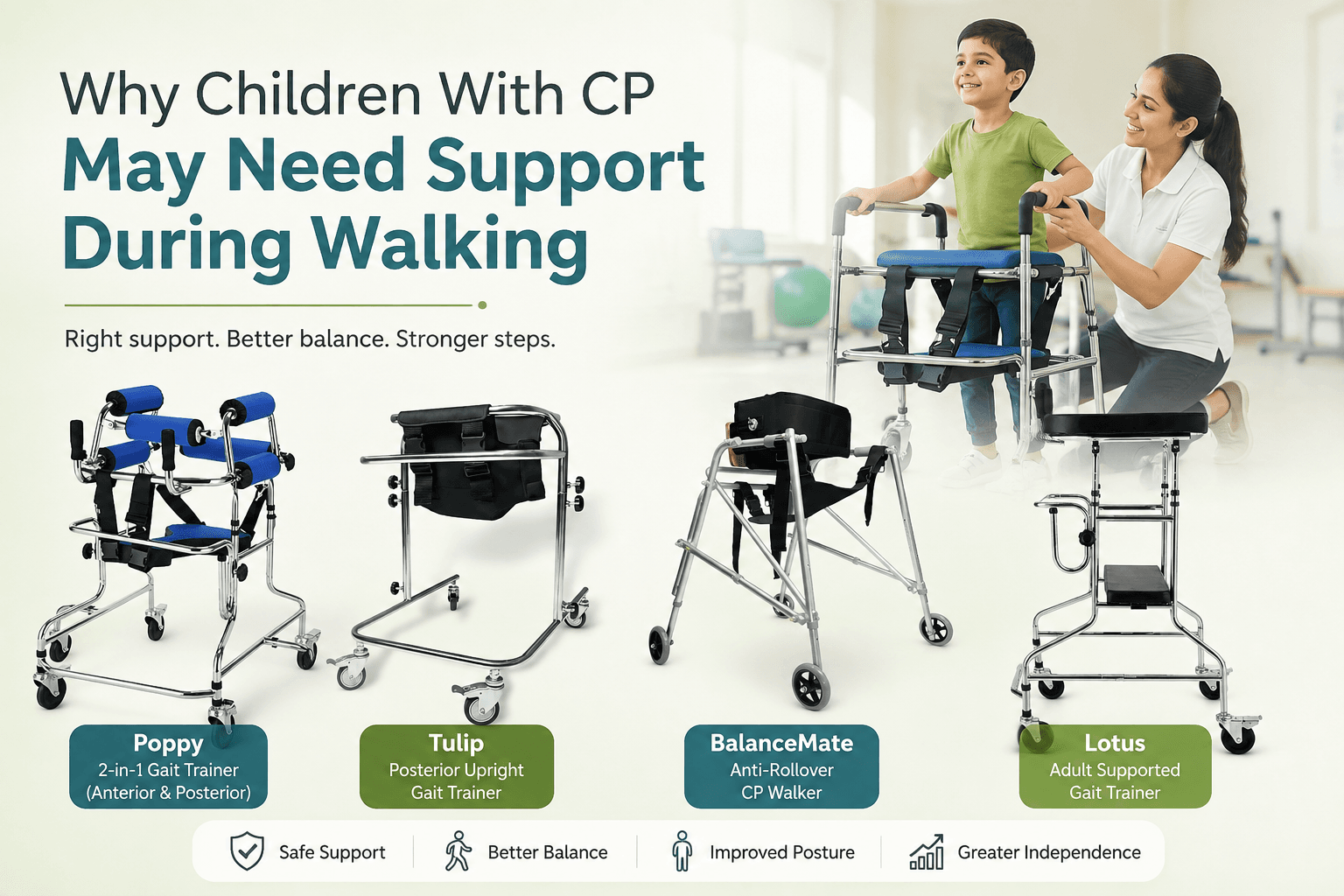
For parents of children with Cerebral Palsy (CP), seeing their child take their first steps can be an important milestone.
But taking a few steps does not always mean a child is ready to walk safely and independently.
A child may be able to step forward but still struggle with balance, posture, weight shifting, pelvic control or coordination. They may need a parent to hold their hand, support their body or walk closely beside them to prevent them from losing balance.
This is where the right walking support can become an important part of supervised gait training.
Different children need different levels of support. Some may benefit from a lightweight walker that encourages active movement, while others may need pelvic and trunk support or a highly stable anti-rollover design.
Morecare offers several pediatric and rehabilitation walking solutions designed around these different needs.
- --
Why Can a Child With CP Take Steps but Still Need Support?
Walking is a complex activity.
Taking one or two steps requires a different level of control than maintaining balance while repeatedly shifting weight from one leg to the other.
Children with CP may experience difficulties with
- Maintaining standing balance
- Controlling their trunk
- Maintaining pelvic stability
- Shifting weight from one leg to another
- Coordinating leg movements
- Keeping an upright posture
- Controlling their knees and feet
- Maintaining a consistent walking pattern
Because of these challenges, a child may be able to walk when a parent holds them but struggle when that support is removed.
The objective of a gait trainer or walker is not simply to hold the child upright. The right device should provide an appropriate level of support while allowing the child to participate in standing, stepping and walking practice.
- --
Why Is Walking Support Important During Gait Training?
A child who is afraid of falling may naturally become more dependent on the person supporting them.
They may hold tightly onto a parent's hand, lean forward, take very small steps or stop walking whenever they feel unstable.
A properly selected walking aid can create a more controlled environment for supervised practice.
Depending on the child's abilities and the type of equipment used, support may be provided around the:
- Pelvis
- Trunk
- Chest
- Upper body
- Legs
- Walking frame itself
This allows the level of assistance to be matched more closely to the child's needs.
- --
Not Every Child With CP Needs the Same Walker
This is an important point for parents.
There is no single "best CP walker" for every child.
A child who can walk with minimal support may need a very different device from a child who has significant balance or postural difficulties.
The right choice may depend on
How much support does the child need?
Can the child maintain an upright position?
Can they shift their weight?
Can they take repeated steps?
Do they tend to lose balance or tip the walker?
Do they need pelvic or trunk positioning?
What are the child's current rehabilitation goals?
This is why Morecare has developed different walking and gait-training solutions rather than treating every child in the same way.
- --
Morecare Poppy: When Walking Support Needs to Change With the Child
Morecare Poppy – 2-in-1 Pediatric Gait Trainer is designed to provide both anterior and posterior walking configurations in one system.
This can be useful when a child's walking ability changes during rehabilitation.
The Poppy can be converted between the two configurations without tools, allowing therapists and caregivers to select the setup that is more appropriate for the child's current stage of gait training.
It includes features such as
- Adjustable chest support
- Removable pelvic sling
- Height adjustment
- Medical-grade wheels
- Anterior and posterior walking options
Morecare recommends Poppy for children 8–13 years, with a recommended GMFCS range of II–IV.
Why this matters
For some children, the amount of support they require can change as their walking skills develop.
Instead of thinking only about "which walker?", parents and therapists can consider:
> "What level and direction of support does my child need at this stage?"
- --
Morecare Tulip: Posterior Support for Upright Walking Practice
Morecare Tulip – Posterior Upright Gait Trainer is a posterior gait trainer designed for children with CP and other neurological conditions.
The frame is positioned behind the child, with adjustable pelvic and trunk support to help provide stability during supervised walking practice.
Tulip is designed for children 3–12 years, supports up to 80 kg, and is recommended by Morecare for GMFCS Levels II–III.
Its support system can help children practise
- Upright standing
- Weight shifting
- Balance
- Step progression
- Supported walking
The posterior configuration is particularly relevant when the rehabilitation goal involves encouraging a more upright walking position while still providing external support.
- --
Morecare BalanceMate: When Stability Is a Bigger Concern
Some children require a significantly more stable walking platform.
For these children, the concern may not simply be
"Can my child take steps?"
It may be
> "Can my child practise standing and walking without the walker tipping or becoming unstable?"
Morecare BalanceMate – Anti-Rollover CP Walker is designed specifically around this requirement.
BalanceMate uses a six-wheel anti-rollover design and wide support base to provide a high level of stability during standing and walking practice. It also includes adjustable pelvic and torso supports.
Morecare recommends BalanceMate for children 4–12 years and GMFCS Levels IV–V, with a maximum user weight of 80 kg.
This makes the distinction important
- Tulip* focuses on posterior upright gait training for children requiring a particular level of support.
- BalanceMate is designed for children who require higher levels of stability and support*, including an anti-rollover base.
The right choice depends on the child's actual mobility and positioning needs—not simply their diagnosis.
- --
What About Older Patients With Similar Walking Challenges?
The same basic rehabilitation principle applies beyond pediatric mobility.
An adult recovering from a neurological condition may also be able to take steps but still require significant support for balance, pelvic stability or confidence.
For this group, Morecare offers Lotus, an adult supported gait trainer designed for people recovering from stroke, hemiplegia and other neurological conditions.
Morecare Lotus – Adult Supported Gait Trainer provides pelvic stability and walking support through features including a butterfly pelvic sling, adjustable back support, hand grips, height adjustment and a wide anti-rollover design.
Lotus is designed for adults with a maximum user weight of 120 kg.
So while Lotus is not a pediatric CP walker, it demonstrates an important point:
> Walking support should be selected according to the person's functional ability, body support requirements and rehabilitation goals—not simply their diagnosis or age.
- --
Which Morecare Walker Might Be Appropriate?
Rather than choosing a product based only on a diagnosis such as CP, consider the type of support required.
| Mobility RequirementMorecare Solution | |
| -------------------------------------------------------------------- | --------------- |
| Child needs a flexible anterior/posterior configuration | Poppy |
| Child needs posterior upright gait training | Tulip |
| Child needs a highly stable anti-rollover walking platform | BalanceMate |
| Adult needs supported gait training after stroke/neurological injury | Lotus |
These are different rehabilitation solutions for different mobility requirements.
A physiotherapist or rehabilitation professional should assess the child's posture, balance, weight-bearing ability, walking pattern and level of assistance before selecting the most appropriate equipment.
- --
The Goal Is Not to Replace the Child's Movement
One of the biggest misconceptions about gait trainers is that the equipment should do all the work.
That is not the goal.
The purpose of appropriately selected walking support is to create an environment where the child can participate in movement with the amount of assistance they currently require.
As the child's abilities change, their support requirements may also change.
The rehabilitation journey may therefore look different for every child
Supported standing → weight shifting → assisted stepping → supported walking → increased participation → greater functional mobility
Progress is not always linear, and every child has different goals.
- --
When Should Parents Consider a Gait Trainer or Supported Walker?
You may want to discuss a gait trainer with your child's physiotherapist if your child:
- Can take steps but cannot maintain balance
- Requires someone to hold them while walking
- Frequently loses balance during walking practice
- Has difficulty maintaining an upright posture
- Has difficulty shifting weight between the legs
- Needs pelvic or trunk support
- Is beginning structured gait rehabilitation
- Becomes fearful of walking because of instability
The important question is not simply
"Does my child have CP?"
It is
> "What support does my child need to participate in walking safely and effectively?"
- --
Choosing the Right Support Is About the Child, Not Just the Product
Children with CP can have very different mobility abilities even when they have the same diagnosis.
One child may need only moderate support to practise walking. Another may need pelvic and trunk positioning. Another may require a highly stable anti-rollover frame.
This is why Morecare's approach includes different gait trainers and walking support systems such as Poppy, Tulip and BalanceMate, while adult rehabilitation needs may be addressed with solutions such as Lotus.
The right equipment should be selected around the individual's current abilities, support requirements, comfort and rehabilitation goals.