
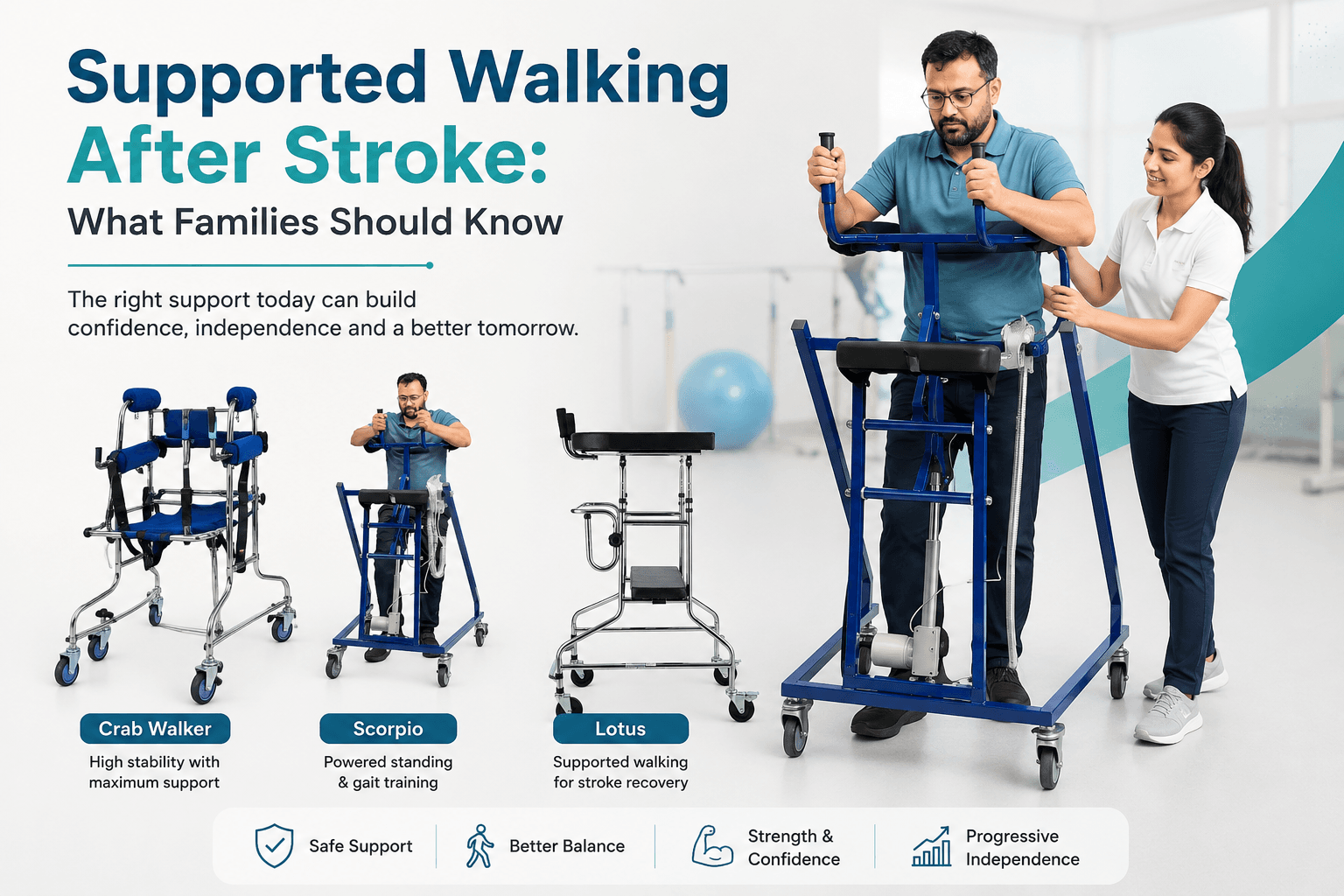
Walking after a stroke can look very different from one person to another. Some people may be able to stand or take a few steps but still struggle with balance, weight shifting, leg weakness, coordination, or controlling one side of the body.
For families, this can create an important question
“If they can take a few steps, should we encourage them to walk—or do they need more support first?”
The answer depends on the person's current abilities and rehabilitation goals. In many cases, supported gait training can provide a safer environment to practice standing, weight shifting and walking while reducing the physical effort required from the caregiver.
> Important: A gait trainer should be selected according to the individual's assessment, walking ability, strength, balance and rehabilitation goals. Use under the guidance of a qualified physiotherapist or rehabilitation professional.
Why Walking Can Be Difficult After a Stroke
A stroke can affect the systems responsible for movement, balance and coordination. Depending on the area affected, a person may experience:
- Weakness on one side of the body
- Difficulty maintaining standing balance
- Poor weight shifting between the legs
- Reduced control of the affected leg
- Difficulty lifting or advancing the foot
- Abnormal walking patterns
- Reduced confidence while walking
- Fatigue during walking practice
- Increased risk of losing balance
This means that being able to take a step does not necessarily mean that a person can walk safely without support.
For some individuals, the goal of early gait rehabilitation is not simply to walk farther. It may be to repeatedly practice the basic components of walking—standing, weight shifting, stepping and maintaining an upright posture.
What Is Supported Gait Training?
Supported gait training uses an appropriate mobility or rehabilitation device to provide additional stability while the person practices walking.
Instead of a caregiver physically holding the person's body throughout the session, the equipment can provide structured support around areas such as the pelvis, trunk, chest, arms or legs, depending on the design.
This can allow the therapist to focus more on the person's movement and walking pattern rather than constantly preventing a loss of balance.
The appropriate level of support can also change as rehabilitation progresses.
- --
Which Morecare Walker May Be Suitable After Stroke?
There is no single walker that is right for every stroke survivor. Different users require different levels and types of support.
Morecare offers several gait-training solutions that can be considered depending on the person's functional ability.
Morecare Lotus – For Supported Walking & Hemiplegia Rehabilitation
The Morecare Lotus is specifically designed as an adult supported gait trainer for stroke and hemiplegia rehabilitation.
It provides pelvic stability through an adjustable butterfly pelvic sling, along with back support, ergonomic hand grips and a wide anti-rollover base. The frame can be adjusted to suit different users and can be used with or without the pelvic sling as the person's mobility progresses. ([Morecare][1])
Lotus may be worth considering when the person
- Can participate in walking practice but needs additional stability
- Has hemiplegia following stroke
- Struggles with balance during walking
- Needs pelvic support during gait training
- Requires a more structured alternative to a conventional walker
Learn more about Morecare Lotus
- --
Morecare Scorpio – When Standing Is the First Challenge
For some stroke survivors, the biggest difficulty comes before walking.
They may have significant lower-limb weakness or limited weight-bearing ability and require substantial assistance to move from sitting to standing.
The Morecare Scorpio combines powered sit-to-stand assistance with gait training. Its electric linear actuator helps the user transition from sitting to standing, while adjustable arm, knee, chest and pelvic supports provide positioning during standing and supervised walking practice. ([Morecare][2])
This can make Scorpio particularly relevant when the rehabilitation journey looks more like:
Sit → Stand → Weight Bear → Step → Walk
rather than immediately starting with unsupported walking.
Learn more about Morecare Scorpio
- --
Morecare Crab Walker – When Maximum Stability Is Needed
Some stroke survivors need considerably more physical support during standing and walking.
The Morecare Crab Walker uses an eight-wheel anti-rollover design with a wide wheelbase and low centre of gravity. It also provides padded chest support, adjustable arm supports and a weight-bearing pelvic sling. ([Morecare][3])
This makes it appropriate to consider for adults who require a highly supportive environment for:
- Standing practice
- Weight shifting
- Balance training
- Supported walking
- Progressive gait rehabilitation
The Crab Walker is designed for adults from approximately 5 ft to 6.2 ft and has a maximum recommended user weight of 150 kg. ([Morecare][3])
Learn more about Morecare Crab Walker
- --
How Do You Know Which Level of Support Is Needed?
A useful way to think about gait rehabilitation is to look at what the person can already do safely.
If they can walk but lose balance easily
A supported gait trainer such as Lotus may provide additional pelvic and postural support while allowing walking practice. ([Morecare][1])
If they struggle to stand before walking
A powered standing and gait system such as Scorpio may be considered when powered sit-to-stand assistance is clinically appropriate. ([Morecare][2])
If they need substantial support during standing and walking
A highly stable rehabilitation walker such as Crab Walker may be considered for supported standing, weight-bearing and gait training. ([Morecare][3])
The important point is that the goal should not simply be to put a person into the biggest or most supportive walker available.
The support should match the person's rehabilitation needs while allowing as much active participation as safely possible.
- --
What Families Should Look For in a Stroke Gait Trainer
When comparing walking aids, don't look only at the number of wheels or the appearance of the frame.
Consider
###
1. How much weight can the person bear?
Can they stand independently, partially bear weight, or require significant assistance?
###
2. How is their balance?
Do they fall forward, backward or toward the affected side?
###
3. Can they control their pelvis and trunk?
If the trunk or pelvis is unstable, additional positioning support may be important.
###
4. Can they actively move the affected leg?
The equipment should allow the person to participate in stepping rather than simply being moved by the caregiver.
###
5. How much caregiver assistance is required?
A suitable rehabilitation device should ideally reduce unnecessary physical strain on caregivers while maintaining appropriate supervision.
###
6. What is the rehabilitation goal?
The goal could be
Standing → Weight Bearing → Weight Shifting → Stepping → Walking → Functional Mobility
The equipment should support the current stage while allowing progression where clinically appropriate.
- --
Walking Practice Is More Than Just “Walking”
For a stroke survivor, every walking session can involve several skills
- Maintaining an upright posture
- Shifting weight onto the affected leg
- Moving the opposite leg forward
- Controlling the knee
- Maintaining balance
- Coordinating both sides of the body
- Repeating the movement consistently
This is why structured gait training can be useful even when the person is already able to take a few steps.
The objective is not simply more steps.
It is better-controlled, purposeful and progressively safer movement.
- --
When Should Families Consider a Supported Gait Trainer?
Consider discussing a gait trainer with a physiotherapist if your family member
- Can take steps but requires someone to hold them
- Frequently loses balance while walking
- Has significant weakness on one side after stroke
- Has difficulty standing for longer periods
- Is afraid of falling
- Requires substantial caregiver assistance during walking practice
- Is beginning or progressing through gait rehabilitation
A therapist can assess whether the person is ready for supported gait training and determine the level of assistance required.
The Right Support Can Change With Recovery
One of the most important things families should understand is that the ideal walking support today may not be the ideal support six months from now.
As strength, balance and motor control improve, the amount of external support may be reduced or changed.
That is why Morecare focuses on different levels of supported mobility—from powered standing and gait training with Scorpio, to high-stability supported walking with Crab Walker, to progressive adult gait training with Lotus. ([Morecare][2])
The goal is not to replace the person's effort.
The goal is to create the right environment for them to participate in it.
Final Thought
For families supporting a loved one after stroke, seeing those first few steps can be extremely encouraging. But if every step requires someone to physically hold the person, walking may still need more structured support.
With the right assessment, an appropriate gait trainer can provide a more controlled environment for practising standing, weight shifting, balance and walking as part of a rehabilitation programme.
Every person's recovery is different. The right walking solution should be selected around the person—not the other way around.
[1]: https://www.morecare.in/lotus/?utm_source=chatgpt.com "Morecare Lotus – Adult Stroke & Hemiplegia Gait Trainer"
[2]: https://www.morecare.in/scorpio/?utm_source=chatgpt.com "Morecare Scorpio | Powered Standing & Gait Training System"
[3]: https://www.morecare.in/crab-walker/?utm_source=chatgpt.com "Morecare Crab Walker | Adult Standing & Gait Training Walker"