
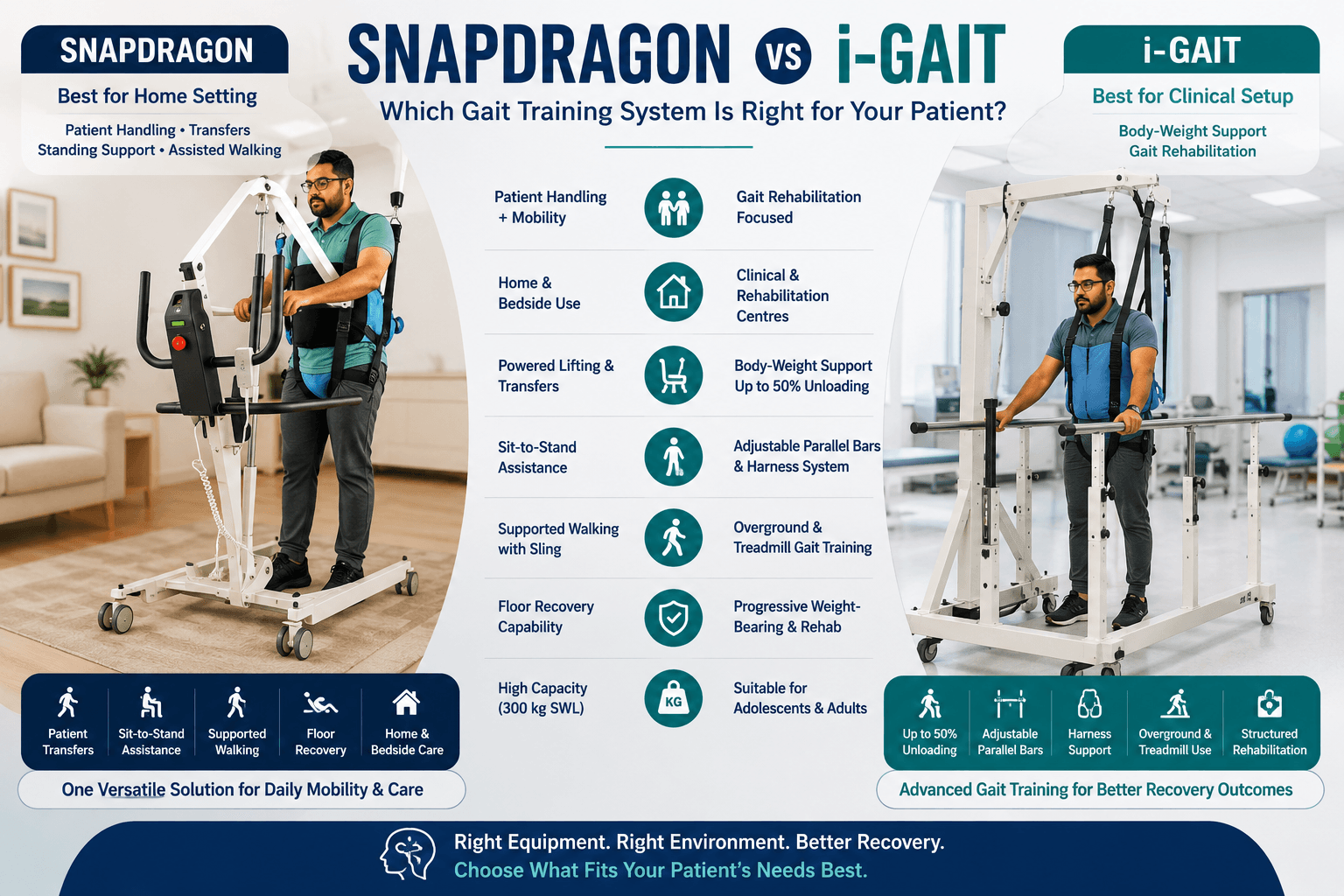
Both systems may have a role in neurological rehabilitation, but the appropriate choice depends on what the patient needs and where the rehabilitation is taking place.
At Home: Snapdragon
A stroke survivor may require assistance with
Getting out of bed
Bed-to-wheelchair transfers
Sit-to-stand
Toilet transfers
Supported standing
Walking practice
In this situation, Snapdragon's broader patient-handling capability can make it particularly practical for home-based care and mobility assistance.
In a Rehabilitation Clinic: i-Gait
A patient attending regular physiotherapy may have a different objective.
The therapist may want to
Reduce body-weight loading
Practise repetitive stepping
Progress weight-bearing gradually
Work on balance and posture
Combine overground and treadmill gait training
Adjust the level of unloading as the patient improves
This is where i-Gait's controlled body-weight support becomes particularly valuable.
Snapdragon vs i-Gait for Different Patient Needs
If the main problem is transferring the patient
Consider Snapdragon.
It is designed to support powered patient transfers in addition to standing and walking.
If the main problem is getting the patient safely into standing
Consider Snapdragon.
Its powered lifting mechanism can assist the sit-to-stand process.
If the patient can participate in walking but needs body-weight unloading
Consider i-Gait.
Its adjustable suspension system allows controlled unloading during gait training.
If treadmill gait training is part of the programme
Consider i-Gait.
It is designed to support structured treadmill and overground gait rehabilitation.
If the equipment will primarily be used at home
Snapdragon may be the more practical choice.
Its combination of transfer, lifting, standing and walking support addresses multiple daily-care requirements.
If the equipment will primarily be used in a physiotherapy or rehabilitation centre
i-Gait may be the more appropriate solution.
Its design is focused on structured and progressive gait rehabilitation.
Which Conditions Can These Systems Be Used For?
Equipment should not be selected based on diagnosis alone. The person's functional ability and rehabilitation goals should always be considered.
Snapdragon is designed for patients with mobility limitations associated with conditions such as:
Stroke
Spinal cord injury
Parkinson's disease
Multiple sclerosis
Traumatic brain injury
Adult cerebral palsy
Muscular dystrophy
Motor neuron disease
Post-surgical rehabilitation
Age-related frailty
Bariatric care
i-Gait can be considered for neurological, orthopaedic and mobility rehabilitation where progressive gait training and controlled weight-bearing are part of the rehabilitation programme.
A qualified physiotherapist or rehabilitation professional should determine whether either system is appropriate for the individual patient.
Which Is Better: Snapdragon or i-Gait?
There is no universal winner.
The better question is
What does the patient need help with—and where will the equipment be used?
Choose Snapdragon when you need
Patient handling + transfers + standing + assisted walking
Especially for
Home care
Bedside care
Nursing care
Patients requiring substantial assistance
Families managing multiple daily mobility needs
Choose i-Gait when you need
Body-weight support + structured gait rehabilitation + progressive walking practice
Especially for
Physiotherapy clinics
Rehabilitation centres
Hospitals
Neuro-rehabilitation programmes
Treadmill and overground gait training
Snapdragon and i-Gait Are Not Direct Replacements
This is perhaps the most important point.
Snapdragon and i-Gait should not be viewed simply as two competing gait trainers.
They address different parts of the rehabilitation journey.
Snapdragon is a versatile patient mobility and handling system with gait-training capability.
i-Gait is a dedicated gait rehabilitation system focused on progressive body-weight-supported walking.
One is particularly valuable when everyday patient handling and mobility are part of the requirement.
The other is particularly valuable when structured gait rehabilitation is the primary objective.
Final Thoughts
Choosing gait training equipment should start with the patient's functional needs, not the product name.
If the patient needs help with transfers, standing, daily mobility and assisted walking—particularly in a home-care environment—Morecare Snapdragon may be the more versatile solution.
If the primary objective is progressive gait rehabilitation in a clinical or physiotherapy setting, where controlled body-weight unloading, repetitive walking and treadmill training are required, Morecare i-Gait may be the more appropriate choice.
In simple terms
Snapdragon = Home Mobility + Patient Handling + Assisted Gait Training
i-Gait = Clinical Rehabilitation + Body-Weight Support + Progressive Gait Training
The right choice should ultimately be based on the patient's mobility level, weight-bearing ability, body measurements, rehabilitation goals and professional assessment.
The goal is not simply to help a patient walk. It is to provide the right level of support for the right stage of rehabilitation.