
For many parents of children with cerebral palsy (CP), one of the most confusing stages of mobility is when a child can take a few steps but still cannot walk safely or independently.
A child may step when a parent holds their hand or supports their body, but lose balance when that support is removed. They may bend their knees, lean forward, drag their feet, take short steps, or need someone constantly beside them during walking practice.
This often leads to an important question
“My child can walk a little, so why can't they walk safely on their own?”
The answer is that walking is much more than simply taking steps. For some children, the next stage of rehabilitation is learning how to control balance, posture, weight shifting, and movement while walking.
A posterior gait trainer may be one option that a physiotherapist considers for supervised gait training.
Taking Steps Is Not the Same as Walking Safely
A child needs to coordinate several skills at the same time to walk safely
- Balance
- Trunk control
- Pelvic stability
- Weight shifting
- Lower-limb control
- Foot placement
- Forward movement
- Postural control
A child with CP may have enough motor ability to initiate a step but still require significant support to maintain balance and control throughout the walking cycle.
This is why a child may appear to be “walking” when supported by a parent but struggle when that support is removed.
The goal of gait training is therefore not simply to increase the number of steps. It is to create an appropriate and controlled environment where the child can actively practise standing, stepping, weight shifting, and walking with the right level of support.
Why Do Parents Often Need to Hold Their Child While Walking?
Parents naturally become their child's walking support.
One person may hold the child's hand while another supports the trunk. Some parents walk closely behind the child to prevent a fall.
This can help the child practise stepping, but repeated physical support can become tiring and difficult for caregivers.
There is another challenge: human support is not always consistent.
The amount and position of support can change from one step to another. A gait trainer provides a more structured support system, allowing the child to practise movement while the caregiver or therapist supervises and guides the activity.
What Is a Posterior Gait Trainer?
A posterior gait trainer is a walking support device positioned behind the child rather than in front.
This configuration can provide support around areas such as the pelvis and trunk while allowing the child's legs to move more freely during walking practice.
For some children, positioning the support behind them may encourage a more upright orientation and allow greater freedom of movement through the arms and legs.
However, a posterior gait trainer is not automatically suitable for every child. The child's posture, balance, strength, walking ability, level of assistance, and rehabilitation goals should all be considered.
How Can a Posterior Gait Trainer Support a Child With CP?
For a child who can take steps but cannot maintain safe and consistent walking independently, a posterior gait trainer may provide an appropriate level of external support during supervised rehabilitation.
It can create a structured progression
Standing → Weight Shifting → Stepping → Forward Walking
The important principle is active participation.
The equipment should not simply hold the child completely upright. Instead, it should provide an appropriate level of assistance while allowing the child to participate in the movement.
The amount of support should be adjusted according to the child's abilities and therapy goals.
What If My Child Bends Their Knees While Walking?
Parents often notice that their child walks with bent knees.
This may occur for different reasons, including difficulties with balance, strength, motor control, or postural stability.
A child may also
- Lean forward
- Take very short steps
- Drag their feet
- Have difficulty shifting weight
- Lose balance during stepping
- Require continuous physical assistance
A gait trainer can provide a more stable environment for practising walking, but it does not automatically correct an abnormal walking pattern.
A physiotherapist should assess why the movement pattern is occurring and determine what type and level of support is appropriate.
What If My Child Drags Their Feet?
Some children with mobility difficulties have trouble clearing their feet during walking.
This can be associated with differences in strength, motor control, coordination, balance, or lower-limb movement.
A supportive gait trainer can provide a more stable environment in which the child practises stepping and foot placement.
However, the gait trainer should be considered part of a rehabilitation programme, not a replacement for clinical assessment or therapy.
Posterior Gait Trainer vs Front Walker
The main difference is the position of the support.
Front Walker
The walking frame is positioned in front of the child.
Posterior Gait Trainer
The walking frame is positioned behind the child.
A posterior configuration may encourage a more upright walking orientation while leaving the child's upper limbs more available for movement.
The right option depends on the individual child.
Important factors include
- Balance
- Trunk control
- Lower-limb strength
- Weight-bearing ability
- Walking pattern
- Level of assistance required
- Rehabilitation goals
Will My Child Become Dependent on a Gait Trainer?
This is a common concern among parents.
A gait trainer is intended to provide support during walking practice, not replace the child's own movement.
The purpose is to give the child enough assistance to participate safely in the walking activity.
As the child's abilities develop, the support configuration may be adjusted according to the rehabilitation plan.
The goal is to provide the right amount of support, rather than maximum support at all times.
Who May Be Considered for a Posterior Gait Trainer?
A posterior gait trainer may be considered for a child who
- Can take some steps with assistance
- Has difficulty maintaining balance while walking
- Requires support to remain upright
- Needs assistance with weight shifting
- Cannot yet walk safely without support
- Can actively participate in supervised gait practice
For children with CP, suitability should always be determined according to the child's individual functional abilities and rehabilitation goals.
A physiotherapist or qualified rehabilitation professional should assess the child before selecting and configuring a gait trainer.
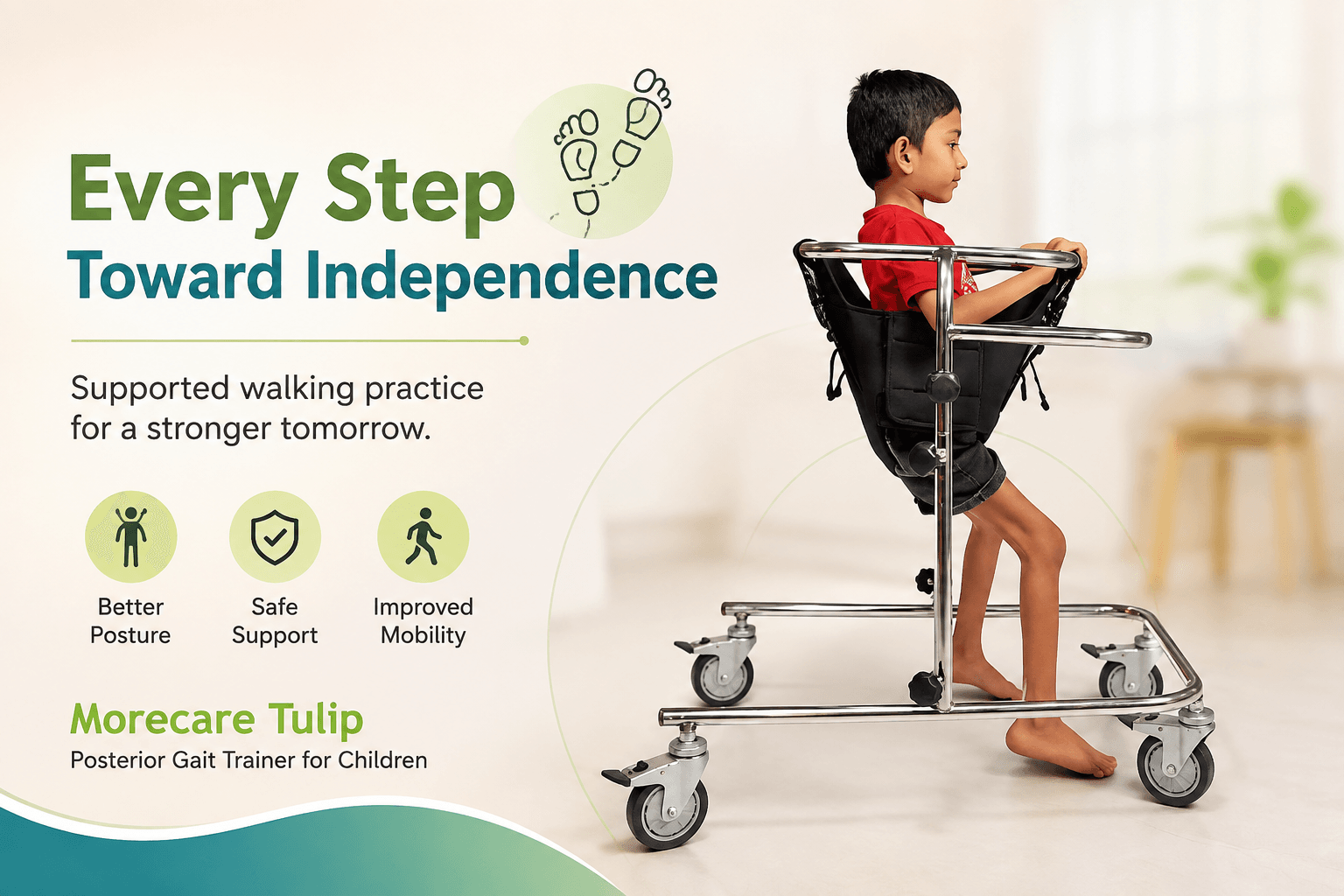
Morecare Tulip: Posterior Gait Training Designed Around the Child
The Morecare Tulip is a posterior upright gait trainer designed for children with cerebral palsy and other neurological mobility conditions who require structured support during walking practice.
Instead of placing the frame in front of the child, Tulip positions the support behind them to encourage an upright walking orientation while providing adjustable support for posture and stability.
Key Tulip Features
- Posterior walking configuration
- Adjustable pelvic support sling
- Adjustable trunk support
- Height-adjustable frame
- Four 360° swivel caster wheels
- Locking brakes on all wheels
- Wide base for stability
- Optional forearm supports
- Optional leg separator
- Foldable design for easier transport and storage
Tulip is designed for children 3–12 years, with a maximum user weight of 80 kg, and is recommended by Morecare for GMFCS Levels II–III.
The configuration should be selected according to the child's physical abilities, posture, walking pattern, and rehabilitation programme.
Why Parents May Consider Tulip for Gait Training
The goal is not simply to place a child inside a walker.
The goal is to create a safer environment where the child can participate in walking practice.
Morecare Tulip is designed to support
Upright posture
Helps provide structured support around the child's trunk and pelvis during gait training.
Controlled weight shifting
Creates a stable environment for practising movement from one leg to the other.
Supported stepping
Allows children who require assistance to practise taking steps while remaining supported.
Greater caregiver confidence
Provides a structured walking support system rather than requiring the caregiver to physically hold the child throughout every step.
Progressive rehabilitation
The configuration can be adjusted according to the child's size, support requirements, and rehabilitation goals.
The Goal Is Not Just More Steps
For parents, seeing a child take their first steps can be incredibly encouraging.
But when a child can take steps only while being held, the next question is often:
“How can we provide enough support while still allowing my child to participate?”
A posterior gait trainer may be one option worth discussing with your child's physiotherapist.
The right equipment should provide appropriate support without unnecessarily restricting movement, while creating repeated and supervised opportunities to practise standing, stepping, and walking.
For children with cerebral palsy, gait training should be individualized according to:
- Posture
- Balance
- Strength
- Motor control
- Weight-bearing ability
- Walking pattern
- Functional mobility
- Rehabilitation goals
Frequently Asked Questions
###
1. What is a posterior gait trainer?
A posterior gait trainer is a walking support device positioned behind the child to provide structured assistance during standing and walking practice.
###
2. Is a posterior gait trainer suitable for children with cerebral palsy?
It may be suitable for some children with CP, particularly those who can participate in stepping but require additional support for balance, posture, or weight shifting. A physiotherapist should assess the child before selecting the equipment.
###
3. My child can take a few steps. Do they still need a gait trainer?
Possibly. Taking a few steps does not necessarily mean a child can walk safely or consistently without support. A gait trainer may provide a controlled environment for practising walking skills.
###
4. Can a gait trainer correct my child's walking pattern?
A gait trainer provides support for walking practice but does not automatically correct abnormal gait patterns. The child's physiotherapist should determine the underlying movement difficulties and appropriate therapy approach.
###
5. Will using a gait trainer make my child dependent on it?
The purpose of a gait trainer is to provide an appropriate level of support while allowing active participation. As the child's abilities change, the support can be reviewed and adjusted as part of their rehabilitation programme.
###
6. What is the difference between a posterior walker and a front walker?
A posterior walker is positioned behind the child, while a front walker is positioned in front. A posterior configuration may encourage a more upright walking orientation and allow greater freedom of movement, but suitability depends on the individual child.
###
7. What age is the Morecare Tulip designed for?
The Morecare Tulip is designed for children from 3–12 years, with a maximum user weight of 80 kg.
###
8. What GMFCS levels is the Morecare Tulip recommended for?
Morecare recommends Tulip for children at GMFCS Levels II–III. Final suitability should be determined based on the child's individual clinical and functional needs.
###
9. Can Tulip be customized?
Yes. Tulip can be configured with different support options based on the child's size, posture, and rehabilitation requirements. Morecare's rehabilitation team can help determine the appropriate configuration.
###
10. Should my child use Tulip without a therapist?
Initial assessment and configuration should be performed with guidance from a qualified physiotherapist or rehabilitation professional. Walking practice should be supervised appropriately.
Help Your Child Take the Next Step
If your child can take steps with support but is not yet walking safely or independently, a posterior gait trainer may be worth discussing with their physiotherapist.
Morecare Tulip is designed to provide structured posterior support for children who are working toward safer, more confident walking.
Share your child's age, height, weight, diagnosis, GMFCS level, and a short walking video with the Morecare rehabilitation team to help determine whether Tulip may be appropriate and which configuration best matches their needs.