
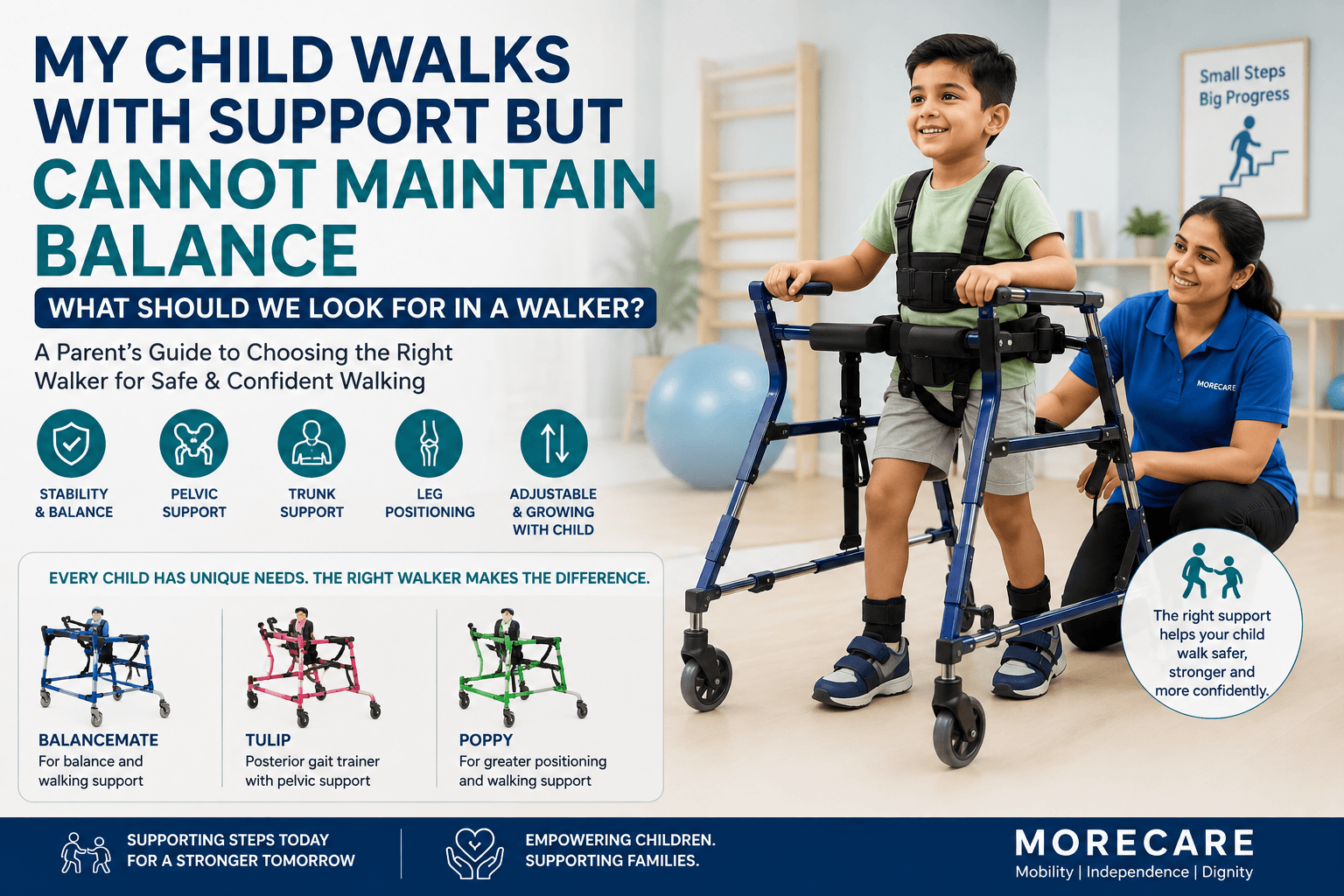
A child may be able to take a few steps but still struggle to maintain balance, stay upright, or walk safely without an adult's support. This is common in children with cerebral palsy (CP), developmental delay, muscle weakness, and other conditions affecting posture, balance, and coordination.
For parents, this often creates a difficult question
“My child can walk with my support, but what kind of walker will actually help them walk more safely and independently?”
The answer is not simply to choose the walker with the most support. The right walking aid should provide appropriate stability and positioning while allowing the child to actively participate in walking practice.
Why Can a Child Take Steps but Still Struggle With Balance?
Walking requires much more than moving the legs. A child also needs sufficient
Trunk control
Pelvic stability
Lower-limb strength
Balance and coordination
Weight-bearing ability
Postural control
Ability to initiate and control steps
A child may therefore be capable of taking steps but still need considerable assistance to remain upright.
Parents may notice that their child
Falls frequently while walking.
Needs an adult to hold their hands or body.
Leans forward or backward.
Bends their knees while standing or stepping.
Has difficulty controlling the pelvis.
Crosses or brings the legs inward.
Drags the feet.
Becomes tired quickly during walking practice.
In these situations, a conventional walker may not provide enough positioning support.
What Should Parents Look for in a Pediatric Walker?
The most important thing is to match the support provided by the walker to the child's actual walking ability.
- Stable Support During Walking
If a child frequently loses balance, the walker should provide a stable base while allowing controlled movement.
Look for
A stable frame
Appropriate wheel configuration
Lockable wheels where required
A design that helps reduce unwanted movement or tipping
Sufficient space for the child to step comfortably
The objective is to create a more controlled environment for walking practice rather than simply giving the child something to hold.
- Pelvic Support
Pelvic control plays an important role in maintaining a stable standing and walking position.
Some children need more than hand or arm support. An adjustable pelvic support can help provide additional positioning during gait training.
This is particularly relevant when a child has difficulty maintaining their pelvis in a stable position while taking steps.
Morecare Tulip uses an adjustable pelvic support sling and a posterior design to provide structured support during walking practice.
- Trunk Support
Some children cannot maintain an upright trunk without assistance.
Depending on the child's needs, a gait trainer may include
Adjustable trunk support
Chest support
Back support
Forearm support
The important consideration is to provide enough support without unnecessarily restricting the child's active movement.
- Knee and Leg Positioning
Parents should also observe what happens to the child's legs during standing and walking.
Does your child
Bend the knees excessively?
Bring the knees inward?
Cross the legs?
Drag the feet?
Have difficulty maintaining lower-limb alignment?
If so, appropriate knee or leg positioning features may be important.
Some pediatric gait trainers can be configured with knee supports or leg separators depending on the child's rehabilitation requirements.
How Much Support Does Your Child Actually Need?
This is perhaps the most important question.
A child who only needs balance assistance may require a very different walker from a child who needs substantial pelvic and trunk support.
If the main problem is balance
A walker focused on stability and balance support may be appropriate.
Morecare Balancemate can be considered when the primary requirement is supported balance and walking practice.
If the child needs pelvic support while walking
A posterior gait trainer may be useful for children who need additional pelvic positioning while practicing steps.
Morecare Tulip is a posterior gait trainer designed for children and provides adjustable pelvic support for supported gait training.
If the child requires greater body positioning support
Some children need additional trunk, pelvic and lower-limb positioning.
A more supportive system such as Morecare Poppy may be considered depending on the child's individual requirements and therapist's assessment.
Posterior Gait Trainer vs Conventional Walker
Not all walkers work in the same way.
A conventional walker generally requires the child to move behind or within the frame while using the frame for support.
A posterior gait trainer is positioned behind the child. This configuration can encourage the child to move forward while maintaining a more upright walking position.
This is one of the key features of the Morecare Tulip.
The goal is not simply to move the child forward. The aim is to provide appropriate support while encouraging the child to participate in standing, stepping and walking practice.
Why Adjustability Matters
Children grow, and their physical abilities can also change with therapy.
A walker should therefore be appropriately adjustable for the child's
Height
Pelvic position
Trunk position
Arm or forearm position
Support requirements
An adjustable gait trainer can also be configured as the child's rehabilitation needs change.
This is especially important for children who may use the equipment regularly over an extended period.
A Simple Checklist for Parents
Before choosing a walker, discuss these questions with your physiotherapist
Can my child
Stand without losing balance?
Take several steps?
Maintain an upright trunk?
Control their pelvis?
Bear weight through their legs?
Keep their knees reasonably positioned?
Stop safely?
Turn without falling?
Walk without becoming excessively fatigued?
The answers can help determine whether your child needs basic walking support, pelvic support, trunk support, or a more comprehensive gait-training system.
When Should Parents Consider a Gait Trainer?
A gait trainer may be worth discussing with a physiotherapist when a child
Can initiate steps but cannot maintain balance.
Requires continuous hand-holding during walking.
Falls frequently.
Needs assistance to maintain an upright posture.
Has poor pelvic or trunk control.
Needs structured support for gait training.
Has difficulty safely practising walking without assistance.
A gait trainer is not intended to replace physiotherapy. Instead, it can provide a structured environment in which appropriate walking practice can take place.
Morecare Walking & Gait Training Solutions
Morecare offers different walking and gait-training solutions because children do not all have the same support requirements.
Morecare Balancemate – focused on supported balance and walking practice.
Morecare Tulip – posterior gait trainer with adjustable pelvic support for structured pediatric gait training.
Morecare Poppy – designed for children who require a higher level of positioning and walking support.
The right product should be selected according to the child's balance, trunk control, pelvic stability, weight-bearing ability, gait pattern, size and rehabilitation goals.
The Right Walker Is About the Right Support
If your child can take steps but cannot maintain balance, the goal should not simply be to find a walker that keeps them upright.
The better question is
“What support does my child need to practise walking safely while still actively participating?”
The right combination of stability, pelvic positioning, trunk support, adjustability and freedom of movement can make walking practice more structured and manageable for both the child and caregiver.
For children with CP and other mobility challenges, gait-training equipment should be selected and configured with guidance from a qualified physiotherapist or rehabilitation professional.