
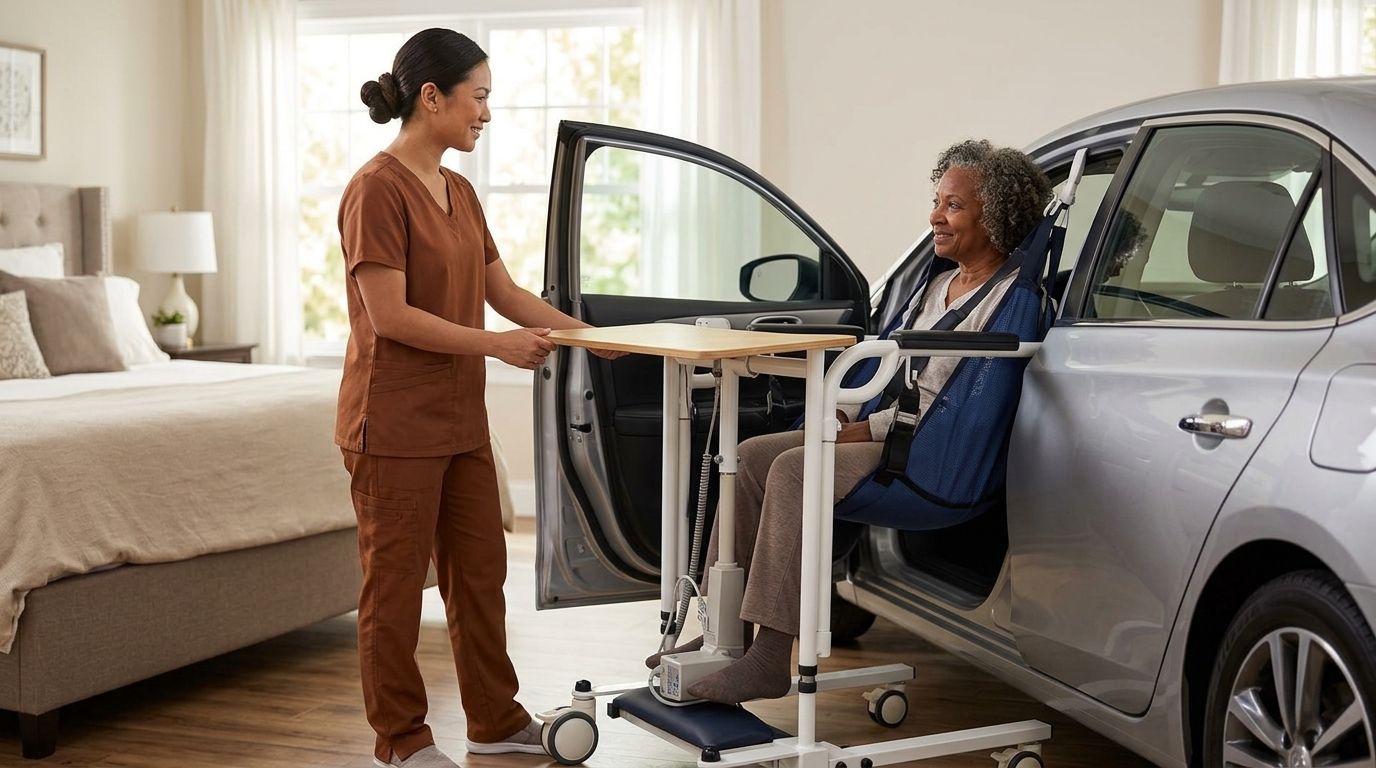
Getting a patient from a wheelchair into a car can be one of the most difficult transfers a family has to manage.
A bed-to-wheelchair transfer usually happens in a relatively open and predictable space. A car is different. The doorway is narrow, the seat is fixed, legroom is limited, and the patient may have to change position while the caregiver works around the vehicle.
For a patient with limited mobility, reduced weight-bearing ability, poor balance or difficulty standing, the challenge can become even greater.
Families often try different solutions—transfer boards, modified car seats, manual lifting or sling-based transfers. Some can work for appropriately selected patients, but they may not solve the problem when the patient has very limited ability to participate in the transfer.
The important question is therefore not simply
“How do we get the patient into the car?”
It is
“How much of the transfer can the patient safely participate in?”
Why Is a Car Transfer So Difficult?
A car transfer involves much more than moving from one seat to another.
The patient may need to
Position beside the vehicle
→ Stand or be lifted
→ Move through the car doorway
→ Turn or reposition
→ Lower into the car seat
→ Move the legs inside
→ Find a comfortable sitting position
Each step can become difficult when the patient has limited mobility.
The vehicle itself creates challenges
- Narrow door openings
- Limited space around the seat
- Different seat heights
- Deep or low car seats
- Limited legroom
- Restricted space for the caregiver
- Difficulty positioning a wheelchair close enough to the vehicle
A transfer method that works well beside a bed may therefore not work equally well beside a car.
What Can Make the Transfer Difficult for the Patient?
The patient's functional ability is one of the most important factors.
Reduced leg strength
The patient may not be able to stand for long enough to complete the transfer.
Limited weight-bearing
A patient may be able to stand briefly but still not be able to safely support enough of their body weight during the transfer.
Poor balance
The patient may need continuous support while standing, turning or lowering into the seat.
Limited trunk control
Turning and controlling the upper body while entering a car can become difficult.
Difficulty moving the legs
Even after the patient reaches the seat, getting the legs through the doorway can require additional assistance.
Pain or stiffness
Movement into a confined car space may be uncomfortable, particularly when the patient has restricted movement.
Fatigue
A patient may be capable of performing part of a transfer but become tired quickly, especially when transfers are repeated for appointments or outings.
Being able to complete a transfer once does not necessarily mean the same method is practical for every transfer.
What Makes It Difficult for the Caregiver?
The caregiver is often managing several things at once.
They may need to
- Position the wheelchair
- Open and manage the vehicle door
- Support the patient's body
- Assist with standing
- Control the patient's movement
- Help move the legs
- Guide the patient into the seat
- Reposition the patient once seated
- Store or move the wheelchair
And all of this may happen in a restricted space beside the vehicle.
The caregiver has two people to think about
> The patient's safety and their own physical effort.
If the patient contributes very little to the transfer, the caregiver may end up doing most of the physical work.
When this happens repeatedly, families may start looking for a different way to manage the transfer.
What Do Families Usually Try?
There is rarely one solution that works for everyone.
Families often explore several approaches before considering powered transfer equipment.
Transfer Boards
A transfer board can be useful for patients who have sufficient sitting balance, upper-body control and ability to participate in the transfer.
But the patient still needs to actively participate in positioning and sliding.
For someone with very limited mobility, poor trunk control or reduced ability to reposition themselves, a transfer board may not address the entire transfer challenge.
The board helps with the sliding movement; it does not automatically provide the lifting and positioning support the patient may need.
Modified or Customized Car Seats
Families may modify the vehicle seat to improve
- Seat height
- Cushioning
- Positioning
- Comfort
- Leg support
These modifications can sometimes improve the patient's final sitting position.
But there is an important distinction
Making the car seat easier to sit in is not necessarily the same as making it easier to get into the car.
The patient still has to complete—or be assisted through—the transfer into that position.
Manual Lifting
Another common approach is simply having one or two caregivers physically lift the patient.
This may appear straightforward, but the difficulty increases when the patient
- Cannot stand
- Has limited weight-bearing ability
- Has poor balance
- Has limited trunk control
- Has higher body weight
- Cannot reliably follow the transfer movement
The caregiver may end up supporting most of the patient's body weight while simultaneously trying to position them inside a confined vehicle.
Manual Sling Transfers
A sling can provide patient support, but the sling itself is only one part of the transfer.
The important questions are
* How will the sling be attached?
* What will lift the patient?
* How will the patient be moved through the vehicle doorway?
* How will the patient be lowered into the seat?
* How will the legs be positioned?
* Is there enough space for the equipment and caregiver?
This is why the complete transfer system matters, not just the sling.
When Does the Usual Transfer Method Stop Working?
There is no single point at which every patient needs a powered transfer system.
But it is worth reassessing the transfer when
- The patient can no longer stand as before.
- Weight-bearing has reduced significantly.
- One caregiver has become two.
- The caregiver is physically lifting most of the patient's weight.
- The patient feels pain or significant discomfort during transfers.
- The patient is increasingly afraid of falling.
- Getting into the car requires several attempts.
- Families are avoiding hospital visits, therapy appointments or outings because of the transfer difficulty.
These are signs that the transfer method may no longer match the patient's current functional ability.
The Psychological Side of Car Transfers
The physical difficulty is only part of the problem.
A difficult transfer can also affect how the patient feels about travelling.
Fear of falling
A patient who has previously lost balance during a transfer may become anxious the next time.
Fear of pain
If previous transfers have caused discomfort, the patient may become tense or hesitant during future transfers.
Loss of independence
Needing significant physical assistance to get into a car can be frustrating, particularly for someone who was previously independent.
Caregiver anxiety
Caregivers can also become nervous about
> “What if I can't control the patient?”
> “What if they slip?”
> “What if I hurt them?”
When both the patient and caregiver are anxious, a physically difficult transfer can become even harder to manage.
The Key Question: How Much Can the Patient Participate?
This is one of the most important things to consider before choosing a transfer solution.
If the patient can stand, bear weight and pivot
An assisted standing transfer may be appropriate, depending on the patient's abilities and the vehicle.
If the patient can participate but has limited weight-bearing
Additional support may be required during the transfer.
If the patient cannot safely stand or contribute significantly
A sling-supported lifting approach may need to be considered.
The diagnosis alone does not answer this question.
Two patients with the same condition may have completely different transfer requirements.
Where Can Morecare EasyLift Help?
For appropriate patients with limited mobility and reduced weight-bearing ability, a powered sling-supported transfer system can provide another approach to car transfers.
The Morecare EasyLift is designed for assisted patient transfers and includes car transfer capability alongside everyday transfers such as:
- Bed to wheelchair
- Wheelchair to commode
- Bathroom transfers
- Chair transfers
- Car transfers
With its electric lifting system and interchangeable sling options, EasyLift can support the patient during the lifting and repositioning process rather than relying entirely on the patient's ability to stand and pivot.
The suitability of the system depends on the patient, vehicle, transfer environment and required configuration.
Why Car Transfer Capability Matters
For many families, a patient transfer system is not only about getting someone out of bed.
The patient may need to travel for
- Hospital appointments
- Physiotherapy
- Rehabilitation
- Medical consultations
- Family visits
- Everyday outings
If getting into a car becomes the biggest barrier, then a transfer solution that can also be used for vehicle transfers can have practical value.
The goal is not simply
> “Move the patient into the car.”
It is to make the overall process more manageable for both the patient and caregiver.
One System for More Than the Car
Another advantage of choosing a multi-purpose transfer system is that the same equipment may be useful beyond vehicle transfers.
With an appropriate configuration, EasyLift can support
Bed → Wheelchair
Wheelchair → Commode
Bathroom transfers
Chair transfers
Car transfers
It can also be used for supported standing and basic gait-training activities with the appropriate sling and professional supervision.
This means the equipment can be considered around the patient's overall mobility and transfer requirements, rather than solving only one isolated problem.
Before Choosing a Car Transfer Solution
Before selecting equipment, consider three things.
The Patient
* Can they sit independently?
* Can they stand?
* How much weight can they bear?
* Can they control their trunk?
* Can they move their legs?
* Do they experience pain during transfers?
* How much assistance do they need?
The Vehicle
* What is the vehicle model?
* How wide is the door opening?
* What is the seat height?
* Is there enough space for the transfer equipment?
* Where will the wheelchair be positioned?
* Can the equipment access the intended transfer position?
The Caregiver
* How many caregivers are available?
* How much physical assistance is currently required?
* Can the current method be repeated safely and practically?
* Is the transfer becoming stressful or difficult to manage?
Is EasyLift Suitable for Your Car and Patient?
Car transfers can vary significantly depending on the patient and vehicle.
Before choosing a solution, Morecare recommends discussing the actual transfer requirement rather than selecting equipment based only on the patient's diagnosis.
You can share
- Patient age
- Height and weight
- Sitting ability
- Standing ability
- Weight-bearing ability
- Current wheelchair
- Current transfer method
- Vehicle model
- What part of the car transfer is difficult
Photos or a short video of the current transfer setup can also help the Morecare team understand the requirement.
The Bottom Line
A difficult car transfer is rarely caused by just one problem.
It can be a combination of
Patient limitations
Vehicle limitations
Caregiver limitations
Fear and anxiety
A transfer method that no longer matches the patient's ability
Transfer boards, modified seats, manual lifting and sling-based methods can all have a place for appropriately selected patients. But when the patient can no longer participate sufficiently in the transfer, these approaches may become difficult to manage.
For appropriate patients, a powered sling-supported system such as Morecare EasyLift can provide another option for car transfers while also supporting everyday transfers and basic supported mobility activities.
The right question isn't
> “Which accessory should we try next?”
It is
“What can this patient safely do during the transfer, and what level of support do they actually need?”
- Patient transfer suitability depends on the individual's functional ability, body dimensions, transfer requirements and vehicle environment. Equipment should be used according to the manufacturer's instructions and appropriate professional guidance.*