
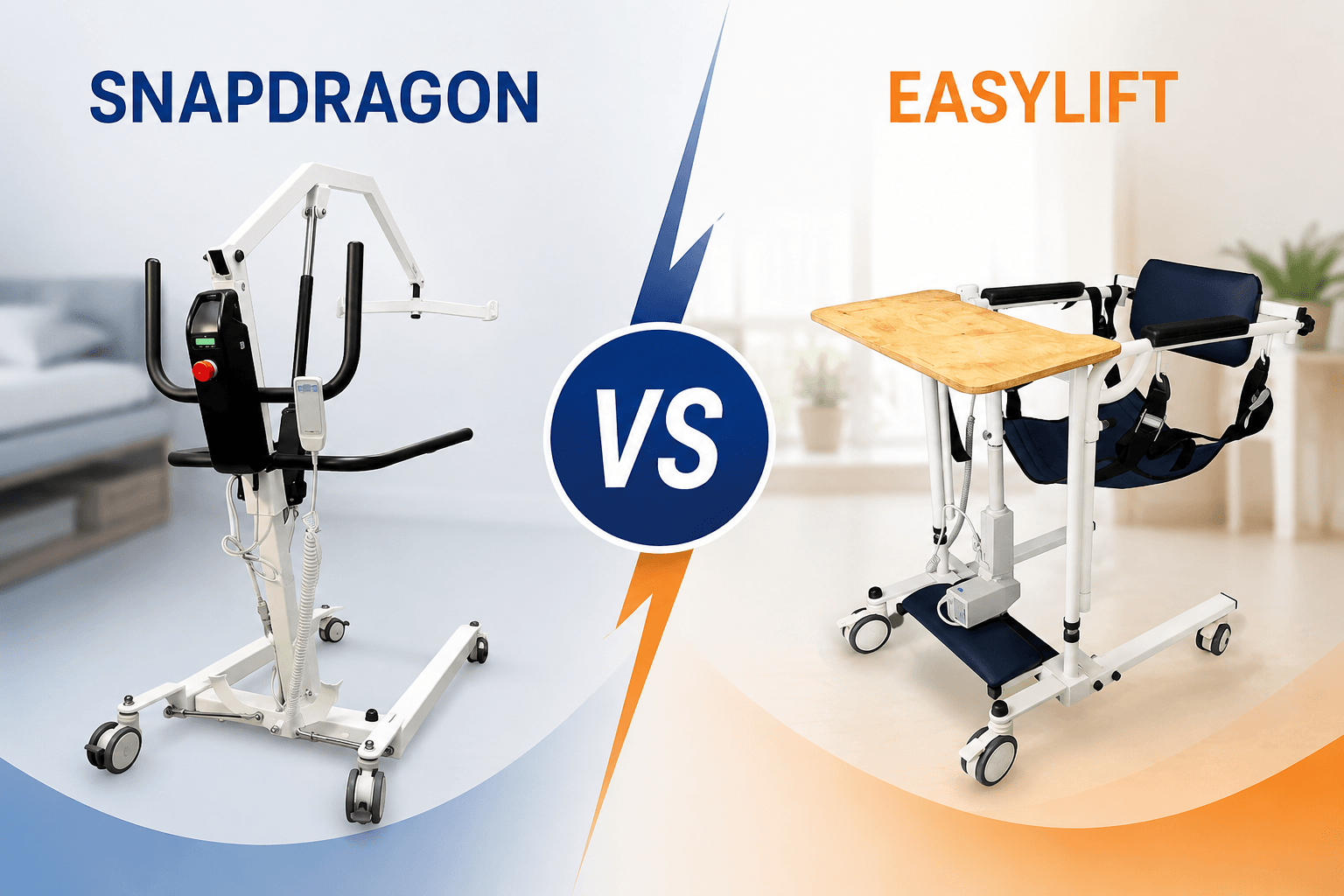
How to Transfer a Completely Bed-Ridden Patient: Snapdragon vs EasyLift
When a patient becomes completely bed-ridden, everyday transfers can become one of the hardest parts of home care.
Moving the patient from bed to wheelchair, toilet, commode, bathroom or another seating surface may require significant caregiver assistance. If the patient cannot stand, bear weight, or actively participate in the transfer, manually lifting them can become physically demanding and difficult to manage repeatedly.
This is where a powered patient lift can make a major difference.
For a completely bed-ridden patient whose primary requirement is lifting and transferring, Morecare Snapdragon is generally the first solution to consider. EasyLift is also a sling-supported electric transfer system, but its broader 5-in-1 design makes it better suited when the family needs additional transfer and rehabilitation functions.
What Makes a Bed-Ridden Patient Transfer Different?
A transfer becomes more challenging when the patient cannot
- Stand independently
- Bear weight through the legs
- Push up from the bed or chair
- Maintain adequate balance
- Assist the caregiver during the transfer
- Reposition themselves easily
In these situations, the caregiver may have to provide most or all of the physical assistance.
For families, the problem is often not simply “How do we move the patient?”
It is
“How can we move the patient repeatedly without manually lifting their entire body every time?”
A powered sling-supported lift addresses this problem by providing controlled lifting and support during the transfer.
Why Snapdragon Is a Strong Choice for a Completely Bed-Ridden Patient
The Morecare Snapdragon Electric Patient Lift is designed primarily around powered patient lifting and supported transfers.
For a patient who is highly dependent on caregivers, this makes Snapdragon particularly relevant when the main requirement is:
Lift → Support → Transfer
The patient is supported using the appropriate sling while the electric lifting system assists with the transfer.
This can be useful for everyday transfers such as
Bed → Wheelchair
Bed → Commode
Wheelchair → Toilet
Bed → Bathroom
and other suitable surface-to-surface transfers.
The exact sling and configuration should be selected according to the patient's body size, condition, transfer ability and care environment.
Why a Sling-Supported Lift Matters
For a completely bed-ridden patient, asking them to stand or pivot may simply not be practical.
A sling-supported lifting system takes a different approach.
Instead of depending on the patient's ability to stand, the patient is supported by the sling while the powered mechanism assists with lifting.
This can help reduce the amount of manual lifting required from caregivers and make repeated transfers more manageable.
The goal is not to make the patient “walk.” The immediate goal is to make necessary transfers safer and more manageable.
Snapdragon vs EasyLift: Which One Should You Consider?
Both Snapdragon and EasyLift use powered lifting and sling support, but their primary positioning is different.
Morecare Snapdragon
Primary focus: Patient lifting and transfers
Snapdragon is particularly relevant when the patient is highly dependent and the main requirement is repeated lifting and transfer assistance.
It is a strong option to consider when
- The patient is completely or largely bed-ridden
- The patient cannot stand independently
- The patient has little or no weight-bearing ability
- Transfers require substantial caregiver assistance
- Bed-to-wheelchair transfers are frequent
- Toileting transfers are difficult
- The family primarily needs a powered lifting solution
Morecare EasyLift
Primary focus: Versatile transfer + rehabilitation
EasyLift is a 5-in-1 electric patient transfer and rehabilitation system designed to cover a wider range of activities.
It combines
- Electric patient lifting
- Transfer support
- Commode transfer
- Car transfer
- Basic gait-training support
It also uses interchangeable Transfer, Commode and Gait Training Slings.
This makes EasyLift particularly useful when the family's requirements extend beyond basic bed-to-surface transfers.
Snapdragon vs EasyLift: The Practical Difference
Choose Snapdragon when the main problem is
“We need to lift and transfer a highly dependent, bed-ridden patient.”
Consider EasyLift when the requirement is
“We need a versatile transfer system that can also support commode transfers, car transfers and rehabilitation activities.”
So this isn't simply a question of which product is better.
It is a question of
Which transfer problem are you trying to solve?
Quick Comparison
Snapdragon
- Focused on powered patient lifting and transfers
- Suitable to consider for highly dependent patients
- Sling-supported transfer
- Designed for repeated transfer assistance
- Helps reduce manual lifting by caregivers
- Particularly relevant when lifting is the primary requirement
EasyLift
- 5-in-1 transfer and rehabilitation system
- Electric sling-supported lifting
- Transfer, commode and gait-training slings
- Supports suitable car-transfer situations
- Supports basic assisted standing and gait training with the appropriate sling
- Useful when multiple transfer and rehabilitation requirements need to be addressed
What If the Patient Is Completely Bed-Ridden?
This is where the distinction becomes important.
If your family member is completely bed-ridden and cannot stand or participate meaningfully in a transfer, don't select equipment simply because it is called a “transfer chair.”
Start with the lifting requirement.
Ask
* Can the patient stand?
* Can the patient bear weight?
* Can the patient sit safely?
* How much can the patient assist during transfer?
* How many caregivers are currently required?
* How often does the patient need to be moved?
* Is the main requirement bed-to-wheelchair transfer?
* Are toilet and commode transfers also required?
* Is car transfer required?
* Is rehabilitation or supported standing also part of the requirement?
If the answer is essentially
“The patient cannot stand and we need to lift them out of bed.”
then Snapdragon is generally the Morecare solution to consider first.
A Real Caregiver Experience With Snapdragon
The importance of the right transfer equipment becomes clearer when we look at an actual Morecare customer experience.
For Om Khandelwal, a 75-year-old stroke survivor from Jaipur, transfers previously required significant assistance. His family described needing two or three people to help move him from the bed to a wheelchair and assist him with bathroom mobility.
After using the Morecare Snapdragon with standing support, the family found the transfer process considerably easier. They also reported that he could take some supported steps and that his wife was able to manage transfers with much less assistance.
The family particularly appreciated the product's installation, sling system, finishing and after-sales support.
“पहले मुझे bed से wheelchair पर shift करने के लिए दो-तीन लोगों की जरूरत पड़ती थी... Snapdragon इस्तेमाल करने के बाद transfers काफी आसान और comfortable हो गए।”
This illustrates an important point
The value of a patient lift is not only the lifting mechanism. It is the reduction in physical burden during everyday care.
Is EasyLift Wrong for a Bed-Ridden Patient?
Not necessarily.
EasyLift also provides sling-supported electric lifting and can be used for patients requiring significant transfer assistance, subject to individual assessment.
Its advantage is its versatility.
If the same patient also needs
- Commode transfers
- Car transfers
- Different sling configurations
- Assisted standing
- Basic gait training
then EasyLift may provide a broader solution.
Therefore, the decision should not be based only on the word “bed-ridden.”
It should be based on the patient's current functional ability and the transfers the family needs to perform every day.
How to Choose the Right Morecare Solution
Before contacting Morecare, keep these details ready
Patient age
Patient weight
Medical condition
Can the patient sit independently?
Can the patient stand?
Can the patient bear weight?
Current wheelchair/bed setup
Required transfers
Number of caregivers
Whether car transfer is required
For example
75 years | Stroke | 82 kg | Completely bed-ridden | Cannot stand | Requires bed-to-wheelchair and toilet transfers
This gives the Morecare team a much clearer understanding of the patient's actual needs.
The Bottom Line
For a completely bed-ridden patient whose primary requirement is powered lifting and repeated transfers, Morecare Snapdragon is generally the first solution to consider.
For families looking for a more versatile transfer and rehabilitation system, particularly where commode transfers, car transfers or supported standing and gait training are also important, Morecare EasyLift may be the better fit.
The right equipment should ultimately be selected according to the patient's weight, mobility, sitting and standing ability, transfer requirements and caregiving environment.