
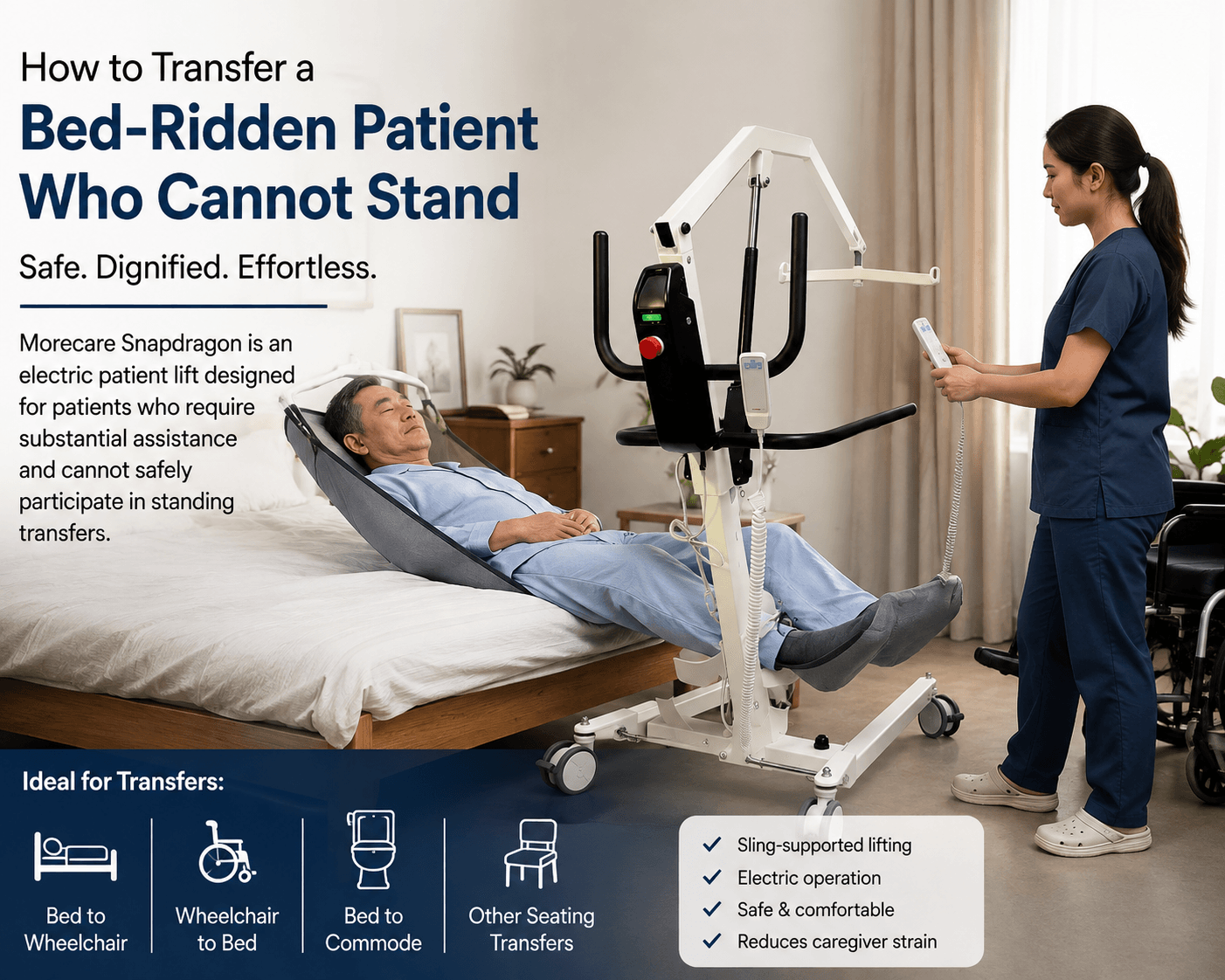
For a bed-ridden patient who can no longer stand or bear weight, everyday transfers can become one of the hardest parts of caregiving.
Moving from bed to wheelchair, wheelchair to bed, or bed to commode may require significant physical effort from the caregiver. When this happens several times a day, manual lifting can become difficult to manage.
The important question is not simply
“Which patient lift should I buy?”
It is
“Can the patient still participate safely in the transfer?”
If the answer is no, the transfer method may need to change.
When Standing Is No Longer Possible
Many traditional transfers depend on some ability to stand or pivot.
A caregiver may normally help the patient
Sit → Stand → Pivot → Sit
But this approach becomes difficult when the patient cannot
Stand safely
Bear weight through the legs
Maintain standing balance
Support their own body during the transfer
Participate meaningfully in the movement
In such situations, asking the patient to stand may no longer be the right transfer strategy.
Instead, the patient may need to be supported throughout the lifting and transfer process.
Two Different Types of Transfer Assistance
Not every patient who uses a wheelchair needs the same type of transfer equipment.
If the patient can still participate in standing
A sit-to-stand lift such as Morecare Guardian may be worth evaluating.
The patient contributes to the standing movement while the equipment provides powered assistance.
If the patient cannot safely participate in standing
A sling-supported electric lift such as Morecare Snapdragon may be more appropriate to evaluate.
The patient is supported by the sling while the powered system assists with lifting and transferring.
The diagnosis does not determine the lift. The patient's current transfer ability does.
Why Manual Transfers Become Difficult
When a patient cannot stand, caregivers may end up supporting or lifting much of the patient's body weight manually.
And transfers are rarely a one-time task.
A patient may need assistance
In the morning to get out of bed
Before and after toileting
When moving to a wheelchair
Before returning to bed
During hospital visits
During other daily activities
Repeated manual lifting can become physically demanding for caregivers and uncomfortable or difficult for the patient.
A powered lift can shift much of the lifting work from the caregiver to the equipment.
How a Sling-Supported Transfer Works
A full-body sling-supported transfer changes the process from a standing transfer to a supported lifting transfer.
The basic process is
Position the sling
↓
Secure the patient
↓
Lift using the powered system
↓
Move to the destination
↓
Lower into position
The patient does not need to perform the standing movement required in a conventional sit-to-stand transfer.
The exact sling and transfer method should be selected according to the patient's body dimensions, functional ability and transfer requirements.
Morecare Snapdragon for Highly Dependent Transfers
Morecare Snapdragon is an electric patient lift designed for users who require substantial assistance during transfers.
Its sling-supported electric lifting system allows the caregiver to lift and transfer the patient without requiring the patient to stand before the lift.
This makes it relevant for situations where manual lifting has become difficult or the patient can no longer safely participate in a standing transfer.
Depending on the patient's requirements, it can be considered for transfers such as:
Bed → Wheelchair
Support the patient during the transfer without requiring them to stand.
Wheelchair → Bed
Assist with returning the patient to the bed when standing or pivoting is not practical.
Bed → Commode
Support toileting transfers for patients who require substantial assistance.
Other Seating Transfers
Assist with moving between appropriate seating and care surfaces where the patient requires powered lifting support.
A Bed-Ridden Patient Is Not Necessarily Completely Dependent
The term “bed-ridden” can describe very different patients.
One person may
Sit independently
Be unable to stand
Still participate in transfers
Another may
Need assistance to sit
Have little or no weight-bearing ability
Require almost complete support during transfers
This distinction matters.
A patient who can still participate in supported standing may need a different solution from someone who cannot safely bear weight at all.
That is why Morecare recommends looking at functional ability rather than diagnosis or age alone.
When Should You Consider a Full-Body Patient Lift?
A sling-supported lift may be worth evaluating when the patient
Cannot safely stand
Has little or no weight-bearing ability
Requires substantial caregiver assistance
Cannot participate meaningfully in a standing transfer
Needs frequent transfers during the day
Has become difficult to move manually
Requires support for bed-to-wheelchair or toileting transfers
This does not mean every patient with these characteristics will require the same configuration.
The patient's individual requirements should be assessed before selecting equipment.
What About Guardian?
The distinction is straightforward.
If the patient can still participate in supported standing
→ Morecare Guardian may be worth evaluating.
If the patient cannot safely participate in standing and requires sling-supported lifting:
→ Morecare Snapdragon may be worth evaluating.
The objective is not to choose the most powerful lift.
It is to choose the type of transfer assistance that matches the patient's current ability.
Before Choosing a Patient Lift, Look at the Whole Transfer
The patient's physical ability is only part of the decision.
Also consider
Patient
Weight
Height
Sitting balance
Standing ability
Weight-bearing ability
Trunk control
Level of assistance required
Transfer
Bed → wheelchair
Wheelchair → bed
Bed → commode
Bathroom transfers
Frequency of transfers
Environment
Space around the bed
Doorway width
Wheelchair dimensions
Bathroom access
Available turning space
Caregiver
Number of caregivers
Physical ability
How frequently transfers are performed
A lift that works well for one patient may not be appropriate for another with a similar diagnosis.
How to Tell Morecare About Your Requirement
You don't need to know the product name before contacting us.
Send these details
Patient age
Weight
Height
Can the patient sit?
Can the patient stand?
Can the patient bear weight?
Current wheelchair
Main transfer required
Number of caregivers
For example
72 years | 68 kg | Cannot stand | Requires full assistance | Bed-to-wheelchair transfer | Two caregivers
This gives the Morecare team a much clearer understanding of what type of transfer solution needs to be evaluated.
The Bottom Line
When a patient can no longer safely stand, continuing to rely on manual standing and pivot transfers may no longer be practical.
A sling-supported electric lift provides a different approach
Support → Lift → Move → Lower
For highly dependent patients who require substantial assistance during transfers, Morecare Snapdragon can be evaluated as a powered patient transfer solution.
The right equipment should not be selected simply because a patient is “bed-ridden.”
It should be selected based on what the patient can safely do, what the caregiver needs to manage, and what transfers are required every day.
When the patient can no longer participate in the transfer, the equipment needs to do more of the work.
Need Help Choosing a Patient Transfer Lift?
Share the patient's age, weight, sitting ability, standing ability and the transfers that are becoming difficult with the Morecare team.
We can help you understand whether a sling-supported solution such as Snapdragon is worth evaluating for your requirement.
This article is for general educational information and does not replace assessment or advice from a qualified physiotherapist, occupational therapist, neurologist or rehabilitation professional.