
Walking rehabilitation does not look the same for every person.
Some people can stand and walk but need help with balance. Others may need pelvic or trunk support. Some cannot safely move from sitting to standing without assistance, while others may need partial body-weight support to practise walking.
This is why choosing a gait trainer should start with one question
How much support does the person need to stand and walk safely?
Morecare offers gait and mobility rehabilitation systems designed for different levels of support—from basic assisted walking to powered standing and advanced body-weight-supported gait training.
Who May Benefit From Gait Training?
Gait training may be considered for people whose ability to stand or walk has been affected by:
Cerebral palsy
Stroke and hemiplegia
Spinal cord injury
Traumatic or acquired brain injury
Multiple sclerosis
Parkinson's disease
Muscle weakness
Balance and coordination difficulties
Reduced weight-bearing ability
Post-surgical or orthopaedic rehabilitation
Age-related mobility limitations
However, the diagnosis alone does not determine which gait trainer is appropriate. Two people with the same condition may require very different levels of support.
Factors such as balance, muscle strength, trunk and pelvic control, weight-bearing ability, body size, endurance and rehabilitation goals should all be considered.
Different Levels of Gait Training Support
A useful way to understand gait trainers is to look at the level of assistance required.
- The User Can Stand and Walk but Needs Balance Support
Some users can take steps but are unsteady, lose balance or require an adult to provide continuous support.
A suitable gait trainer may need
A stable frame
Appropriate wheel configuration
Height adjustment
Hand or arm support
Anti-rollover stability
Controlled movement during walking
Morecare Lotus
Lotus is an adult supported walking system designed for users who require assistance during gait training. Its positioning features provide additional support while practising standing and walking.
Best suited for
Adults who can participate in walking but require additional stability and positioning support.
- The User Needs More Body Positioning Support
Some users need more than something to hold onto.
They may have difficulty controlling their
Pelvis
Trunk
Chest
Arms
Knees
Weight-bearing position
For these users, a more supportive gait trainer can provide a structured position during standing and walking practice.
Morecare Crab Walker
The Crab Walker combines chest, arm and pelvic support with a stable multi-wheel frame. It can be used for standing, weight-bearing and gait training, making it suitable when a user requires a higher level of physical support.
Best suited for
Adults requiring greater positioning, stability and therapist-assisted weight-bearing during rehabilitation.
- The Main Problem Is Getting From Sitting to Standing
For some users, walking is not the first challenge.
Standing up is.
A person may have enough ability to participate in walking but not enough lower-limb strength or weight-bearing capacity to safely transition from a chair to standing.
In this situation, a conventional walker may not be enough because the user needs assistance before walking can even begin.
Morecare Scorpio
The Scorpio combines powered sit-to-stand assistance with supported standing and gait training.
Its battery-operated lifting system assists the user during the transition
Sitting → Standing → Weight Bearing → Walking Practice
Best suited for
Teenagers and adults who require powered assistance to achieve a supported standing position before gait training.
- When Transfers and Gait Training Need to Be Combined
Home rehabilitation can become particularly difficult when caregivers have to repeatedly help a person transfer, stand and begin walking.
A multifunctional system can make these activities more manageable.
Morecare Snapdragon
Snapdragon is designed as a multifunctional mobility and rehabilitation system that can support lifting, transfers, standing and gait-training activities.
Its battery-operated operation, practical design and home-friendly setup make it particularly relevant for homecare rehabilitation.
Best suited for
Users who need assistance with transfers, standing and walking practice in a homecare environment.
- When the User Cannot Tolerate Full Body Weight During Walking
This represents a more advanced level of gait rehabilitation.
Some patients may be able to move their legs but have difficulty supporting their full body weight during walking practice.
In such situations, body-weight-supported gait training may be considered.
Instead of requiring the legs to carry the user's entire body weight, the system can provide controlled unloading while the person practises stepping.
Morecare i-Gait
The i-Gait is an advanced gait-training system designed around motorized body-weight support and controlled unloading.
It is particularly suited to professional rehabilitation environments, such as physiotherapy clinics, hospitals and rehabilitation centres, where structured gait training can be performed under trained supervision.
Best suited for
Users requiring advanced gait rehabilitation with adjustable body-weight support and professional clinical supervision.
Home Gait Training vs Advanced Clinical Gait Training
Not every patient needs an advanced rehabilitation system.
For home use, factors such as ease of operation, storage, installation, caregiver handling and the available space become important.
Morecare solutions for different requirements
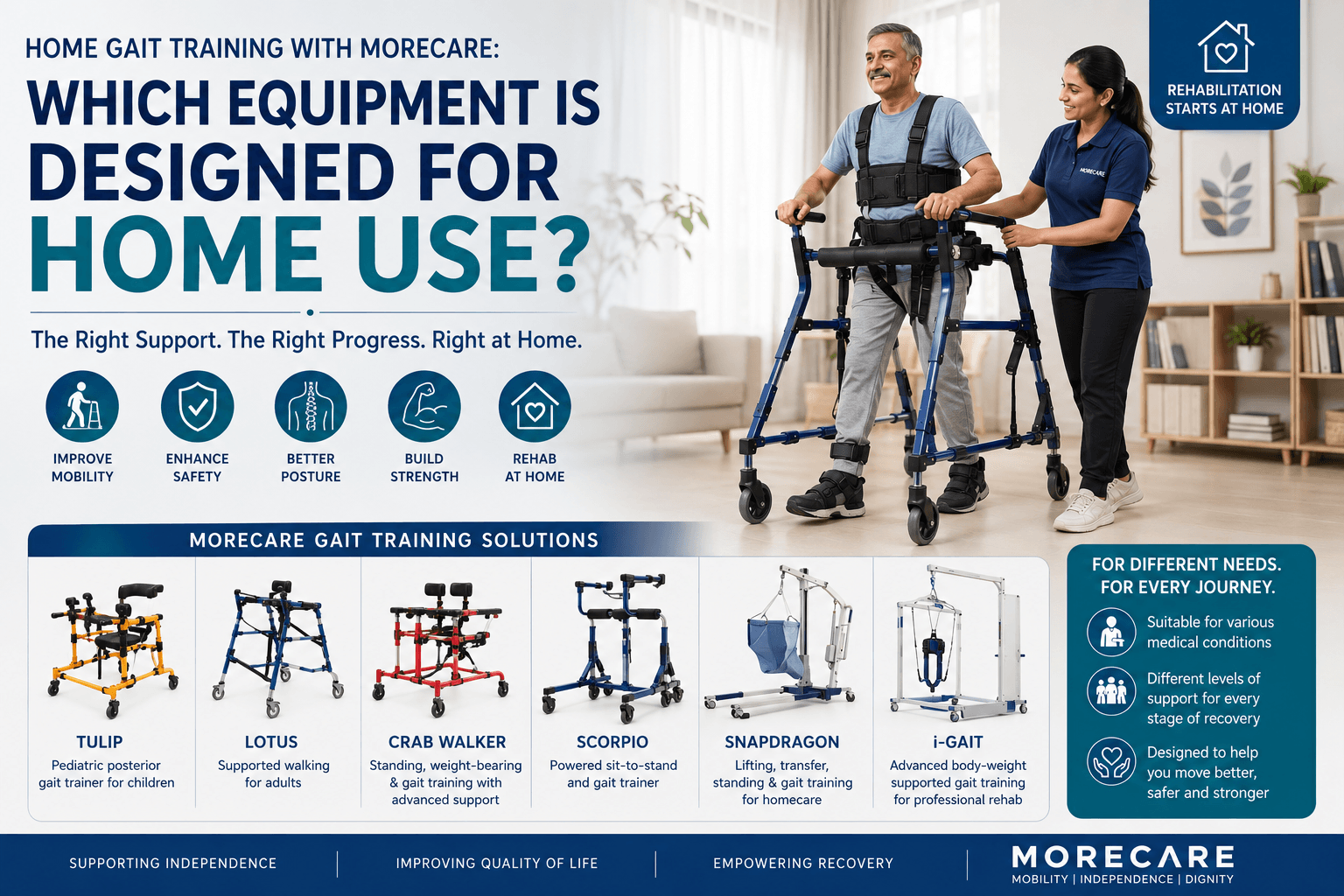
Lotus – supported adult walking and gait training.
Crab Walker – higher-support standing, weight-bearing and gait training.
Scorpio – powered sit-to-stand assistance combined with gait training.
Snapdragon – multifunctional lifting, transfer, standing and gait training with a strong homecare application.
i-Gait – advanced body-weight-supported gait training, particularly suited to clinical rehabilitation.
Tulip – pediatric posterior gait training for children who require structured support during walking.
Which Gait Trainer Is Right for the User?
Instead of choosing a product based only on the medical diagnosis, consider the person's functional ability.
If the person can walk but frequently loses balance
Look for
Stable frame + walking support + appropriate positioning.
Consider: Morecare Lotus
If the person needs pelvic, chest, arm or greater body support
Look for
Multi-point positioning + greater stability + weight-bearing assistance.
Consider: Morecare Crab Walker
If the person cannot safely stand without assistance
Look for
Powered sit-to-stand assistance + standing support.
Consider: Morecare Scorpio
If transfers, standing and walking all require assistance at home
Look for
A multifunctional homecare rehabilitation system.
Consider: Morecare Snapdragon
If the person needs partial body-weight unloading during gait training
Look for
Advanced suspension and controlled weight-bearing support.
Consider: Morecare i-Gait
If the user is a child requiring posterior gait training
Look for
Pediatric sizing + pelvic/trunk positioning + supported step practice.
Consider: Morecare Tulip
Why Home Gait Training Can Be Valuable
Regular rehabilitation can be difficult when every session requires travelling to a clinic, particularly for people with significant mobility limitations.
Appropriately selected homecare equipment can make supervised mobility practice more convenient and allow rehabilitation activities to become part of the user's regular routine.
However, home gait training should not mean unsupervised walking with complex equipment. The device should be correctly fitted and used according to the person's rehabilitation programme.
When Should You Consider an Advanced Gait Trainer?
A higher-support or advanced gait trainer may be worth discussing with a physiotherapist when the user:
Cannot maintain standing balance.
Requires substantial assistance to stand.
Has very limited weight-bearing ability.
Cannot safely practise walking with a conventional walker.
Requires pelvic or trunk positioning.
Needs partial body-weight unloading.
Requires structured and closely supervised gait rehabilitation.
Has significant weakness following neurological injury or surgery.
The important distinction is that advanced gait training is based on functional requirements, not simply the name of the diagnosis.
The Right Gait Trainer Is About the Right Level of Support
There is no single gait trainer that is best for everyone.
The appropriate solution depends on where the person is in their mobility journey:
Balance Support → Positioning Support → Supported Standing → Sit-to-Stand Assistance → Weight-Bearing Support → Advanced Gait Training
Morecare's range is designed to address different stages of this journey, from pediatric gait training and supported adult walking to powered standing and advanced clinical gait rehabilitation.
Final Takeaway
The goal of gait training is not simply to make someone walk with a device. The goal is to provide the right amount of support so the person can participate safely and meaningfully in standing and walking practice.
For homecare, a practical system such as Lotus, Crab Walker, Scorpio or Snapdragon may be appropriate depending on the user's needs, while advanced systems such as i-Gait are better suited to structured professional rehabilitation.
A physiotherapist or qualified rehabilitation professional should assess the user's strength, balance, weight-bearing ability, posture, gait pattern, size and rehabilitation goals before selecting and configuring a gait trainer.