
A patient does not always need to walk independently before gait-related rehabilitation can begin.
For some patients, rehabilitation may start with supported standing, weight shifting and assisted stepping before independent walking is possible.
The challenge is providing enough support to help the patient remain stable while still allowing them to participate in the movement.
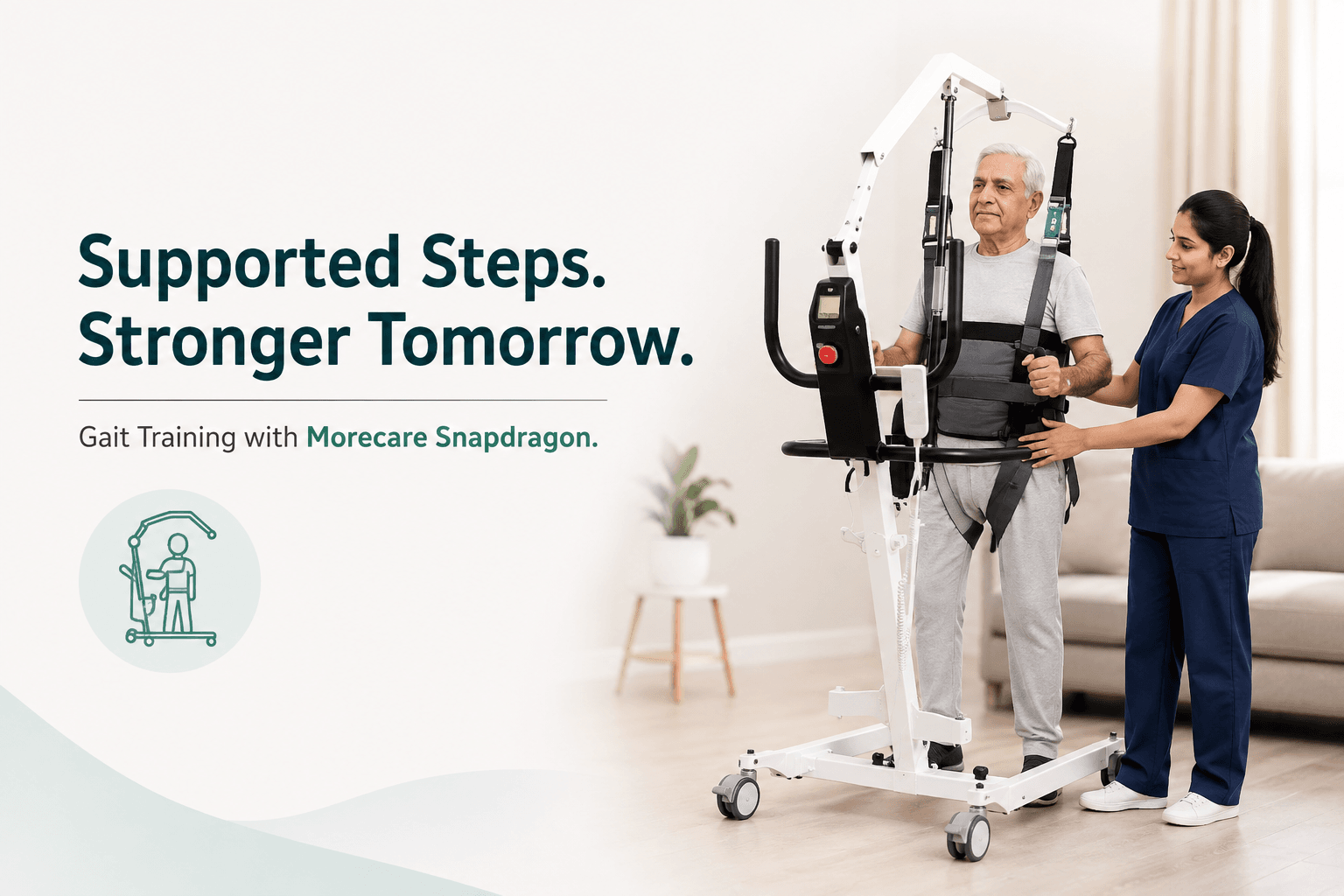
The Morecare Snapdragon is an electric patient lift and transfer system that can also provide supported standing and gait-training assistance when used with its dedicated gait-training sling and an appropriate rehabilitation plan.
Can a Patient Who Cannot Walk Practise Gait Training?
Yes, some patients who cannot walk independently may still participate in gait-related rehabilitation.
Not being able to walk does not necessarily mean that the patient cannot practise the individual components involved in walking.
Depending on the patient's condition and rehabilitation goals, training may include:
Supported standing
↓
Weight shifting
↓
Assisted stepping
↓
Supported gait practice
The appropriate progression depends on the patient's physical ability and should be determined by a qualified physiotherapist or rehabilitation professional.
The Important Question Is Not Just “Can They Walk?”
For gait training, a more useful question is
What can the patient safely do while standing?
A patient may be unable to walk independently but still have some ability to
- Sit with or without assistance
- Bear some weight through the legs
- Maintain a standing position with support
- Shift weight from one side to another
- Follow movement instructions
- Participate in assisted stepping
Another patient may have very limited weight-bearing ability and require a completely different rehabilitation approach.
- Gait-training equipment should therefore be selected according to functional ability, not simply the diagnosis or whether the patient currently walks.
Why Support Matters During Gait Training
Standing and stepping can become difficult when a patient has poor balance, reduced strength or a fear of falling.
Without appropriate support, the patient may not be able to practise the movement safely or confidently.
A suitable support system can provide assistance while the patient works on the movement themselves.
The purpose is not to make the equipment “walk the patient.”
It is to provide controlled physical support while the patient participates in appropriate standing and gait activities.
How Morecare Snapdragon Supports Gait Training
The Morecare Snapdragon combines powered patient lifting with supported standing and gait-training capability.
When used with its dedicated gait-training sling, the system can assist with bringing an appropriate patient from a seated position into supported standing.
Once standing, the patient can participate in activities such as
- Standing practice
- Weight shifting
- Assisted stepping
- Basic gait-training activities
The level of support required will depend on the patient's functional ability and rehabilitation goals.
From Sitting to Supported Standing
The gait-training process demonstrated with Snapdragon follows a practical sequence.
###
- Position the Patient
The gait-training sling is positioned around the patient according to the required setup.
###
- Secure the Sling
The appropriate attachment points, buckles and support straps are connected and checked before lifting.
Correct sling positioning is important for patient support and comfort.
###
- Raise Into Supported Standing
The electric lifting system gradually raises the patient from the seated position into supported standing.
The patient can then begin participating in the standing activity according to their ability.
###
- Begin Assisted Gait Activities
With appropriate professional guidance, the patient may practise standing, weight shifting and assisted stepping.
A treadmill or other rehabilitation equipment may also be incorporated where appropriate to the therapy setup.
###
- Return to Sitting
After the activity, the patient can be lowered back into a seated position or transferred as required.
What the Gait-Training Sling Does
The sling is an important part of the gait-training setup.
It provides support around the patient while the electric lift assists with maintaining the appropriate position.
The setup includes
- Sling support
- Locking attachments
- Support belts
- Adjustable positioning
- Additional support where required
The sling should be fitted and adjusted according to the patient's body dimensions and the intended rehabilitation activity.
Comfort and Positioning Matter
Gait-training support is not simply about lifting the patient.
The patient must also be comfortable in the setup.
During the demonstration, the patient is regularly asked about
- Pain
- Pressure
- Discomfort
- Positioning
- Overall ease of use
If discomfort occurs, the setup should be reassessed.
Morecare can also discuss patient-specific sling configurations and additional padding where required.
This is particularly important because patients can have different body shapes, support requirements and tolerance levels.
Can Snapdragon Help With Fear of Falling?
Fear of falling can make standing and stepping difficult for some patients.
When appropriate physical support is available, the patient may feel more confident participating in movement practice.
Snapdragon's gait-training setup provides additional physical support during standing and assisted gait activities.
However, it should not be described as eliminating fall risk.
Safe use depends on
- Correct sling fitting
- Appropriate patient selection
- Proper equipment setup
- Supervision
- Appropriate rehabilitation technique
Gait training should be performed according to the patient's clinical ability and rehabilitation plan.
Gait Training Is Different From Patient Transfer
Snapdragon has an important advantage in that the same system can support both patient handling and rehabilitation activities.
Patient Transfer
The objective is to move the patient between appropriate surfaces.
Supported Standing
The objective is to help an appropriate patient achieve and maintain a standing position with assistance.
Gait Training
The objective is to practise appropriate components of walking, such as standing, weight shifting and assisted stepping.
This gives Snapdragon a broader role than a conventional patient transfer system when the patient's requirements include both daily transfers and supported mobility training.
Who May Be Considered for Supported Gait Training?
A patient may be considered for this type of gait-training support when they require assistance with standing or walking practice.
A rehabilitation professional may assess
- Sitting balance
- Standing ability
- Weight-bearing capacity
- Lower-limb strength
- Trunk control
- Balance
- Ability to follow instructions
- Fatigue
- Rehabilitation goals
A patient who cannot walk independently is not automatically suitable for gait training.
The appropriate level of support and training should be determined individually.
When Snapdragon May Be Worth Considering
Snapdragon may be worth discussing when a patient
- Cannot walk independently but can participate in supported standing
- Requires assistance to maintain an upright position
- Needs support during stepping practice
- Is undergoing therapist-guided gait rehabilitation
- Also requires regular patient transfers
- Would benefit from a system that combines transfer and supported mobility functions
The key is the combination of the patient's functional ability and rehabilitation requirement.
One System for Transfer and Supported Mobility
For families and rehabilitation centres, using separate equipment for every activity may not always be practical.
Snapdragon can be configured to support different stages of patient handling
Transfer
→ Supported standing
→ Gait-training activities
This makes it relevant for situations where a patient requires assistance with both everyday transfers and rehabilitation-related mobility activities.
Before Using Snapdragon for Gait Training
Before starting gait-training activities, consider
Patient
* Can the patient sit?
* Can they bear weight?
* Can they follow instructions?
* How much standing support is required?
Sling
* Is the sling appropriate for the patient's body dimensions?
* Is it correctly positioned?
* Are all attachment points secure?
* Is the patient comfortable?
Environment
* Is there sufficient space?
* Is the floor suitable?
* Is the equipment correctly positioned?
* Is additional rehabilitation equipment being used?
Rehabilitation
* What is the goal of the activity?
* How much assistance is required?
* How long can the patient tolerate standing?
* Who will supervise the activity?
Not Sure Whether Snapdragon Is Suitable for Your Patient?
You don't need to know the equipment configuration before contacting Morecare.
Share
- Patient age
- Weight
- Height
- Sitting ability
- Standing ability
- Weight-bearing ability
- Current mobility level
- Current rehabilitation goal
- Type of transfer assistance required
If available, a short video showing the patient's sitting, standing or assisted walking ability can also help the Morecare team understand the requirement more clearly.
The Bottom Line
A patient does not necessarily need to walk independently before participating in gait-related rehabilitation.
For appropriate patients, rehabilitation may involve supported standing, weight shifting and assisted stepping before independent walking is possible.
The Morecare Snapdragon, when used with its gait-training sling and under appropriate professional supervision, can provide powered support during these activities while also serving as a patient transfer system.
The goal is not for the equipment to walk for the patient.
The goal is to provide the right level of support so the patient can participate in appropriate movement practice as safely and comfortably as possible.
- Gait-training suitability, sling configuration and level of assistance should be assessed by a qualified physiotherapist or rehabilitation professional. This article is for general educational information and does not replace clinical assessment or treatment advice.*