
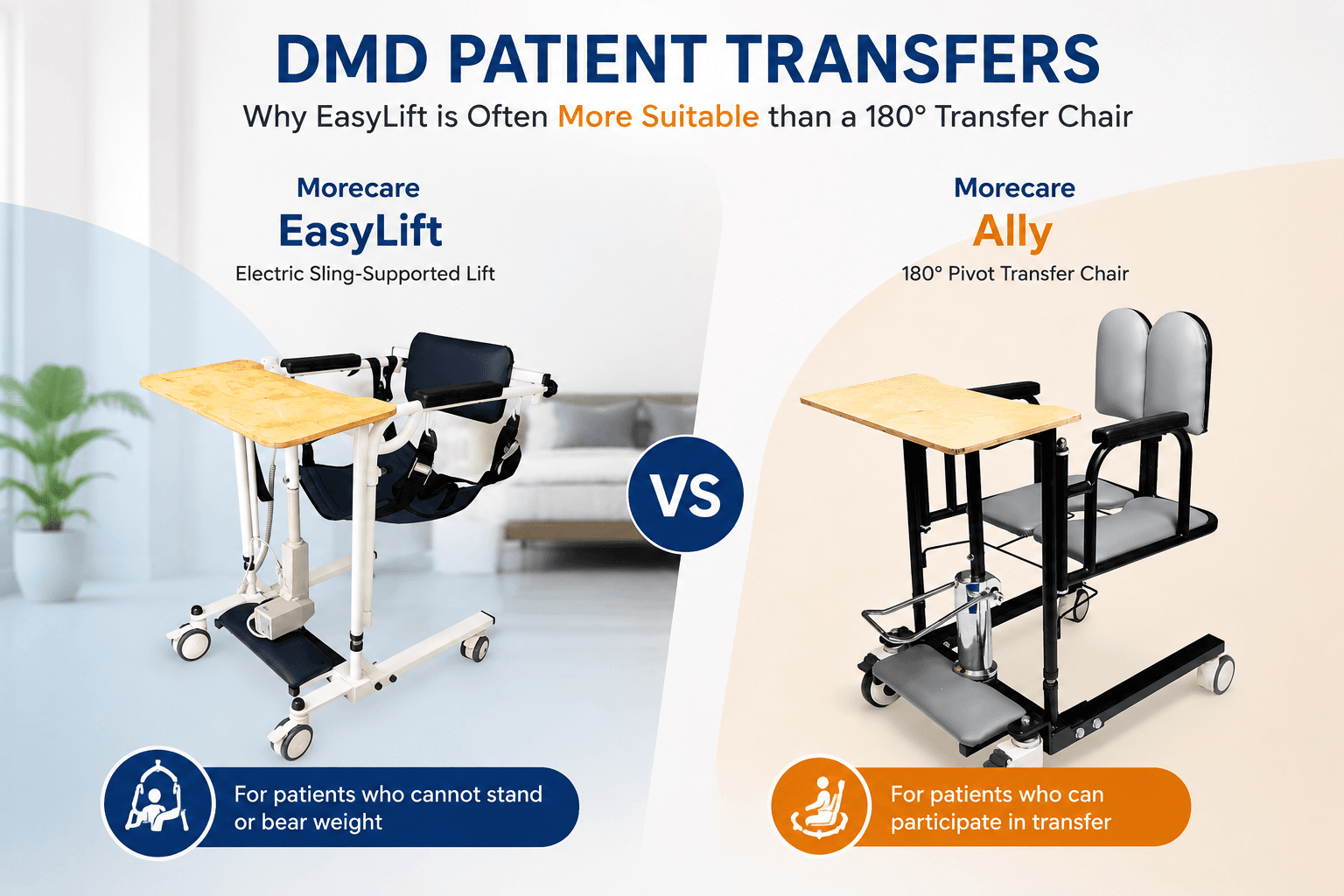
When muscle weakness progresses, transferring a person with Duchenne muscular dystrophy (DMD) can become one of the most difficult parts of everyday care. The right equipment depends on what the person can still do—not simply on the diagnosis.
For many families, the question is simple
“My son has DMD and can no longer stand properly. Which transfer equipment can actually lift him?”
Why Transfers Become Difficult in DMD
DMD causes progressive muscle weakness, and as mobility declines, transfers between the bed, wheelchair, toilet and other surfaces can become increasingly difficult.
A person may gradually lose the ability to
- Stand independently
- Bear enough weight through the legs
- Maintain balance during a transfer
- Push up from a chair or bed
- Perform a standing-and-pivot transfer
- Assist the caregiver during lifting
Duchenne care guidance recommends training families in safe transfers and considering adaptive equipment and patient-lift systems as mobility decreases.
This creates an important distinction
A patient who can participate in a transfer is different from a patient who needs to be fully lifted.
The Important Question: Can the Patient Still Stand?
Before choosing a transfer chair or lift, don't start with the product.
Start with the patient.
Ask
Can the patient stand independently?
If yes, a standing or pivot-based transfer solution may sometimes be appropriate, depending on strength, balance and professional assessment.
Can the patient stand only with significant assistance?
The transfer method needs more careful assessment. An active/standing transfer device may not be appropriate if the person cannot reliably participate.
Can the patient no longer stand or bear weight?
This is where a sling-supported electric patient lift can become much more relevant.
For people with muscle-wasting conditions, guidance notes that active/standing hoists require the person to participate in the transfer, including maintaining posture and grip, and therefore may not be suitable for everyone.
Why a 180° Pivot Transfer Chair May Not Be the Right Choice for Some DMD Patients
A product such as the Morecare Ally is a transfer chair designed around a different transfer method.
The basic concept is
Position the patient → transfer them into the chair → rotate/swivel → move to the destination.
This can work very well when the patient can participate sufficiently in the transfer and can be positioned safely.
But consider a DMD patient with significant muscle weakness.
If the patient
- Cannot stand independently
- Has very limited leg strength
- Cannot reliably bear weight
- Has difficulty maintaining posture
- Cannot participate effectively in a pivot transfer
- Requires substantial lifting assistance
then asking that person to participate in a standing/pivot-style transfer may not be the most appropriate approach.
This is where the transfer mechanism matters more than the diagnosis.
EasyLift Uses a Different Transfer Approach
The Morecare EasyLift uses a sling-supported electric lifting system.
Instead of asking the patient to stand and pivot first, the appropriate sling supports the patient while the electric lifting mechanism performs the lifting movement.
This can allow transfers between
Bed → Wheelchair
Wheelchair → Commode
Bed → Commode
Chair → Bathroom
Room → Car
where the vehicle and transfer configuration are suitable.
The EasyLift has interchangeable transfer, commode and gait-training slings, allowing the configuration to be selected according to the transfer requirement.
EasyLift vs 180° Transfer Chair: What's the Difference?
The important difference isn't simply the number of features.
It's how the patient is transferred.
EasyLift vs Ally: Which Transfer Approach Is Different?
Morecare EasyLift
Electric sling-supported lifting
Patient does not necessarily need to stand.
Designed for users requiring moderate to maximum transfer assistance.
Uses interchangeable transfer slings.
Supports bed-to-wheelchair transfers.
Supports commode and toilet transfers with the appropriate sling.
Designed for suitable car-transfer situations.
Can also support assisted standing/gait training with the appropriate sling.
Morecare Ally
Seated/pivot-style transfer
Designed around seated transfer between surfaces.
Generally requires the patient to participate in the transfer.
Suitable for users who can maintain the required sitting/transfer position.
Useful for everyday transfers such as wheelchair, toilet and chair transfers.
Its primary purpose is transfer, rather than sling-supported lifting.
The Key Difference
EasyLift lifts and supports the patient using a sling.
Ally assists with a seated/pivot-style transfer.
So, for a DMD patient who cannot stand, cannot bear weight, or cannot safely participate in a pivot transfer, a sling-supported solution such as EasyLift may be more appropriate to consider.
The key point
Ally and EasyLift are not competing products designed for exactly the same patient.
They solve different transfer problems.
When EasyLift May Make More Sense for a DMD Patient
EasyLift may be worth considering when the person
- Has significant muscle weakness
- Can no longer stand independently
- Has limited or no weight-bearing ability
- Requires substantial caregiver assistance
- Needs repeated bed-to-wheelchair transfers
- Needs toilet or commode transfers
- Needs assistance with vehicle transfers
- Cannot safely participate in a pivot transfer
However, DMD alone does not determine suitability. The person's current functional ability, weight, sitting balance, range of motion, contractures, positioning needs and transfer environment should be assessed by an appropriate rehabilitation professional.
This is particularly important in DMD because muscle weakness progresses differently between individuals, and care needs change over time. ([Parent Project Muscular Dystrophy][3])
Why Reducing Manual Lifting Matters
For families caring for someone with progressive muscle weakness, repeated manual lifting can become increasingly difficult.
The goal isn't simply to make the caregiver's job easier.
It is also about making transfers more controlled and predictable, while reducing unnecessary physical strain on both the person being transferred and the caregiver.
Duchenne care recommendations specifically emphasize safe transfers and consideration of patient-lift systems to reduce risks during transfers, toileting and bathing.
Which One Should You Choose?
Consider EasyLift when
“My patient cannot stand or participate sufficiently in a pivot transfer, and we need a lifting-based transfer solution.”
Consider Ally when
“My patient can participate in the transfer, but needs assistance moving between the bed, chair, toilet or other surfaces.”
Not sure?
Don't choose based only on the diagnosis.
Tell Morecare
- Patient age
- Patient weight
- DMD stage / current mobility
* Can the patient sit independently?
* Can the patient stand?
* Can they bear weight?
* Can they follow transfer instructions?
- Current wheelchair type
- Required transfers
- Number of caregivers
- Whether car transfers are required
These details are more useful than simply saying “DMD patient.”
A Morecare Approach to Patient Transfer
At Morecare, we believe the right transfer equipment should be selected around the person's actual functional ability, not simply their diagnosis.
For a DMD patient who can no longer safely stand or participate in a pivot transfer, a sling-supported electric lifting solution such as EasyLift may provide a more suitable transfer method than a pivot-style transfer chair.
For someone who can still participate in transfers, a transfer chair such as Ally may be a more practical option.