
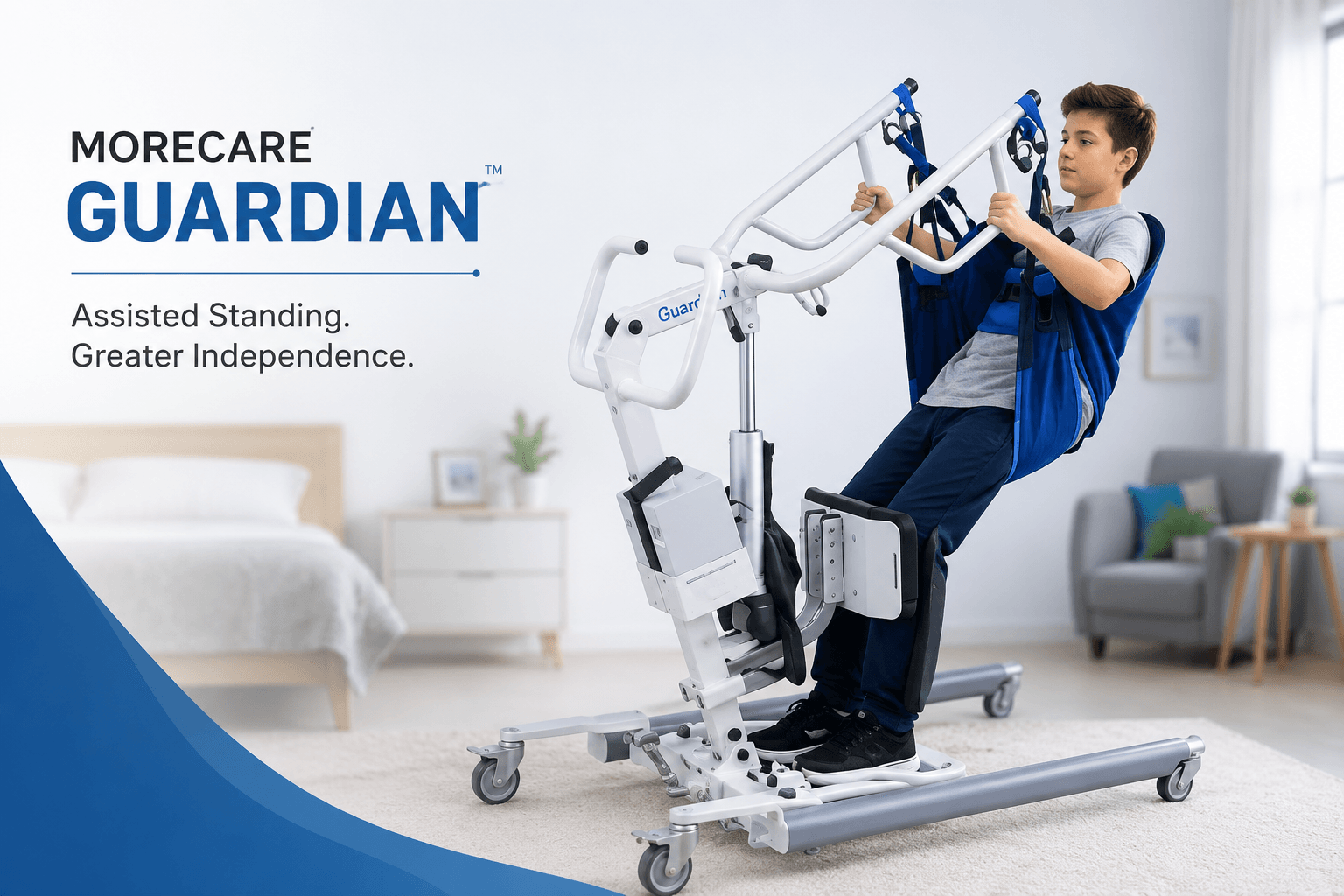
For a person living with Duchenne muscular dystrophy (DMD), transfers can become harder as muscle strength changes.
Getting from a wheelchair to standing, bed to wheelchair, or wheelchair to toilet may gradually require more assistance from family members or caregivers.
This often leads to an important question
Can an electric sit-to-stand lift help, or does the patient need a full-body lift?
The answer depends less on the diagnosis itself and more on what the person can still do during a transfer.
If the person can still participate in supported standing, an electric sit-to-stand lift such as Morecare Guardian may be worth considering.
If the person can no longer safely stand or bear weight, a different type of lifting solution may be more appropriate.
How DMD Can Change Patient Transfers
As muscle weakness progresses, a transfer that was manageable earlier may gradually become difficult.
A person may still be able to sit and follow instructions but struggle to generate enough strength to:
Rise from a wheelchair
Stand for the required time
Maintain their position during a transfer
Move between the bed and wheelchair
Transfer to the toilet
Repeat transfers several times a day
The result is often increased dependence on caregivers.
What matters is how much of the transfer the patient can still safely participate in.
The Key Question: Can the Patient Still Participate in Standing?
This is the most important question when considering a sit-to-stand lift.
A sit-to-stand lift is intended to assist the patient's standing movement, rather than completely replace it.
A person may still be able to
Sit with appropriate support
Position their feet
Bear some weight through their legs
Follow instructions
Participate in the standing movement
but may no longer have enough strength to complete the transfer without substantial assistance.
This is the situation in which a powered sit-to-stand solution may be worth evaluating.
Morecare Guardian for Assisted Standing and Transfers
Morecare Guardian is an electric sit-to-stand patient lift designed to assist users during supported standing and transfers.
Instead of requiring the caregiver to manually lift the patient into standing, the powered system assists the standing movement while the patient remains supported.
Guardian can be considered for transfer situations such as
Wheelchair → Standing
Wheelchair → Toilet
Bed → Wheelchair
Chair → Standing
The appropriate configuration depends on the patient's physical ability, body dimensions and transfer requirements.
When May Guardian Be Appropriate for a Person With DMD?
Guardian may be worth considering when the person
Can still participate in supported standing
Has some weight-bearing ability
Can maintain an appropriate seated position
Can follow transfer instructions
Needs substantial assistance to stand
Finds manual transfers increasingly difficult
The idea is simple
The patient participates in the movement. Guardian provides powered assistance where additional support is needed.
This can make the transfer process more manageable than relying entirely on manual lifting.
Why a Transfer Method May Need to Change Over Time
A person's transfer ability can change gradually.
A simplified progression may look like
Independent transfer
↓
Transfer with caregiver assistance
↓
Supported standing transfer
↓
Highly dependent transfer
The equipment that was appropriate at one stage may not remain appropriate later.
This is why families should periodically reassess how the patient is being transferred rather than choosing equipment based only on the diagnosis.
Signs That It May Be Time to Reassess Transfers
Consider reviewing the current transfer method if
The caregiver is lifting more of the patient's weight
The patient is no longer able to contribute as much to the movement.
Standing is becoming unstable
The patient struggles to maintain standing even with assistance.
Transfers are becoming exhausting
Repeated transfers throughout the day are physically demanding for both the patient and caregiver.
More caregivers are required
A transfer that previously needed one person increasingly requires two people.
Everyday transfers are becoming difficult
Bed-to-wheelchair, wheelchair-to-toilet or other routine transfers are becoming harder to manage.
These changes do not automatically mean that Guardian is the right solution. They indicate that the patient's transfer needs may need to be reassessed.
When a Sit-to-Stand Lift May Not Be Enough
A sit-to-stand lift depends on the patient being able to participate in the standing transfer to some degree.
If the patient cannot safely
Bear weight
Participate in standing
Maintain the required position
Support themselves during the transfer
then a sit-to-stand lift may not be the appropriate option.
In these situations, a full-body sling-supported patient lift may need to be considered.
For example, Morecare Snapdragon is designed around powered lifting and sling-supported transfers for users who require a higher level of assistance.
The important distinction is
Guardian
Patient can still participate in supported standing.
Powered assistance → standing → transfer
Snapdragon
Patient requires substantially more lifting support.
Sling support → powered lifting → transfer
The diagnosis alone does not determine which solution is appropriate.
Guardian vs Snapdragon for DMD Transfers
Patient's current ability Solution to evaluate
Can participate in supported standing Morecare Guardian
Has some weight-bearing ability but needs significant assistance Guardian may be worth evaluating
Cannot safely participate in standing Full-body lift may be more appropriate
Requires substantial lifting support during transfers Morecare Snapdragon may be worth evaluating
This is a general guide, not a clinical prescription. The patient's current strength, sitting balance, weight-bearing ability, fatigue, body dimensions and transfer requirements should be considered before selecting equipment.
What Should You Tell Morecare?
You don't need to know which product you need before contacting us.
Share
Patient age
Weight
Height
DMD status/current mobility
Sitting ability
Standing ability
Weight-bearing ability
Current wheelchair
Transfers that are difficult
Number of caregivers currently required
For example
25 years | DMD | 60 kg | Can sit | Can stand with assistance | Wheelchair-to-toilet transfer is difficult | Requires caregiver support
This gives the Morecare team a clearer understanding of the patient's current transfer requirement.
The Bottom Line
For a person with DMD, a sit-to-stand lift may be worth considering when muscle weakness is making transfers difficult but the person can still participate in supported standing.
Morecare Guardian is designed for this type of assisted standing and transfer requirement.
If the person can no longer safely stand or bear weight, a sit-to-stand lift may not be the appropriate solution. A full-body sling-supported lifting system such as Snapdragon may need to be evaluated instead.
The diagnosis tells you the condition. The patient's current functional ability helps determine the transfer solution.
Need Help Choosing a DMD Transfer Solution?
Send Morecare the patient's age, weight, sitting ability, standing ability and the transfers that are becoming difficult.
Our rehabilitation team can help you understand which type of patient transfer solution may be worth evaluating for your requirement.
This article is for general educational information and does not replace assessment or advice from a qualified physiotherapist, occupational therapist, neurologist or other rehabilitation professional.