
For families caring for someone with Duchenne muscular dystrophy (DMD), transfers can become difficult as muscle strength changes.
Getting from bed to wheelchair, wheelchair to toilet, or sitting to standing may gradually require more help from a caregiver.
At this stage, many families start looking for a patient lift.
But the important question is
Can the person still participate in the standing transfer?
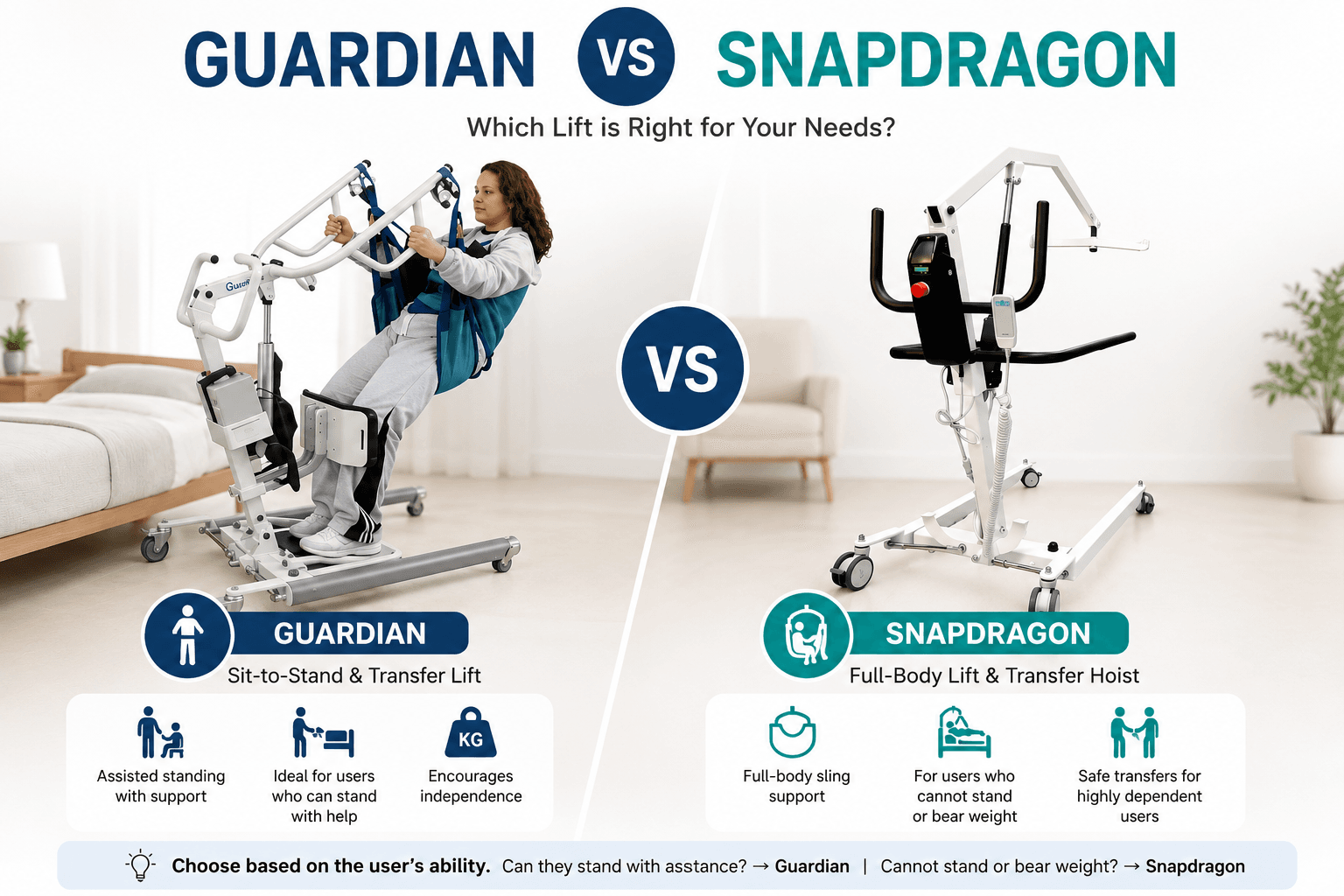
If they can still bear some weight and participate with support, a sit-to-stand lift such as Morecare Guardian may be appropriate to consider.
If they can no longer safely stand or bear weight, a full-body sling-supported lift such as Morecare Snapdragon may be a better option to evaluate.
When Does a DMD Patient Need More Transfer Support?
A transfer may be becoming difficult when
- The patient needs increasing help to stand.
- The caregiver is lifting more of the patient's body weight.
- Standing has become tiring or unstable.
- Bed-to-wheelchair transfers are becoming difficult.
- Two caregivers are increasingly needed.
- The patient's previous transfer method is no longer comfortable or practical.
The goal is not to wait until the caregiver has to manually lift the entire patient.
Instead, transfer equipment can be considered as the person's functional ability changes.
The Key Question: Can the Patient Still Stand?
This is the most important consideration when looking at a sit-to-stand lift.
A sit-to-stand lift is intended to assist the patient's standing movement, not completely replace it.
A person may still be able to
- Sit with appropriate support
- Position their feet
- Bear some weight through their legs
- Follow instructions
- Participate in the standing movement
but may no longer have enough strength to stand and transfer safely without substantial assistance.
This is where a powered sit-to-stand system can become useful.
Morecare Guardian: For Assisted Standing and Transfers
The Morecare Guardian is an electric sit-to-stand patient lift designed to assist users during standing and transfers.
The lift provides powered assistance while the patient remains supported during the transfer.
It can be considered for situations such as
Bed → Wheelchair
Wheelchair → Chair
Wheelchair → Toilet
Sitting → Supported Standing
The appropriate setup depends on the patient's physical ability, body dimensions and transfer requirements.
When Guardian May Be Appropriate
Guardian may be worth considering when the patient
- Can still participate in standing
- Has some weight-bearing ability
- Can maintain an appropriate seated position
- Can follow transfer instructions
- Needs substantial assistance to stand
- Is becoming difficult to transfer manually
The objective is simple
Use powered assistance for the part of the transfer the patient's muscles can no longer safely provide.
What If the Patient Can No Longer Stand?
This is where a different type of lift may be needed.
If the patient cannot safely
- Bear weight
- Participate in standing
- Maintain the required position
- Support themselves during the transfer
then a sit-to-stand lift may not be the appropriate solution.
A full-body sling-supported patient lift may need to be considered instead.
This is where Morecare Snapdragon becomes relevant.
Guardian vs Snapdragon: The Important Difference
The easiest way to understand the difference is to look at what the patient can still do.
Morecare Guardian
- Primary purpose:* Assisted standing and transfers
Consider Guardian when the patient can still participate in a supported standing transfer but needs powered assistance.
Think
Patient participates + lift assists
Morecare Snapdragon
- Primary purpose:* Powered lifting and transfers
Consider Snapdragon when the patient is highly dependent and cannot safely perform a conventional standing transfer.
Think
Lift supports the patient + caregiver controls the transfer
A Simple Way to Decide
Can the patient still participate in standing?
YES
→ Evaluate whether a sit-to-stand lift such as Guardian is appropriate.
NO
→ A full-body sling-supported solution such as Snapdragon may be more appropriate to evaluate.
This is not determined by the DMD diagnosis alone. The patient's current strength, sitting balance, weight-bearing ability, fatigue, joint position and transfer ability matter.
Why Transfer Equipment Should Be Considered Early
Families sometimes wait until transfers become almost impossible before looking for equipment.
By then
- Caregivers may already be physically exhausted.
- Transfers may require two or more people.
- The patient may become anxious during transfers.
- Everyday activities such as toileting and getting into a wheelchair may become difficult.
It can be useful to review transfer options before the current method becomes unmanageable.
The right time to consider equipment is not necessarily when the patient has completely lost mobility.
It is when the current transfer method is no longer safe, comfortable or sustainable.
What Information Is Needed to Choose the Right Lift?
When discussing a patient transfer solution, share
- Patient age
- Weight
- Height
- DMD stage / current mobility
- Sitting ability
- Standing ability
- Weight-bearing ability
- Current wheelchair
- Difficult transfers
- Number of caregivers
For example
18 years | DMD | 55 kg | Can sit | Can stand with assistance | Difficult bed-to-wheelchair transfer
This gives the Morecare team a better understanding of whether Guardian or Snapdragon should be evaluated.
The Bottom Line
For a person with DMD, the right patient lift depends less on the diagnosis and more on current transfer ability.
If the patient can still participate in supported standing
- Guardian* may be appropriate to consider.
If the patient can no longer safely stand or bear weight
- Snapdragon* may be more appropriate to evaluate.
The objective is not simply to find a stronger lift.
It is to find a transfer system that matches what the patient can safely do today.
Need Help Choosing a DMD Transfer Solution?
Share the patient's age, weight, sitting ability, standing ability and the transfers that are becoming difficult with the Morecare team.
We can help you understand which type of transfer solution may be worth evaluating.
- This article is for general educational purposes and does not replace assessment or advice from a qualified physiotherapist, occupational therapist, neurologist or rehabilitation professional.*