
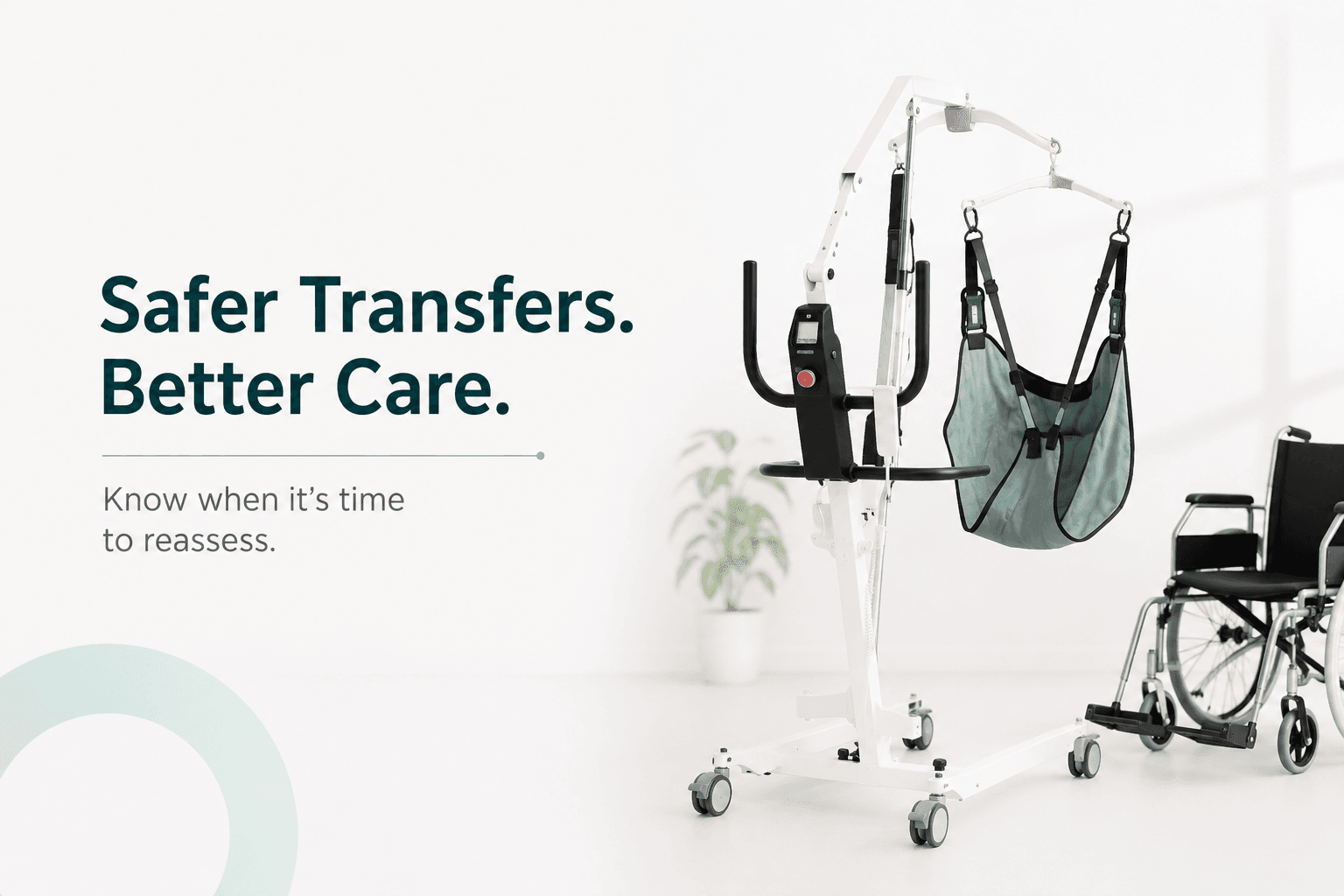
The transfer method that worked six months ago may not work today.
A patient may have become weaker, lost the ability to stand, gained weight, or started requiring more assistance than before. At the same time, caregivers may be doing more of the physical work during every transfer.
The warning sign is not always a fall or an injury. Sometimes it is much simpler:
One caregiver has become two. A short transfer now takes much longer. Or the caregiver is physically lifting rather than assisting the patient.
When this happens, it may be time to reassess how the patient is being transferred.
- Transfers Now Require Two Caregivers
A patient who previously transferred with one caregiver may gradually start needing two people.
This can happen when the patient's
Strength decreases
Balance becomes poorer
Weight-bearing ability changes
Ability to follow the transfer decreases
Overall mobility becomes more limited
If two caregivers are regularly required simply to move the patient from bed to wheelchair, wheelchair to toilet, or chair to bed, the current transfer method may no longer match the patient's needs.
The important question is: Why does the patient need two people?
If the patient can still participate in standing and weight-bearing, a sit-to-stand transfer solution such as Morecare Guardian may be worth evaluating.
If the patient cannot safely stand and needs sling-supported lifting, a different type of patient transfer system may be more appropriate.
- The Patient Can No Longer Stand Like Before
Many transfers depend on some ability to stand.
A common transfer pattern is
Sit → Stand → Pivot → Sit
But a patient's functional ability can change.
What was once
“He can stand if we help him.”
may become
“He cannot stand safely anymore.”
Continuing to use the same transfer technique after this change can make the process increasingly difficult for both the patient and caregiver.
The right equipment should be selected according to what the patient can safely participate in today, not what they were able to do several months ago.
Still able to participate in standing?
A sit-to-stand solution such as Guardian may be worth discussing.
Unable to stand safely?
A sling-supported transfer system such as EasyLift or Snapdragon may need to be considered, depending on the patient's requirements.
- The Caregiver Is Doing More Lifting Than Assisting
There is an important difference between assisting a transfer and lifting a patient.
When the patient participates in the movement, the caregiver may mainly provide guidance, balance support and positioning.
But if the caregiver is increasingly supporting or lifting most of the patient's body weight, the physical demands of the transfer change significantly.
A simple question can help
Is the caregiver helping the patient move, or is the caregiver moving the patient?
If the answer is increasingly the second one, it may be time to reassess the transfer method.
Powered patient transfer equipment can shift more of the physical lifting work to the equipment, reducing the need for repeated manual lifting.
- Toilet and Bathroom Transfers Have Become the Hardest Part of the Day
Not every transfer is equally difficult.
For many families, the repeated transfers involved in toileting and personal care become particularly challenging:
Bed → Toilet
Wheelchair → Toilet
Toilet → Wheelchair
Bedroom → Bathroom
These transfers may happen several times a day, making an inefficient or physically demanding transfer method even harder to sustain over time.
If the patient needs assistance across several daily transfer situations, a multi-purpose sling-supported system such as Morecare EasyLift may be worth evaluating.
EasyLift is designed for supported transfers involving the bed, wheelchair, commode, bathroom, chair and car, with different sling options for different requirements.
- Your Family Has Started Avoiding Transfers
This is a sign that is easy to overlook.
You may hear things like
“We don't take him outside anymore.”
“Hospital visits have become difficult.”
“We wait until someone else comes before transferring her.”
“We try not to move him unless it is absolutely necessary.”
At this point, the problem is no longer just the transfer itself.
It may be affecting medical appointments, family outings, rehabilitation, personal care and everyday participation.
When transfers become so difficult that families start avoiding them, it is worth reassessing whether the current equipment and transfer technique are still appropriate.
What Type of Transfer Assistance Does the Patient Need?
There is no single patient lift that is right for everyone.
The first question should not be
“Which patient lift should I buy?”
It should be
“What can the patient safely do during the transfer?”
Consider
Can the patient sit independently?
Can they stand?
Can they bear weight through their legs?
Can they follow instructions?
How much assistance do they require?
How many caregivers are needed?
Which transfers are difficult?
Does the patient need transfer assistance only, or also supported standing or gait training?
These factors are often more useful for selecting equipment than the diagnosis alone.
A Simple Way to Think About the Options
Patient can still participate in standing
Consider a sit-to-stand solution
Morecare Guardian is designed for assisted sit-to-stand transfers where the patient can participate in supported standing.
Patient cannot safely stand and needs sling-supported everyday transfers
Consider a sling-supported transfer system
Morecare EasyLift is designed for multiple everyday transfer situations, including bed, wheelchair, commode, bathroom and car transfers.
Patient requires substantial lifting support
Consider a powered patient lift
Morecare Snapdragon provides powered lifting and transfer support and can also be configured for supported standing and gait-training activities for appropriate users.
Patient has a specific or unusual requirement
Talk to Morecare before choosing the equipment.
Some patients need a solution based on their individual body dimensions, functional ability, transfer environment or rehabilitation requirements.
Don't Choose a Transfer Lift Based Only on the Diagnosis
Two patients with the same diagnosis may have completely different transfer requirements.
For example, one patient may still be able to
Sit independently
Bear weight
Stand with assistance
Participate in a pivot transfer
Another patient with the same diagnosis may have very limited standing or weight-bearing ability and require sling-supported lifting.
The equipment requirement can therefore be completely different.
Diagnosis tells you what condition the patient has. Functional ability tells you what kind of transfer assistance they may need.
When Should You Reassess the Transfer Method?
You don't necessarily have to wait for a fall, injury or major decline.
Consider reassessing the transfer method when
The patient needs more caregiver assistance than before.
Transfers are taking significantly longer.
The patient can no longer stand as they previously could.
Manual lifting has become common.
Caregivers are experiencing increasing physical difficulty.
Toileting or bathroom transfers have become difficult.
The family is avoiding necessary transfers or outings.
A change in the patient's functional ability should trigger a conversation about whether the current transfer method is still appropriate.
Not Sure Which Morecare Transfer Solution You Need?
You don't need to know the product name before contacting us.
Share the patient's
Age
Weight
Height
Sitting ability
Standing ability
Weight-bearing ability
Current transfer method
Transfers that are difficult
Number of caregivers available
If possible, you can also share a short video showing how the patient currently sits, stands or transfers.
Our team can use this information to better understand the requirement and discuss which type of patient transfer or lifting solution may be appropriate to evaluate.
The Bottom Line
A transfer method should change when the patient's ability changes.
If a patient now needs two caregivers, can no longer stand as before, requires increasing manual lifting, struggles with toileting transfers, or is avoiding everyday movement because transfers have become too difficult, the current transfer method deserves a reassessment.
The right solution is not determined by the diagnosis alone.
It starts with a simple question
What can this patient safely do during the transfer—and how much assistance do they actually need?
From sit-to-stand assistance with Guardian, to sling-supported everyday transfers with EasyLift, to powered lifting and supported mobility with Snapdragon, Morecare's approach is to match the equipment to the patient's functional requirement rather than simply recommending the same product to everyone.
Need help choosing? Talk to Morecare about the patient's actual transfer requirement before deciding on equipment.
Patient transfer equipment should be selected and used according to the patient's individual condition, functional ability and care environment. Where appropriate, assessment by a qualified physiotherapist, occupational therapist or rehabilitation professional is recommended.